Australia replaced the long-standing Genuine Temporary Entrant (GTE) criterion with the Genuine Student (GS) criterion on 23 March 2024. The GS framework changed the structure of student-visa assessment: applicants now respond to specific GS questions in writing, and the Department of Home Affairs (DHA) evaluates each response against documented evidence. For Indian applicants, GS-driven refusals are now the dominant Subclass 500 refusal pattern.
This guide walks through the Genuine Student criterion, the most common Indian-applicant refusal patterns, and the realistic recovery sequence — from Lifeset Overseas, licensed visa consultants based in Patiala, Punjab.
What changed in March 2024: GTE to GS
Under the old GTE criterion (in place since 2011), applicants wrote a single statement addressing factors like circumstances in home country, value of the course, employment prospects, etc. DHA case officers exercised broad discretion.
Under the new GS criterion (effective 23 March 2024), applicants respond to specific structured questions in the visa application. DHA evaluates responses against the supporting evidence. The framework is intentionally more structured and harder to address with templated answers.
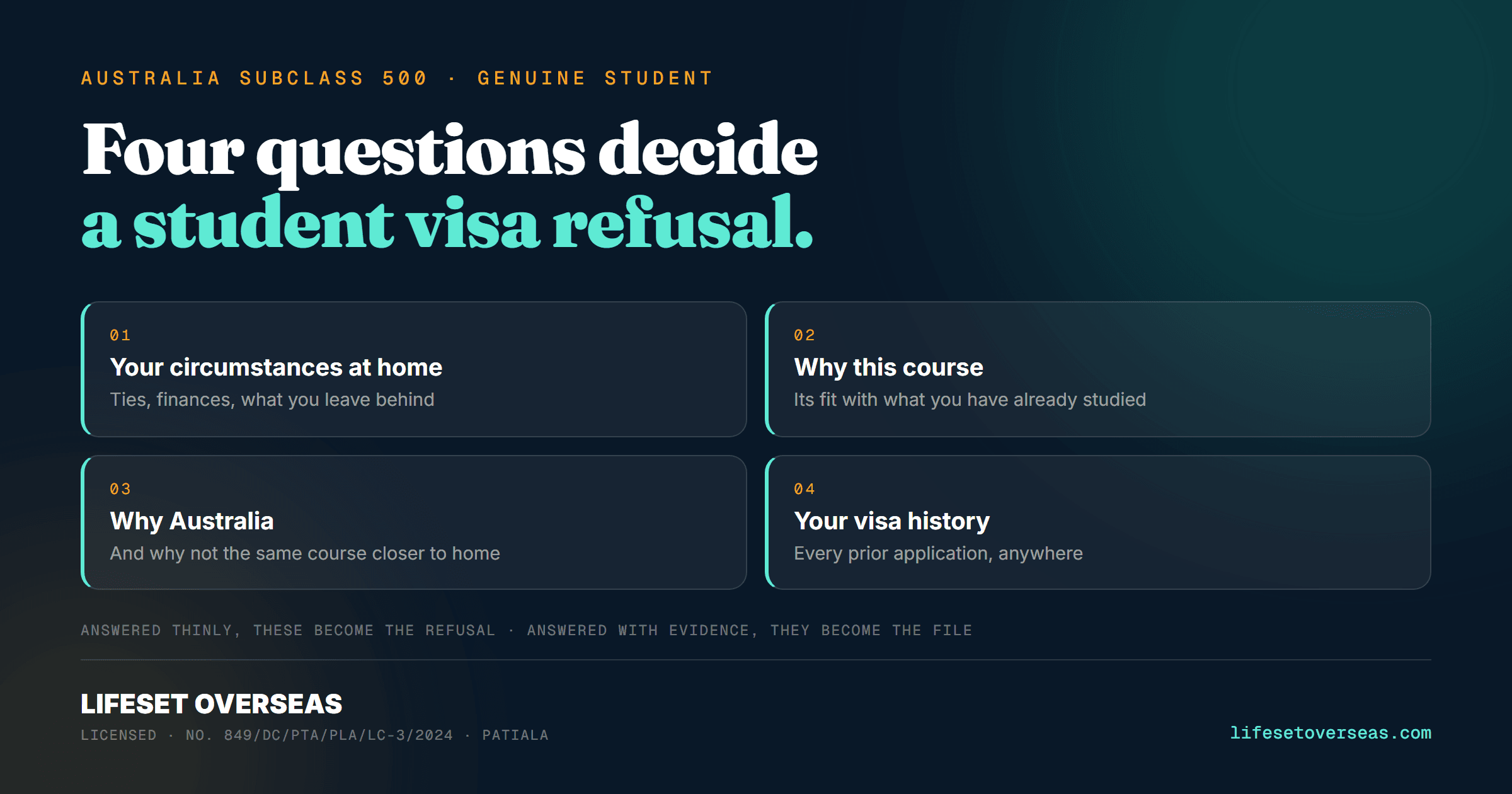
The GS questions cover:
- Your current circumstances in your home country — ties to family, community, employment, financial situation, why you are leaving these.
- Your immigration history — prior visa applications, refusals, travel history to any country.
- The reasons you have chosen this specific course of study with this specific education provider in Australia.
- How completing the course will benefit you in your home country or elsewhere outside Australia.
- Any other relevant information.
The GS evaluation is not an exam of whether you are a "good" applicant — it is an assessment of whether the totality of your responses + evidence supports a credible study intention.
Step 1 — Read your refusal notice
Subclass 500 refusal notices issued by DHA cite the specific clause not satisfied. The most common refusal grounds for Indian applicants:
- Subclause 500.212 (Genuine Student criterion) — DHA is not satisfied that you are a genuine applicant for entry and stay as a student. This is the most common ground.
- Subclause 500.213 (Financial capacity) — funds documentation is insufficient or unreliable.
- Subclause 500.215 (English requirement) — English evidence not satisfied.
- Subclause 500.214 (Health insurance) — Overseas Student Health Cover (OSHC) not in place.
- Public Interest Criterion (PIC) 4020 — false or misleading information provided.
For 80%+ of Indian Subclass 500 refusals, the cited ground is 500.212 (Genuine Student).
The refusal notice typically includes 200-600 words of officer reasoning explaining what specifically wasn't satisfied. Read this carefully — unlike Canada GCMS notes which require a separate request, the DHA refusal notice itself contains the officer's reasoning.
Step 2 — Decide between AAT appeal and fresh application
Subclass 500 refusals can be reviewed by the Administrative Appeals Tribunal (AAT) when the application was lodged inside Australia. Refusals on applications lodged from India (offshore) generally cannot be reviewed by AAT — the only path is a fresh application.
- AAT review (onshore only)
- Onshore refusals
- Fresh application (offshore)
- Both onshore and offshore
- AAT review (onshore only)
- 21 days (onshore)
- Fresh application (offshore)
- No deadline
- AAT review (onshore only)
- AUD 1,840 + lawyer fees
- Fresh application (offshore)
- AUD 1,600 (current Subclass 500 fee) + other costs
- AAT review (onshore only)
- 12-18 months
- Fresh application (offshore)
- 4-12 weeks
- AAT review (onshore only)
- Moderate when new evidence available
- Fresh application (offshore)
- High when underlying GS concern is addressed
For applicants in India whose Subclass 500 was refused, AAT is not available. Fresh application is the only path forward.
Step 3 — Decode the specific GS concern
The refusal notice usually cites specific GS factors the officer wasn't satisfied with. Common patterns:
Programme-fit concern
The officer concluded your chosen programme doesn't logically fit your past education or career plans. Triggers:
- A BCom graduate applying for a Master of Hotel Management.
- A B.Tech in Mechanical Engineering applying for a Diploma in Aged Care.
- A graduate with five years of accountancy experience applying for an unrelated Master of Business Analytics at a mid-tier provider.
Fix in a fresh application: Either choose a programme that genuinely connects to your past, or write a GS response that explicitly justifies the career pivot with documented reasoning (industry change, family business pivot, regulatory shift in your previous field, etc.). Don't hide the gap — explain it.
Funds concern
DHA verified your declared funds and found issues:
- Lump-sum deposits shortly before application suggesting borrowed funds.
- Funds source unclear (e.g., a large family gift without documentation).
- Tuition payment commitment not credibly evidenced.
The financial capacity requirement for Subclass 500 (2024 indicative): AUD 29,710 per year for the primary applicant, plus family member additions where relevant. This is the indicative minimum; many universities require higher tuition deposits which DHA verifies separately.
Fix in a fresh application: Show consistent funds growth over 6+ months. If family gift, document the gift formally with family financial records (parents' ITR, bank statements). If education loan, document the loan with sanction letter and the lender's solvency.
Ties concern
Officer concluded ties to India are weak — you don't have credible reasons to return after studies:
- No property, no family financial responsibilities, no return-employment commitment.
- Multiple family members already in Australia (parents migrated, siblings on student visas, etc.).
- Mid-twenties single male in moderate-paying role.
Fix in a fresh application: Document family responsibilities (aging parents in India, dependent siblings), property in your name or in family, business interests, prior employer commitment for return. For applicants with family in Australia, address the connection openly in the GS response and explain why return is still the genuine intent.
Course history concern
You have completed studies in Australia before, and the officer questions why you're applying for another course. The "course hopping" pattern flagged by DHA — applicants moving from one Australian course to another without clear progression — is a frequent refusal trigger.
Fix in a fresh application: A clear, documented progression rationale linking the prior course(s) to the new one. DHA looks at programme level (e.g., a downgrade from Masters to Diploma is a flag) and field continuity.
Education provider tier concern
The officer questions why you chose a specific provider (often a private vocational training provider) over a public university with similar offerings. Some Australian private providers have higher refusal rates because DHA is more skeptical of their applicant pool.
Fix in a fresh application: Either choose a higher-tier provider, or document specific reasons (programme content unavailable elsewhere, industry connections, scholarship, specific recommendation) for the chosen provider.
Step 4 — Build the GS response in the fresh application
The GS response is the single highest-leverage element of a fresh application. Strong GS responses typically:
- Address each of the five GS questions explicitly, in order, with clear paragraphs.
- Reference supporting evidence at each claim — "as evidenced in [document name attached as folio X]".
- Avoid templates — write in your own voice with specific personal detail.
- Don't exaggerate — credibility is the entire point. Officers read hundreds of these per week.
- Acknowledge any prior refusal openly — explain what changed and why this application is different.
- Tell a coherent story — programme choice connects to past, funds connect to source, ties connect to future return.
A common mistake: applicants treat the GS response as a generic study-abroad statement. The DHA officer is evaluating against documented evidence. Every claim should be evidenced.
Step 5 — Strengthen supporting evidence
Beyond the GS response, a winning fresh application:
- Confirmation of Enrolment (CoE) from a CRICOS-registered education provider, current and matching the visa application.
- OSHC (Overseas Student Health Cover) confirmed for the visa duration, from a registered Australian provider.
- English evidence — IELTS 5.5 minimum overall with no band below 5.0 for direct entry to most undergrad/postgrad; higher for elite providers.
- Funds documentation — bank statements 6 months minimum, ITRs, sponsor documentation if applicable, education loan sanction if applicable.
- PCC — police clearance certificate from India.
- Health examinations — DHA-panel-doctor health check, typically completed during application processing on DHA request.
- For under-18 applicants: welfare arrangements documentation.
Common Indian-applicant Subclass 500 refusal patterns
Pattern 1: VET sector private-provider refusal cluster
Applicants targeting private Vocational Education and Training (VET) providers offering diploma courses (often AUD 12,000-18,000 per year fees, lower than university tuition). DHA has been particularly skeptical of this applicant pool since 2023, with elevated refusal rates for some specific providers.
Fix: Either choose a CRICOS-registered public TAFE for VET courses (lower refusal rates) or pivot to a university programme. If genuinely committed to the VET sector, document the career-specific rationale.
Pattern 2: Single applicants, mid-twenties, weak ties
The classic ties-thin profile. Mid-twenties, single, working in moderate-paying role, no property, applying for a 2-year Masters at a mid-tier Australian provider. Fix: Build prior international travel history if possible (Schengen, UK, Singapore, etc. returned timely), document family responsibilities, consider applying after marriage or property purchase if those are imminent.
Pattern 3: Course hopping
Multiple Australian student visas, multiple course changes, no clear progression. Fix: A clear progression narrative documented with educational logic. A second pattern of hopping after a refusal almost always produces another refusal.
Pattern 4: Funds parked
The single most common funds issue across Indian Subclass 500 applications. Funds appeared in the account weeks before submission. Fix: Hold funds for 6+ months in genuine activity. Document source clearly.
Pattern 5: Family-in-Australia connection
Sibling or parent already in Australia (on student, work, or PR visa). DHA infers the actual intent is family reunification via Australia rather than genuine study. Fix: Address the family connection openly in the GS response. Explain why return is still the intent — specific career plans in India, family responsibilities in India, business plans.
How Lifeset can help
We handle Subclass 500 student visa refusal recovery for Indian applicants:
- Refusal diagnosis — read the DHA refusal notice with you, identify the specific GS or other concern.
- GS response strategy — structured response addressing each GS question with evidence references, written in your voice.
- Fresh application file rebuild — programme review (course-fit assessment), provider selection, funds documentation, OSHC, English evidence, PCC.
- Honest assessment — we will tell you if your profile needs to mature (additional work experience, completed home-country course, family circumstances) before a fresh application has a real chance.
We do not handle Subclass 482 (Skills in Demand), 494 (regional sponsored), or 186 (Employer Nomination Scheme) — those are employer-sponsored work permits requiring an MEA Recruiting Agent licence we do not hold. We handle Subclass 500 (student), Subclass 600 (visitor), Subclass 189 / 190 / 491 (skilled migration PR) under our licensed scope.
We are a licensed visa consultancy at Shop No. 2, near PRTC Workshop, Nabha Road, Patiala 147001, Punjab — Licence No. 849/DC/PTA/PLA/LC-3/2024. Book a free 30-minute assessment — we will read your refusal notice and outline a realistic GS response strategy for the next application.