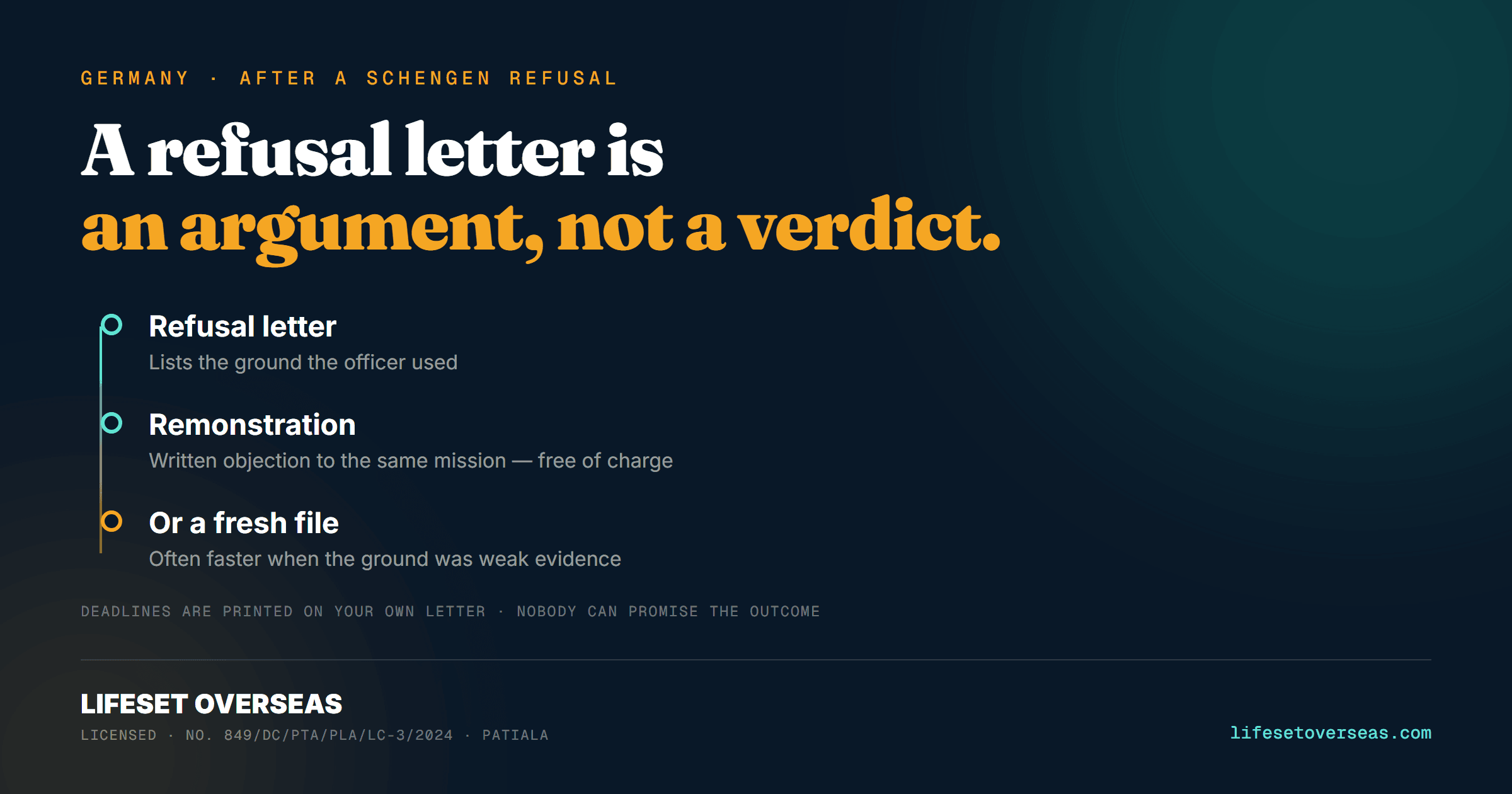
Germany is one of the highest-volume Schengen destinations for Indian applicants — tourism in Munich and Berlin, business at the trade-fair calendar, family visits across the Verpflichtungserklärung network. When a German Schengen visa is refused, the recovery path depends on the specific Annex VI grounds cited and whether the file deserves a Remonstration (Germany's formal appeal) or a fresh application.
This guide walks through the diagnosis and recovery sequence we use at Lifeset Overseas — licensed visa consultants based in Patiala, Punjab.
Step 1 — Read your Annex VI refusal letter
Every Schengen refusal in the EU is delivered via the standardised Annex VI form, which ticks one or more boxes from the EU Visa Code refusal grounds. For Germany specifically, the most common boxes ticked for Indian applicants are:
- #3 — Insufficient means of subsistence (the funds concern)
- #4 — Doubt about your intention to leave before visa expires (the ties concern)
- #9 — Doubt about the authenticity of supporting documents (document concerns)
- #10 — Doubt about the reliability of statements (consistency concerns)
- #2 — Purpose and conditions of intended stay not justified (often used for unclear cover letters)
German consulates frequently tick multiple boxes simultaneously. Multiple boxes typically point to a profile-level concern. A single box ticked points to a document-level concern.
Step 2 — Decide: Remonstration or fresh application?
Germany has a formal appeal route called Remonstration — unique among Schengen consulates in being a fully internal review by the German Federal Foreign Office (Auswärtiges Amt), not a court.
- Remonstration
- EUR 35-200 (varies)
- Fresh application
- EUR 90 standard Schengen fee + VFS service fee
- Remonstration
- 1 month from the refusal notice
- Fresh application
- No deadline
- Remonstration
- Written submission to the German consulate addressing the refusal grounds
- Fresh application
- Submit a new application via VFS Germany
- Remonstration
- Allowed and expected
- Fresh application
- Encouraged
- Remonstration
- 3-6 months typical
- Fresh application
- 15 days target, 2-4 weeks typical
- Remonstration
- Low without strong new evidence — the appeal re-reads the original decision
- Fresh application
- Better when the underlying issue is genuinely addressed, though no one can put a number on your own case
For most refused Indian applicants, a fresh application is faster, cheaper, and more likely to succeed. Remonstration is the right path only when:
- The consulate clearly misread your documents (e.g., they ticked the funds box but your bank statements showed sufficient balance throughout the requested period).
- You can demonstrate the original file already met the standard and the refusal was an error.
- You have travel deadlines that don't allow a fresh-application timeline.
- Your underlying profile cannot reasonably change in time for a useful fresh application.
If your refusal was substantively correct (i.e., funds genuinely were thin, or ties genuinely were weak), Remonstration will not succeed — and you'll lose 3-6 months waiting for it.
Step 3 — Decode the specific German refusal patterns
Funds refusals (Annex VI #3)
The German consulate uses indicative funds of approximately EUR 65 per day for the German leg plus return travel. Common refusal patterns:
- Lump-sum deposit pre-application — the funds appeared in your account 7-21 days before applying, suggesting borrowed funds parked for show. German consulates particularly look at the source and stability of funds.
- Low or inconsistent salary history — bank statements showing irregular activity, low base salary, undocumented business income.
- Sponsor's funds incorrectly documented — if sponsored by family or employer, the sponsor's bank statements, ITRs, and a clean sponsorship affidavit weren't provided or were inconsistent with each other.
- Currency mismatch — funds shown only in INR with no clear EUR-equivalent at the application-relevant rate.
Fix in a fresh application: Show 3-6 months of consistent activity in the account. Avoid lump-sum deposits within 30 days of application. If parents or employer fund the trip, include their bank statements, ITRs, and a notarised sponsorship affidavit. Calculate EUR equivalent at a reasonable rate and label clearly.
Intention-to-leave refusals (Annex VI #4)
The German consulate is particularly thorough on ties for first-time Schengen applicants and applicants from regions with historical overstay patterns. Common refusal triggers:
- Single, mid-twenties, working professional, no property — the classic ties-thin profile.
- No prior international travel — first-time travellers face a higher evidence bar.
- Family in Germany without a Verpflichtungserklärung — German consulates expect the formal Verpflichtungserklärung (declaration of sponsorship from German host, processed at their local Ausländerbehörde) for family-visit cases, not a generic invitation letter.
- Vague employment letter — generic leave-approval without explicit return commitment.
- No documented family responsibilities — aging parents, siblings, immediate-family commitments not in the file.
Fix in a fresh application: Strengthen ties evidence — employment letter with explicit return date and position-on-return, family-responsibility documentation, property documents (in your name or family), business documents. For family visits, obtain a proper Verpflichtungserklärung from the German host. Build prior travel history if possible (a Schengen-friendly first trip like a short Singapore / Dubai / Sri Lanka visit completed and returned demonstrates compliance).
Authenticity / reliability refusals (Annex VI #9 / #10)
These are document-consistency refusals. The German consulate found inconsistencies between your various documents.
Common triggers:
- Employment letter says one thing, bank statements show another — claimed salary doesn't match bank deposits.
- ITR doesn't match income claim — income on tax returns doesn't support the lifestyle / funds claim.
- Cover letter inconsistent with itinerary — the cover letter says one trip purpose, the bookings suggest another.
- Template-style documents — multiple applicants submitting identically-worded employment letters or cover letters flag template use.
- Hotel bookings cancelled before submission — applicants who use refundable bookings sometimes cancel before applying, which is detectable.
Fix in a fresh application: Match every document against every other document for consistency. Use custom-drafted cover letters and employment letters. Use bookings that survive submission. Avoid template-style language.
Step 4 — The German Verpflichtungserklärung — key for family visits
For visit-family applications to Germany, the Verpflichtungserklärung (formal declaration of sponsorship) is the single most important document. The German-resident host submits this at their local Ausländerbehörde (foreigners' office), which verifies the host's income and accommodation before issuing the official document.
A clean Verpflichtungserklärung from a host with adequate income often substantially reduces the funds-evidence burden on the visitor. Conversely, a missing or weak Verpflichtungserklärung is a frequent refusal trigger for what should be straightforward family visits.
If your family-visit refusal didn't include a Verpflichtungserklärung, this is the first thing to fix.
Step 5 — Plan the timing of the fresh application
There is no formal waiting period, but most experienced applicants wait 30-90 days between a refusal and a fresh German Schengen application. Reapplying within 7-14 days with no material change usually produces a second refusal — and the German consulate sees your refusal history through the Visa Information System.
Material change for a German Schengen reapplication includes:
- Improved financial position (more savings, salary increase, new fixed deposit).
- New employment / business developments (promotion, new role, expanded business).
- New travel history (a developed-country trip completed and returned on time).
- New family or property events (marriage, property purchase, business establishment).
- For family-visit cases: a properly-executed Verpflichtungserklärung that wasn't in the prior file.
Common Indian-applicant German Schengen refusal patterns
Pattern 1: Funds parked just before application
The single most common pattern. Funds were transferred in as a lump-sum 10-20 days before submission. The German officer infers borrowed funds. Fix: Hold funds in the account for 90+ days before reapplying, ideally as part of an organic salary/savings pattern.
Pattern 2: Family-visit without Verpflichtungserklärung
Indian family is hosted by a German-resident relative, but the relative submitted only an informal invitation letter — not the formal Verpflichtungserklärung processed at their Ausländerbehörde. Fix: Have the host submit the proper Verpflichtungserklärung. Reapply with that document.
Pattern 3: Single male, no ties
Mid-twenties single male, working in moderate-income role, no property, no family dependents. Plans a 10-day Germany tourist trip self-funded. Fix: Build prior travel history first (short Schengen-friendly destinations or even a Singapore/UAE trip returned timely), document family responsibilities and any property in family name, strengthen employment letter with explicit return language.
Pattern 4: Trade-fair business travel without solid invitation
Applicant claims to attend a German trade fair (Hannover Messe, IFA Berlin, IAA Mobility) but doesn't have a host-company invitation letter, trade-fair registration confirmation, or business-purpose documentation. Fix: Secure formal invitation from the German host company, trade-fair registration with the visitor's name, business cards or corporate documentation supporting the trip purpose.
Pattern 5: Inconsistent documentation
Multiple documents showed inconsistent information — ITR income didn't match bank statement deposits, employment letter said one thing, leave letter said another, cover letter described a different itinerary than the hotel bookings showed. Fix: Comprehensive document audit before reapplication. Every document must be internally consistent with every other document.
How Lifeset can help
We handle German Schengen visa refusal recovery for Indian applicants:
- Refusal diagnosis — we read the Annex VI letter and your prior file with you, identify the specific underlying concern, and recommend Remonstration or fresh application.
- Verpflichtungserklärung coordination for family-visit cases — guidance to your German host on the Ausländerbehörde submission process.
- Fresh application file rebuild — strengthened cover letter, funds documentation, ties evidence, insurance, VFS Germany appointment scheduling.
- Honest assessment — we will tell you if we think your profile isn't ready for a German Schengen reapplication within 30-60 days. A second German refusal materially complicates future Schengen applications across all member states.
We are a licensed visa consultancy at Shop No. 2, near PRTC Workshop, Nabha Road, Patiala 147001, Punjab — Licence No. 849/DC/PTA/PLA/LC-3/2024. Book a free 30-minute assessment — we will read your German refusal letter and outline a realistic recovery strategy.