If your refusal letter just arrived, you are not alone — and you are not finished. A refusal closes that one application. It is not a permanent judgement on you, and it does not bar you from applying again.
We will not tell you what your odds are on a second attempt, because nobody honestly can — that depends on your file and on the officer who reads it. Anyone quoting you a success rate is guessing. What we can tell you is what actually decides it. The key is to identify the actual reason for refusal (rarely the same as what the standard letter says), fix the underlying gap, and reapply with a fundamentally stronger file.
This guide walks through the exact sequence we use for our Indian CAIPS / GCMS clients at Lifeset Overseas — licensed visa consultants based in Patiala, Punjab.
Step 1 — Read the refusal letter carefully, but don't trust it alone
IRCC refusal letters use standardised refusal grounds. The letter typically lists one or more of:
- The applicant is not a genuine student / does not have a genuine intention to leave Canada at the end of their authorised stay.
- The applicant's financial situation is insufficient.
- The applicant's purpose of visit does not appear consistent.
- The applicant has not satisfied the officer regarding their ability to meet the requirements of their proposed studies.
- The officer is not satisfied that the applicant will leave Canada at the end of their authorised stay.
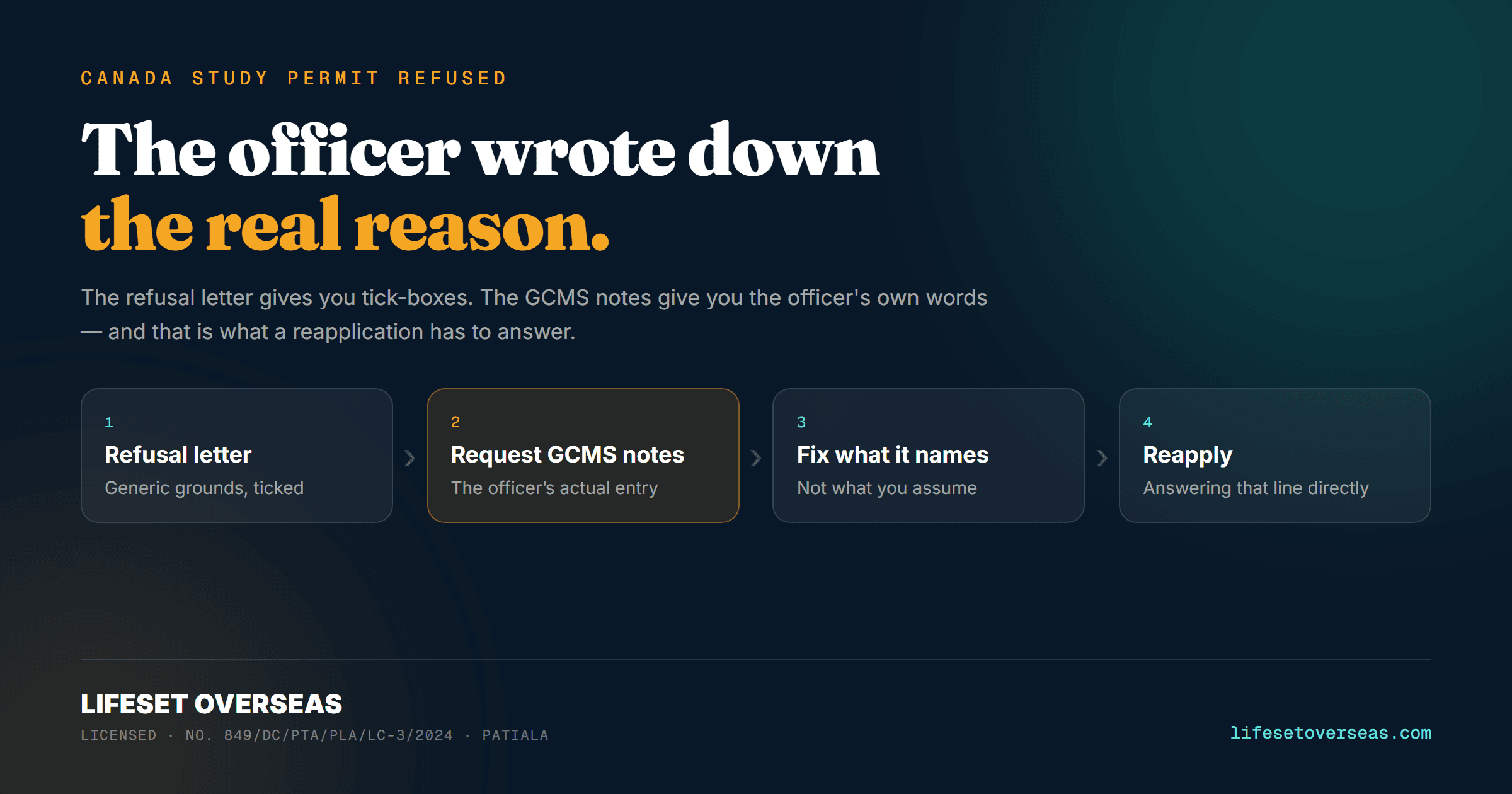
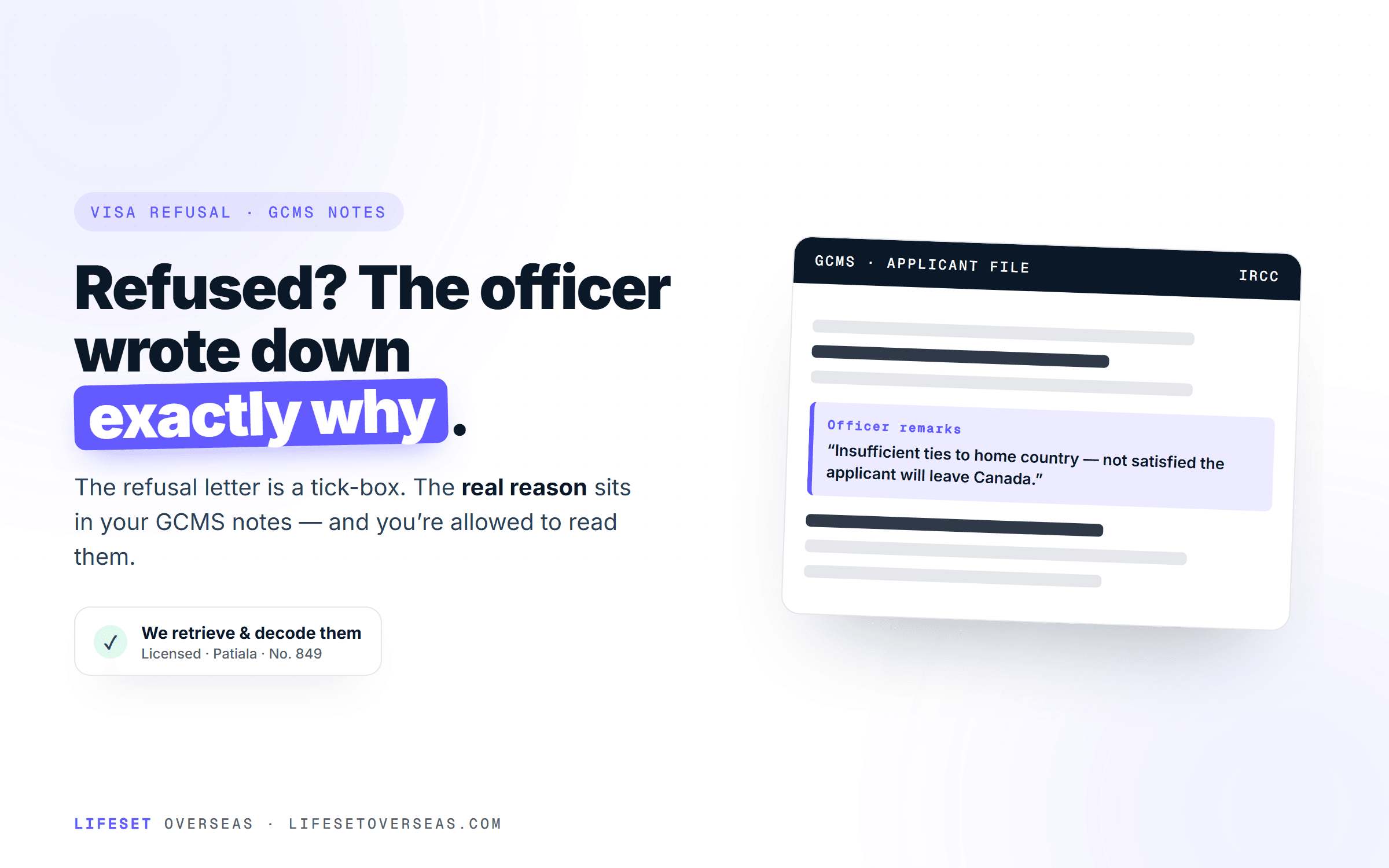
Here is the catch: these standardised grounds are deliberately vague. The actual reason for refusal sits inside the CAIPS or GCMS officer notes — the internal file notes the visa officer wrote when deciding your application. Without ordering those notes, you are guessing at what to fix.
Step 2 — Order your CAIPS / GCMS notes
CAIPS (Computer Assisted Immigration Processing System) and GCMS (Global Case Management System) are the IRCC internal-record systems. The GCMS notes include the officer's reasoning, any concerns flagged, document checks, and the basis for the refusal.
You order GCMS notes through an Access to Information and Privacy (ATIP) request to IRCC. Indian applicants can make the request through a Canadian citizen or permanent resident acting on their behalf (typically a consultant or family member in Canada), or directly using authorised representatives.
You can file this request yourself at no cost, and we publish the full procedure. If you would rather we did it: INR 999 for the notes and file retrieved in your name, INR 1,999 for a written interpretation and reapply roadmap if you already have your notes, or INR 2,499 for both — all inclusive of GST, ordered through caipsnotesapply.com. Delivery runs 25 to 30 days, because that is IRCC's side of it, not ours. The notes arrive as a multi-page PDF.
Step 3 — Decode the notes (this is where most applicants get it wrong)
The GCMS notes look like a series of officer notes, often dense and abbreviated. What you are looking for:
- The "officer's notes" or "decision" entry — usually toward the end. This is the officer's own reasoning, in their words.
- Specific concerns flagged — for example, "Funds appear recent and source unclear", or "Educational path not consistent with prior studies", or "Family ties insufficient to demonstrate intent to return".
- Document concerns — any document the officer flagged as unverified, inconsistent, or weak.
- Profile concerns — gaps in education, weak academic profile relative to programme, age vs. education timeline, prior visa refusals (Canada, US, UK, Schengen).
Common patterns in the refusal notes we read:
- What it actually means
- Sudden lump-sum deposit before application. Officer suspects funds were borrowed for show.
- What it actually means
- Your chosen programme doesn't connect to your past education or career. Officer suspects study is a pretext.
- What it actually means
- Officer doesn't believe you will return. Often triggered by weak employment, no property, no immediate family responsibilities.
- What it actually means
- Either no prior international travel (red flag for fresh applicants) or a prior refusal from Canada, US, UK, Schengen, Australia, NZ.
- What it actually means
- Provincial Attestation Letter / Territorial Attestation Letter — applicant's PAL was missing, expired, or for a different DLI than the LOA.
- What it actually means
- Guaranteed Investment Certificate amount, currency, or institution didn't match the post-SDS expectations.
Step 4 — Decide the right next step
Once you understand the actual refusal reason, you have three options:
Option A: Reapply with a fundamentally stronger file (most common)
This is the right path for most refusals. You are not just submitting the same application again. You are addressing the specific concern in the GCMS notes with new evidence and a strengthened file. Examples:
- Funds concern → Document the source of funds with bank statements going back 6–12 months, income tax returns for 2–3 years, property valuation if relevant, and a clear sponsor declaration if family-funded. Move funds gradually — not as a lump-sum just before application.
- Programme logic concern → Rewrite the Statement of Purpose to explicitly connect your past education and work to the chosen programme. Add a clear post-study return narrative. If the programme genuinely doesn't fit, change the programme.
- Ties concern → Strengthen employment letter with explicit return commitment, family responsibility documentation, property ownership documents, business documents.
Option B: Apply for a different Canadian programme
If the GCMS notes suggest the programme was the problem (not just documentation), consider applying for a different programme that fits your profile better — possibly at a different DLI (Designated Learning Institution) or in a different province. PAL / TAL requirements changed in 2024 and continue to evolve; some applicants find a different province has more workable rules for their profile.
Option C: Wait and improve the profile
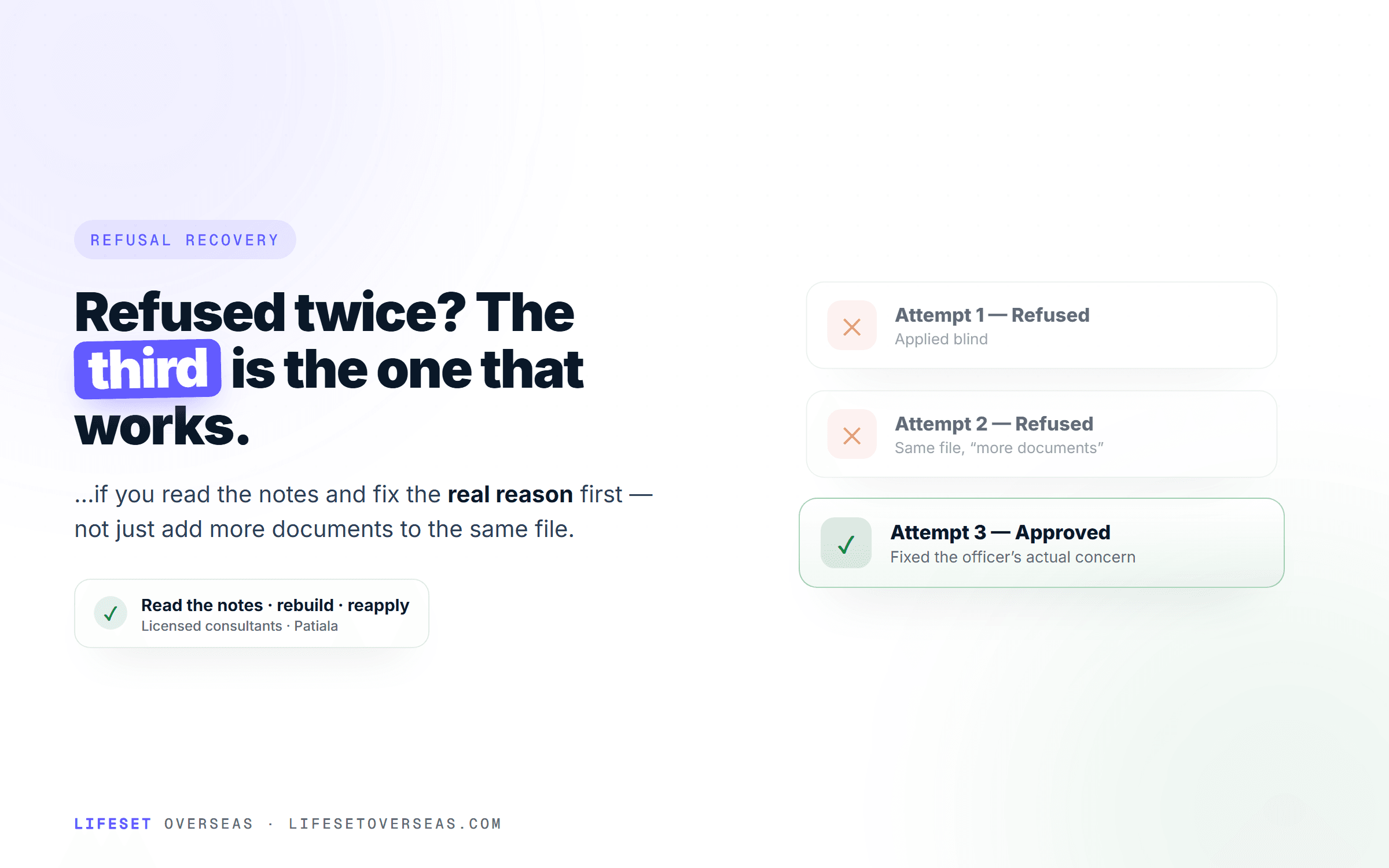
For weak profiles (low IELTS, large education gaps, age-vs-education mismatch, multiple prior refusals), the right answer is sometimes to wait 6–12 months and improve the profile before reapplying — higher IELTS, additional work experience, stronger financial position. Reapplying immediately with an unchanged profile usually leads to a second refusal.
We tell applicants honestly when we think Option C is the right call. A second refusal on the same profile materially complicates future applications to Canada, the US, the UK, Australia, and Schengen.
Option D: Federal Court judicial review
For refusals you believe were legally unreasonable (rare), there is a formal judicial review route at the Federal Court of Canada, with a 15 / 60-day deadline (15 days for inside Canada, 60 days for outside). This is expensive and slow. In nearly all Indian study-visa refusals, a fresh application is faster, cheaper, and more likely to succeed.
Step 5 — Build the reapplication file
For a strong reapplication, the file needs:
- Clear acknowledgment of the prior refusal in a covering letter, addressing the specific GCMS concern.
- New / strengthened evidence for the flagged issue.
- Updated SOP that addresses the genuine-student criterion in plain language.
- Updated PAL (if applying after the November 2024 changes) — make sure the PAL matches the LOA's DLI and study level.
- Updated GIC if applicable — current SDS pathway requires a higher GIC than pre-2024 applications.
- Tuition payment receipt for the first year (where applicable).
- Clean financial story — bank statements showing consistent activity, not lump-sum injections.
- Travel history — any new genuine travel since the refusal helps demonstrate compliance.
Common Indian-applicant refusal patterns and how to fix them
Pattern 1: Funds were borrowed and parked
The single most common GCMS concern. A loan or family gift was deposited shortly before application, showing in bank statements as a sudden balance. The officer assumes funds will be withdrawn after visa approval. Fix: Use the existing funds as actual self-funded study capital, document the loan or gift with an affidavit and the lender's bank statements, and demonstrate continuing repayment ability.
Pattern 2: Programme has no connection to past
A BCom graduate applying for a 2-year diploma in business management, or a B.Tech graduate applying for an unrelated hotel-management programme. Fix: Either choose a programme that connects to past education / work, or explicitly justify the change with a credible career-pivot story in the SOP.
Pattern 3: Weak ties to India
Single, mid-twenties, working in a low-skilled role, no property, no family dependent on you — IRCC reasonably concludes you might not return. Fix: Document everything that anchors you to India — family responsibilities (aging parents, siblings), property in your name or in family, business interests, return employment commitment if available.
Pattern 4: Prior refusal disclosure
A prior US, UK, Schengen, or Canada refusal that wasn't disclosed on the application, or was disclosed but not explained. Always disclose; misrepresentation is a five-year inadmissibility. The way to handle it is to disclose openly and explain in a separate letter why that prior refusal does not apply to the current application.
Pattern 5: SDS / non-SDS confusion post-November 2024
IRCC closed the SDS (Student Direct Stream) for Indian applicants in November 2024. All Indian study-permit applications are now non-SDS. Applicants who tried to file under the old SDS framework after the closure are refused on procedural grounds. Fix: File under the current non-SDS regular pathway, with full documentation.
How Lifeset can help
We handle the full Canada study-visa refusal recovery process for Indian applicants:
- CAIPS / GCMS notes retrieval — from INR 999, 25 to 30 day turnaround (IRCC's timeline, not ours). Free if you file the request yourself.
- Refusal diagnosis — one consultant reads the notes with you, identifies the actual concern, and recommends the right next step (reapply, change programme, wait, or judicial review).
- Reapplication file rebuild — SOP, financial documentation, PAL, GIC, supporting evidence, all matched to the specific GCMS concern.
- Honest assessment — we will tell you if we think your file is not ready for a second application. A weak second application creates compounding problems.
We are a licensed visa consultancy based at Shop No. 2, near PRTC Workshop, Nabha Road, Patiala 147001, Punjab — Licence No. 849/DC/PTA/PLA/LC-3/2024. One consultant from first call to decision. Fixed fees. No work permits (those require a separate MEA Recruiting Agent licence we do not hold).
Book a free 30-minute assessment — we will read your refusal letter, recommend whether CAIPS notes are worth ordering for your file, and outline the realistic next-step strategy.