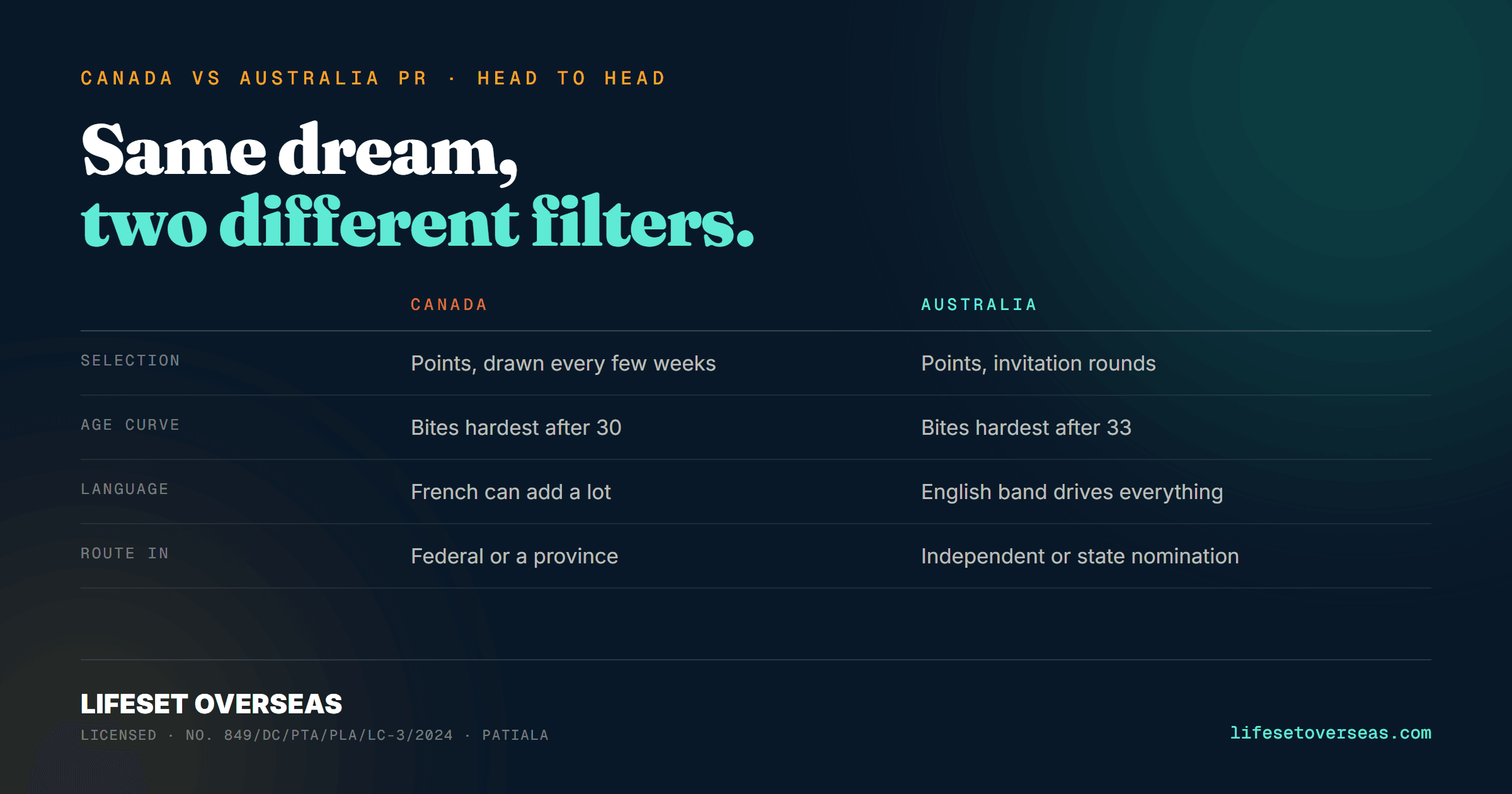
Canada and Australia are the two dominant skilled-migration destinations for Indian applicants — and the two most compared. Both have points-based systems. Both have backlogs. Both have shifted standards since 2022. The right answer for your profile depends on factors most online comparisons skip: your age, occupation list status, English score realism, family situation, and how much risk you can carry.
This is an honest, licensed comparison from Lifeset Overseas, Patiala. We do not push every applicant towards the same country — we tell you what the data says for your profile.
The headline difference
Canada has a single federal Express Entry pool with multiple programmes feeding into it (FSW, FSTP, CEC, PNP-aligned). Draw cut-offs vary draw to draw and are public.
Australia has a separate visa per pathway — Subclass 189 (independent), Subclass 190 (state-nominated), Subclass 491 (skilled regional). Each has its own points-test thresholds and its own occupation lists. Visa subclasses also come with structural differences: 189 is permanent, 190 is permanent with state-nomination conditions, 491 is provisional (regional) leading to permanent.
Plain English: Canada is one big lottery with multiple ticket types. Australia is several separate lotteries with different ticket prices.
Side-by-side: the metrics that actually matter
- Canada Express Entry
- CRS (Comprehensive Ranking System), 0-1200 points
- Australia SkillSelect (189/190/491)
- Points test, 65 baseline, typically need 80-95 for invitation
- Canada Express Entry
- CRS ~480-540 typical late 2025
- Australia SkillSelect (189/190/491)
- 189: 90+ for most occupations; 190/491: state-specific
- Canada Express Entry
- 25-32 (max age points)
- Australia SkillSelect (189/190/491)
- 25-32 (max age points)
- Canada Express Entry
- CLB 9 for max points (IELTS 7.0 all bands)
- Australia SkillSelect (189/190/491)
- Superior English for max points (IELTS 8.0 all bands)
- Canada Express Entry
- Targeted via category-based draws (healthcare, STEM, trades, transport, agriculture)
- Australia SkillSelect (189/190/491)
- MLTSSL / STSOL / ROL — Skilled Occupation Lists per visa subclass
- Canada Express Entry
- 5-6 months Express Entry typical
- Australia SkillSelect (189/190/491)
- 189: 12-18 months; 190: 8-14 months; 491: 6-12 months
- Canada Express Entry
- Spouse + dependent kids in the same application
- Australia SkillSelect (189/190/491)
- Spouse + dependent kids in the same application
- Canada Express Entry
- CAD 1,425 IRCC + biometrics + medicals + RPRF
- Australia SkillSelect (189/190/491)
- AUD 4,640 visa fee 189; 190 similar; 491 lower. Plus skills assessment AUD 500-1,500.
- Canada Express Entry
- 3 years out of 5 as PR
- Australia SkillSelect (189/190/491)
- 4 years legal residence, including 12 months as PR
When Canada is the better choice for an Indian applicant
Canada Express Entry tends to be the right call when:
- Your CRS score is realistically 470+ with strong language (CLB 9 = IELTS 7.0 all bands), age 25-32, post-graduate education, 3+ years of skilled experience.
- You can secure a Provincial Nomination in a strong PNP stream (Ontario tech-stream, BC tech-stream, Alberta express entry, Saskatchewan express entry). Provincial nomination adds 600 CRS points, effectively guaranteeing an invitation.
- Your occupation is on a category-based draw list — healthcare (physicians, nurses, allied health), STEM (software engineers, data scientists), trades (electricians, plumbers, welders), transport (truck drivers, pilots), agriculture. Category-based draws have lower CRS cut-offs (often 430-470) than general draws.
- You prioritise speed to PR — Canada Express Entry processing is 5-6 months from ITA to PR, faster than any Australian skilled pathway.
- You have studied in Canada — Canadian degree, work experience under PGWP, applying CEC. This profile is structurally favoured.
Honest realism: a CRS score of 480-540 is genuinely tough for Indian applicants without provincial nomination or category-aligned occupation. Many self-assessed CRS scores online overstate reality (people miscount work experience, language, education).
When Australia is the better choice for an Indian applicant
Australia tends to be the right call when:
- Your occupation is on the MLTSSL (Medium and Long-Term Strategic Skills List) for 189 independent, with strong points (typically 90+).
- You have a credible state-nomination angle for 190 (Victoria, NSW, Queensland, WA each have programme-specific occupation lists and nominations). Subclass 190 is a strong pathway when state demand matches your occupation.
- You can credibly commit to regional Australia for 491 (regional sponsored) — outside the metro areas of Sydney, Melbourne, Brisbane. 491 has lower points thresholds and clearer paths in some states.
- You can score Superior English (IELTS 8.0 all bands or PTE 79 all sections). This is harder than Canada's CLB 9 requirement, but gives a major points advantage in Australia.
- You have specific Australian experience (Australian study + work experience under post-study work / Subclass 485). This profile is structurally favoured.
- You prefer Australian climate, lifestyle, and Indian community concentration (Melbourne, Sydney, Perth, Adelaide).
Honest realism: Australia's processing times for 189 have stretched to 12-18 months in recent quarters. Sub 189 is structurally harder than Canada Express Entry for most Indian profiles unless your occupation has specific demand.
What both have in common (and what changed in 2024-2026)
Both Canada and Australia have tightened immigration intake in 2024-2026 in response to housing pressure and labour market shifts:
- Canada reduced its PR target for 2025 and 2026, increased CRS cut-offs across the board, closed SDS for Indian study-permit applicants, and tightened study-permit caps via PAL / TAL requirements.
- Australia raised its English score expectations, tightened the Subclass 482 (now Skills in Demand) framework, increased visa fees significantly in 2024, and shifted regional focus through Subclass 491.
Both countries have moved towards occupation-targeted immigration. The generic "any-occupation" pathway is harder than it was 5 years ago.
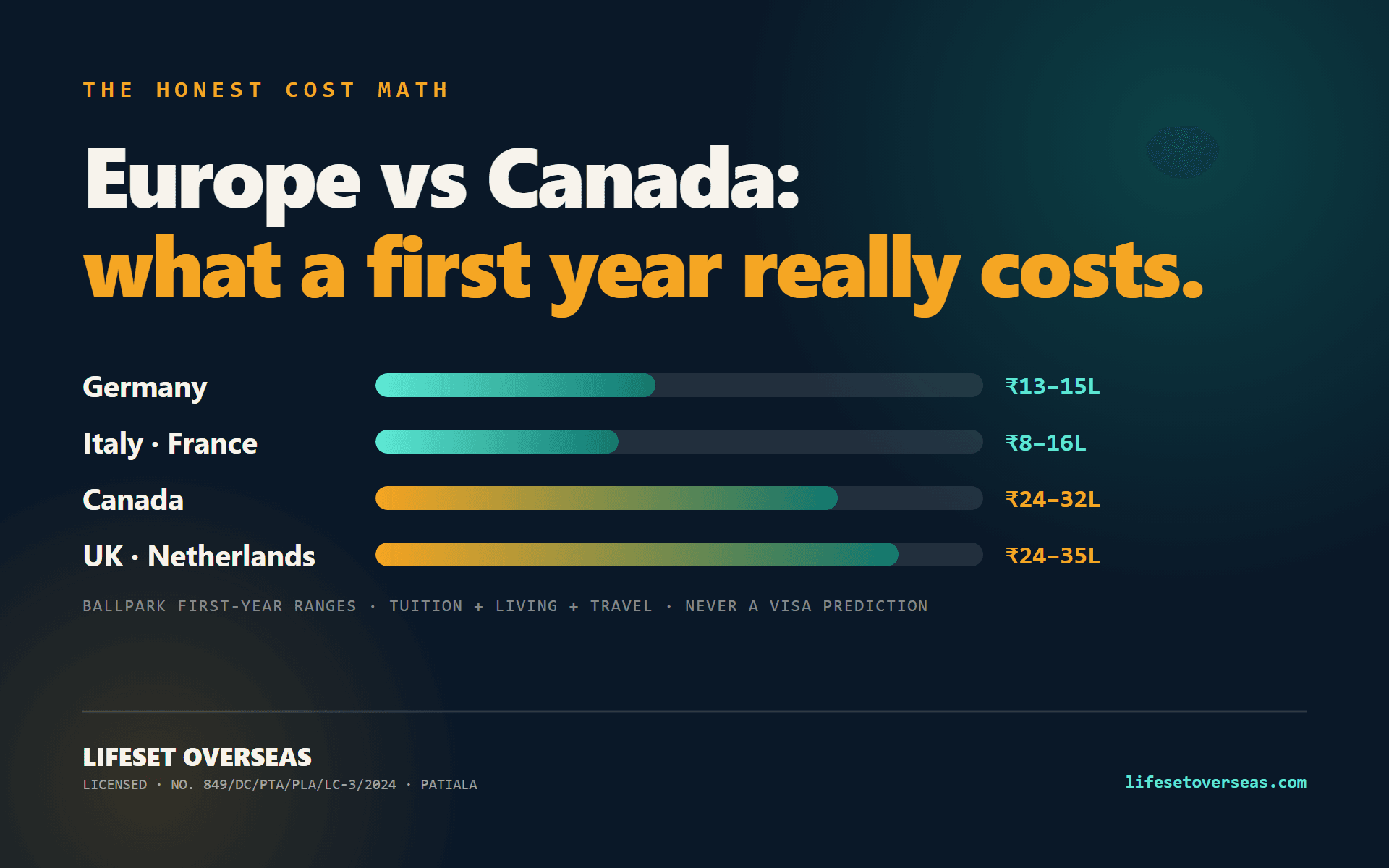
The cost reality nobody talks about
Beyond visa fees, the actual cost of relocating from India varies significantly:
- IRCC visa fee + biometrics + RPRF: CAD ~1,425 + ~85 + ~575 = CAD ~2,085 (INR ~1.3 lakh)
- Medical exam: CAD ~200
- IELTS test (if not already taken): INR ~17,000
- ECA (Educational Credential Assessment): WES typically CAD ~225
- Settlement funds requirement: CAD ~14,690 (single) or CAD ~18,288 (couple) — needs to be in your account before invitation
- Flight + initial settlement: CAD ~3,000-5,000 typical
- First three months of housing + costs in Canada: CAD ~6,000-10,000 typical
- Total first-year exposure: CAD 25,000-30,000 / INR ~15-18 lakh
- Subclass 189 visa fee: AUD ~4,640 (INR ~2.5 lakh) — among the highest in the world
- Skills assessment: AUD ~500-1,500 depending on body
- English test: INR ~17,000
- Medical exam + biometrics: AUD ~400-500
- Settlement funds (not strictly required but recommended): AUD ~20,000-25,000
- Flight + initial settlement: AUD ~2,000-3,000
- First three months in Australia: AUD ~8,000-12,000 typical
- Total first-year exposure: AUD 30,000-40,000 / INR ~16-22 lakh
Australia is structurally more expensive for the visa fee alone — but cost-of-living and salaries can offset.
Family and dependents
Both Canada and Australia allow spouse and dependent children in the same PR application. Differences:
- Canada: spouse can work full-time from arrival (open work permit equivalent under PR). Children of school age have full provincial education access.
- Australia: spouse can work from arrival on the PR. Children have full state education access.
Spouse's English score matters for points in both systems — but Canada's CRS rewards spouse English more proportionally than Australia's points test.
Post-arrival reality check
This is the dimension most online comparisons miss.
Canada post-arrival in 2026
- Cold-weather adjustment — Toronto, Vancouver, Calgary, Edmonton, Winnipeg, Montreal all have winters that require serious adjustment for Indian applicants. Especially Saskatchewan, Manitoba, Quebec.
- Skilled job market — solid but competitive. Software, healthcare, and trades hire actively. Marketing, generic management, and humanities have higher under-employment risk.
- Housing affordability — Toronto and Vancouver are unaffordable for most new PRs. Calgary, Edmonton, Winnipeg, Halifax, Atlantic provinces are more affordable.
- Indian community concentration — Brampton, Mississauga, Surrey, Calgary NE are dense Indian-immigrant neighbourhoods.
Australia post-arrival in 2026
- Climate — significantly more comfortable for Indian applicants than Canada. Melbourne, Sydney are temperate; Brisbane, Perth, Adelaide are warm.
- Skilled job market — strong in healthcare, engineering, IT, education, trades. Highly localised — a job in Sydney's tech sector is much harder to translate to Perth.
- Housing affordability — Sydney and Melbourne are highly expensive. Adelaide, Brisbane, Hobart, Perth more affordable.
- Indian community concentration — Western Sydney (Parramatta, Blacktown), Melbourne's southeast (Clayton, Springvale, Wantirna), Perth's southern suburbs.
- 491 regional reality — committing to regional Australia for 3+ years is not for everyone. Smaller communities, fewer Indian community ties, climate variability.
How to decide for your profile
Honest framework we use with clients:
- Calculate your realistic CRS (Canada) AND Australian points test (for 189 and 190). If one is materially stronger, that's a strong signal.
- Check your occupation status in both. Is it on Canada's category-based draw list? Australia's MLTSSL / STSOL?
- Check your IELTS realism. Can you genuinely score CLB 9 (IELTS 7.0 all bands)? Superior English (IELTS 8.0 all bands)? Be realistic — most applicants overestimate.
- Consider state nomination angles — both systems reward this heavily.
- Consider the dollar exposure — Australia is significantly more expensive on visa fee alone.
- Consider lifestyle priorities — climate, community concentration, regional vs metro tolerance.
For most Indian applicants in the 25-32 age band with strong English, CRS 480+ profile, and occupation on category-based draws, Canada Express Entry is the faster and cheaper path.
For applicants with MLTSSL occupations, willingness to commit to a specific state, and ability to score Superior English, Australia 190 or 491 can outperform Canada.
The wrong answer in this comparison is applying to both simultaneously. Both processes are intensive. Dividing your attention typically means weaker outcomes in both.
How Lifeset can help
We handle both Canada Express Entry and Australia SkillSelect PR pathways for Indian applicants:
- Profile assessment — realistic CRS calculation and Australia points-test scoring against current cut-offs.
- Pathway selection — honest recommendation on whether Canada Express Entry, Provincial Nomination, Australia 189, 190, or 491 is the strongest fit.
- Skills assessment / ECA coordination — WES for Canada, the appropriate skills assessment body for Australia.
- English strategy — realistic IELTS / PTE targeting based on your current ability.
- End-to-end case management — one consultant from first call to PR landing.
- Honest assessment — we will tell you if neither pathway works for your profile, and recommend study-then-PR routes or alternative destinations.
We are a licensed visa consultancy at Shop No. 2, near PRTC Workshop, Nabha Road, Patiala 147001, Punjab — Licence No. 849/DC/PTA/PLA/LC-3/2024. Book a free 30-minute assessment — we will run your profile through both Canadian and Australian systems and recommend the path that gives you the highest probability of success.