Germany and Italy are the two most-applied "near-free public tuition" Schengen study destinations for Indian students in 2026 — and the two most often compared. Both offer strong public universities at very low tuition for non-EU students, both have growing English-medium catalogues, and both demand specific bureaucratic steps unique to that country. The right answer for your profile depends on language preference, programme choice, budget realism, and risk tolerance.
This is an honest, licensed comparison from Lifeset Overseas, Patiala. We do not push every applicant towards the same country.
The headline difference
Germany offers near-zero tuition at public universities — typically only a EUR 150-350 semester contribution (Semesterbeitrag). The visa process is the most paperwork-heavy in Europe: mandatory APS verification, Sperrkonto blocked-account, language proof, and a 6-12 week visa decision. World-class engineering universities (TU Munich, RWTH Aachen, KIT Karlsruhe, TU Berlin) attract serious technical applicants.
Italy offers very low public tuition — typically EUR 0-4,000 per year on income-tested fees (ISEE Parificato). Visa process is moderate: Universitaly portal pre-enrolment, Dichiarazione di Valore at the Italian Embassy, financial proof of approximately EUR 6,000-7,500 per year, 4-8 week visa decision. Strong universities across disciplines (Bologna — oldest in West, Sapienza Rome, Politecnico Milano, Padova, Bocconi private).
Plain English: Germany is paperwork-heavy with a high front-loaded financial commitment (Sperrkonto deposit) but extreme tuition savings. Italy is more accessible bureaucratically with lower front-loaded costs but slightly higher tuition.
Side-by-side: the metrics that matter
- Germany
- EUR 150-350 / semester (some Baden-Württemberg unis EUR 1,500 for non-EU)
- Italy
- EUR 0-4,000 / year (income-tested via ISEE Parificato)
- Germany
- EUR 5,000-25,000 / year (Hochschule Fresenius, IU, etc.)
- Italy
- EUR 6,000-25,000 / year (Bocconi, LUISS, IULM, Catholic)
- Germany
- Munich/Berlin EUR 1,000-1,400/month, smaller cities EUR 800-1,100
- Italy
- Milan/Rome EUR 950-1,300/month, Bologna/Padova EUR 750-1,000
- Germany
- EUR 11,904 blocked for 2024-25 (your own money, returned monthly after arrival)
- Italy
- EUR 6,000-7,500/year financial proof (bank balance / sponsorship)
- Germany
- APS Certificate (4-6 weeks, Delhi office only)
- Italy
- Universitaly pre-enrolment + Dichiarazione di Valore (4-6 weeks)
- Germany
- uni-assist (some unis direct)
- Italy
- Universitaly portal (mandatory)
- Germany
- DSH-2/3 or TestDaF 4-5 for German-medium
- Italy
- B1/B2 Italian for Italian-medium
- Germany
- IELTS 6.5+ / TOEFL 88+
- Italy
- IELTS 6.0-6.5 / TOEFL 80-90
- Germany
- Wide at Masters; growing at Bachelors
- Italy
- Wide at Masters; narrower at Bachelors
- Germany
- EUR 75
- Italy
- EUR 50
- Germany
- 6-12 weeks
- Italy
- 4-8 weeks
- Germany
- Aufenthaltstitel (within 90 days; Bürgeramt registration within 14 days)
- Italy
- Permesso di Soggiorno (within 8 working days, kit giallo)
- Germany
- 120 full days / 240 half days per year
- Italy
- 20 hours/week academic term, full-time breaks
- Germany
- Up to 18 months job-search residence permit
- Italy
- Up to 12 months post-study job-search residence permit
- Germany
- Berlin, Munich, Frankfurt, Stuttgart
- Italy
- Milan, Rome, Bologna, smaller pockets
When Germany is the better choice for an Indian student
Germany tends to be the right call when:
- Your programme is engineering, computer science, applied sciences, or technical — Germany's engineering pedigree (TUM, RWTH, KIT, TU Berlin, TU Dresden) is genuinely world-class, with deep industry connections (Siemens, BMW, Bosch, SAP, the Mittelstand network).
- You can sustain the upfront Sperrkonto deposit — EUR 11,904 deposited into a blocked German bank account (your own money, returned to you monthly after arrival). This is the largest single liquidity requirement for German study.
- You are willing to invest in German language — even for English-medium programmes, B1-B2 German materially improves career outcomes in Germany. German workplaces remain German-language-dominant outside specific tech / international corporate environments.
- You want pure-academic university experience — German public universities are research-focused, with less hand-holding than US / UK / Australian student-services models. Self-directed students thrive.
- You prioritise post-study career in Germany — Germany's strong labour market, English-friendly tech sector, and 18-month job-search permit (plus EU Blue Card pathway) make it one of the strongest post-study work destinations in Europe (note: we do not process work permits — see disclaimer).
When Italy is the better choice for an Indian student
Italy tends to be the right call when:
- Your programme is in design, fashion, architecture, history, classics, or humanities — Italy's strength in these disciplines is unmatched. The Domus Academy, Politecnico Milano School of Design, IED, Naba — these are global magnets.
- You want a less paperwork-heavy entry — Italy doesn't require APS or Sperrkonto. The Universitaly portal is straightforward, the Dichiarazione di Valore is at the Italian Embassy, and the visa decision is faster.
- You can comfortably handle lower-mid living costs — Italy's living costs in smaller university cities (Bologna, Padova, Pisa, Trento) are 20-30% lower than equivalent German cities.
- You prefer Italian culture, climate, lifestyle — for many Indian applicants, Italy's Mediterranean culture and warmer climate are a meaningful quality-of-life factor.
- You have a clear career bridge back to India or to global markets — Italian degrees in design, fashion, or technical fields translate well internationally. Italian post-study employment, however, is more limited than Germany's — language is a bigger barrier.
Programme strength by discipline
Engineering / Computer Science / STEM
- Germany wins clearly. TUM, RWTH, KIT, TU Berlin, TU Dresden, TU Munich, Stuttgart, ETH-equivalents in technical depth.
- Italy's Politecnico Milano and Politecnico Torino are competitive specifically; otherwise Italy is meaningfully behind on engineering.
Business / Economics
- Italy's top private (Bocconi, NOVA SBE-equivalent, LUISS) is competitive with Germany's top private (WHU Otto Beisheim, Mannheim Business School).
- Germany's top public business schools (Mannheim, Munich BWL) generally outrank Italian publics for business.
Architecture / Design / Fashion
- Italy wins clearly. Domus Academy, Politecnico Milano Architecture, IED, Naba — Italy is the global design capital.
- Germany has strong technical-design programmes (Stuttgart, Karlsruhe) but for pure design, Italy.
Humanities / Classics / History / Art History
- Italy wins clearly for classics, art history, archaeology, philosophy.
- Germany strong in philosophy and history; weaker in art history at world-leading level.
Medicine
- Germany medical degrees in English are rare and competitive (limited English-medium MD options).
- Italian English-medium medicine is more accessible (Università Cattolica, Sapienza, Pavia, Padova all offer English-medium MD with admissions exams). For applicants with strong 12th grade biology / chemistry / physics aiming for medicine in Europe, Italy is structurally more accessible than Germany.
Cost comparison: realistic 2-year Masters total
- Tuition (4 semesters × EUR 250 Semesterbeitrag): EUR 1,000.
- Sperrkonto deposit (year 1 then renewed annually): EUR 11,904 outlay (returned to you monthly after arrival — net cost is opportunity cost on parked funds).
- Living costs (24 months × EUR 1,000): EUR 24,000.
- Health insurance (24 months × EUR 130): EUR 3,120.
- Visa + APS + uni-assist fees: ~EUR 500.
- Travel + initial settlement: ~EUR 1,500.
- Total 2-year outlay: ~EUR 30,000-32,000 (excluding Sperrkonto recovery).
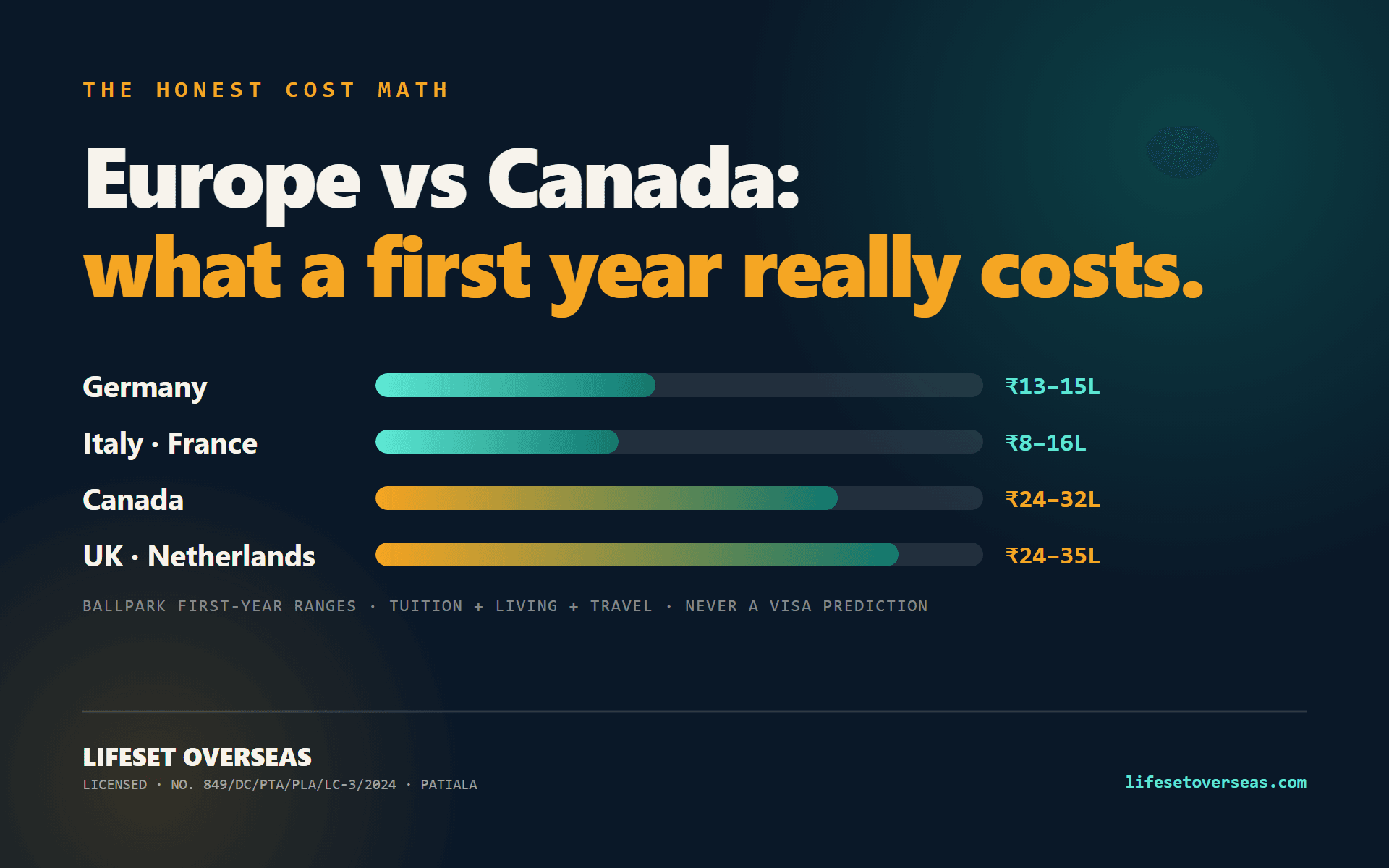
- In INR: approximately 27-29 lakh (excluding refundable Sperrkonto).
Italy — typical Indian applicant, 2-year public-university Masters
- Tuition (income-tested at EUR 2,000/year average): EUR 4,000.
- Living costs (24 months × EUR 900): EUR 21,600 (using Bologna / Padova / Pisa as reference).
- Health insurance (24 months × EUR 100): EUR 2,400.
- Visa + Dichiarazione di Valore + Permesso di Soggiorno: ~EUR 250.
- Travel + initial settlement: ~EUR 1,500.
- Total 2-year outlay: ~EUR 29,500-31,000.
- In INR: approximately 27-28 lakh.
The two are within ~5-10% of each other for a typical 2-year public-university Masters. Germany's tuition advantage is offset by the Sperrkonto liquidity requirement and slightly higher living costs. Italy's slightly higher tuition is offset by lower living costs and simpler upfront finances.
Post-study reality
Germany
- 18-month post-study job-search residence permit (the Aufenthaltserlaubnis zur Arbeitsplatzsuche) — among the most generous in Europe.
- Strong English-friendly tech / engineering / pharma sector in Berlin, Munich, Frankfurt, Hamburg, Stuttgart.
- Pathway to EU Blue Card and permanent residence within 2-4 years for skilled graduates.
- We do NOT process German work permits — those are MEA Recruiting Agent territory.
Italy
- 12-month post-study residence permit for job-search (Permesso di Soggiorno per attesa occupazione).
- Labour market more limited for non-Italian-speaking graduates. Tech / engineering sector smaller than Germany's. Design / fashion sector strong but very specific.
- Pathway to permanent residence after 5 years (slower than Germany's Blue Card track).
- Again, we do NOT process Italian work permits.
Quality-of-life factors
- Climate: Italy significantly warmer year-round than Germany. Indian applicants from northern India may adapt to either; applicants from southern India typically find Italy easier.
- Indian community: Germany has larger Indian student community (especially Berlin, Munich, Stuttgart, Frankfurt). Italy's Indian community is smaller and concentrated in Milan and Rome.
- Food: Both countries have growing Indian restaurant scenes; Germany somewhat more developed for Indian groceries.
- Travel within Europe: Both excellent for weekend / vacation Schengen travel.
How to decide for your profile
Honest framework:
- What discipline? Engineering / CS / STEM → Germany. Design / Fashion / Architecture / Classics → Italy. Business / Economics → Either at top schools. Medicine → Italy is more accessible.
- English-only or willing to learn German/Italian? If English-only, both countries work for Masters but Italy's English-medium catalogue is slightly wider in some fields.
- Liquidity for Sperrkonto? Germany requires ~EUR 12,000 parked in a German blocked account. If that's a stretch, Italy is the easier path.
- Post-study work intent? Germany has stronger post-study work outcomes for skilled graduates. Italy weaker outside design/fashion/tech sectors.
- Climate / cultural fit? Personal preference matters more than people admit.
For most Indian applicants targeting engineering or technical Masters, Germany is the stronger choice despite the heavier paperwork.
For most Indian applicants targeting design, fashion, architecture, humanities, or medicine, Italy is the stronger choice.
For applicants targeting business / economics, both countries have strong options — the specific school matters more than the country.
How Lifeset can help
We handle both German and Italian student visa pathways for Indian applicants:
- Germany: APS coordination in Delhi, uni-assist application support, Sperrkonto provider comparison, language strategy, VFS Germany submission, on-arrival Anmeldung + Aufenthaltstitel briefing.
- Italy: Universitaly pre-enrolment support, Dichiarazione di Valore coordination at the Italian Embassy, financial-proof strategy, VFS Italy submission, on-arrival Permesso di Soggiorno briefing.
- Honest comparison — we will run your profile, programme list, and budget through both countries and tell you which is the higher-probability fit.
We do not process work permits for either country. The German Opportunity Card / Blue Card and Italian work-permit routes are outside our licensed scope.
We are a licensed visa consultancy at Shop No. 2, near PRTC Workshop, Nabha Road, Patiala 147001, Punjab — Licence No. 849/DC/PTA/PLA/LC-3/2024. Book a free 30-minute assessment — we will compare both pathways for your specific profile.