
 Germany visa guide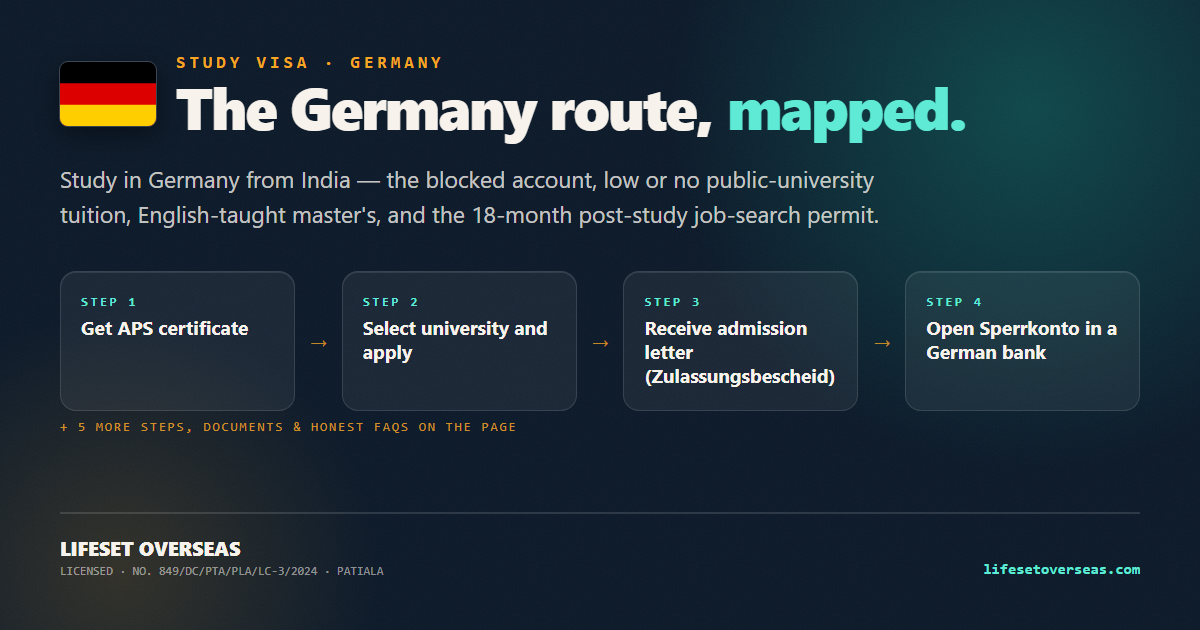
Germany study — world-class engineering at often-zero tuition
Germany is one of the largest international study destinations on the planet, and uniquely combines genuine world-class technical universities with near-zero tuition at public institutions. TU Munich, RWTH Aachen, KIT Karlsruhe, TU Berlin, TU Dresden, Heidelberg, Munich Ludwig-Maximilian — most charge only a semester contribution (Semesterbeitrag) of EUR 150-350 for international students. The state of Baden-Württemberg charges non-EU students EUR 1,500 per semester at its publics, and in Bavaria some universities, including TU Munich, now charge non-EU students tuition, so check your university before you budget.
The trade-off is preparation. Germany has the most documentation-heavy student visa system among the major Schengen destinations — a mandatory APS verification, the Sperrkonto blocked-account requirement, language proof in German or English, and a careful staged application process. We walk Indian students through the full pathway.
APS verification — Germany's mandatory pre-application step
The Akademische Prüfstelle (APS) — the Academic Evaluation Centre run jointly by the German Embassy and the DAAD — is mandatory for nearly all Indian applicants for German university admission. APS verifies your academic documents (10th, 12th, degree transcripts), conducts an interview to confirm authenticity, and issues a certificate that German universities require as part of the admission application.
The APS office is in New Delhi — there is no other office in India. Applications are submitted via the APS Online portal. The process takes four to six weeks from submission to certificate issuance, including the in-person interview. Some programmes accept the APS Interview Receipt for application, with the certificate following — but most German universities want the full certificate.
For applicants entering through Studienkolleg (the preparatory year for those whose 12th-grade qualification doesn't directly qualify for German Bachelor admission), APS issues a "Schule" stream certificate. For degree-holders, APS issues the standard university stream certificate.
uni-assist and Anabin — university selection
The Anabin database (anabin.kmk.org) is the official German registry of recognised foreign institutions. Before applying anywhere, check your Indian undergraduate institution's recognition status on Anabin — H+ status means recognised, H- means not. This affects whether your degree qualifies for German Masters admission directly.
Many German universities use uni-assist — a centralised application processing service — for international applications. You submit transcripts, language certificates, motivation letter, and CV through uni-assist, which evaluates your file against German standards and forwards qualifying applications to your selected universities. uni-assist charges EUR 75 for the first university and EUR 30 for each additional university. Some universities apply directly without uni-assist (TUM, RWTH for Masters in many programmes) — check each programme.
Sperrkonto — Germany's blocked-account requirement
The Sperrkonto (blocked account) is Germany's distinctive financial-proof mechanism for student visas. You open an account with a recognised German provider (Deutsche Bank, Expatrio, Fintiba, Coracle are the most-used among Indian students) and deposit the prescribed annual amount before the visa application. The funds are then released to you in equal monthly instalments after you arrive in Germany.
For the 2024-25 academic year, the required amount is EUR 11,904 (EUR 992 per month for 12 months — tracking the BAföG rate). This is updated annually by the German government. The Sperrkonto confirmation letter from your provider is a critical visa document.
Sperrkonto providers each have small differences in account-opening fees (EUR 50-150 one-time), monthly maintenance fees (EUR 0-5), and ancillary services (some bundle health insurance). We help students compare options and open accounts efficiently.
Language requirements
For German-medium programmes: DSH-2 or DSH-3, or TestDaF with 4-5 across all four sections (reading, listening, writing, speaking). Goethe-Institut C1/C2 certificates are also widely accepted. Programme-specific minimums vary.
For English-medium programmes (now widespread at Masters level — particularly in engineering, business, and sciences): IELTS 6.5 with no band below 6.0, or TOEFL iBT 88-100. Some elite programmes (TU Munich, RWTH for selected programmes) want higher.
The student visa — long-stay national D
The German student visa is a national long-stay D visa, distinct from the Schengen short-stay Type C. It's valid for 3 months for entry into Germany, after which you must convert it into a residence permit (Aufenthaltstitel).
Where you submit depends on your residential jurisdiction. For the New Delhi jurisdiction (which covers Punjab), VFS New Delhi accepts master's, PhD and scholarship students, TestAS holders with 100+ points and bachelor's students with more than 90% in Class 12; bachelor's students below 90% book through the VFS helpline and are seen at the German Embassy itself. The German national visa fee is EUR 76 (INR 8,500). The decision typically takes 6-12 weeks from submission. Allow a 5-6 month total runway: APS 4-6 weeks, uni-assist application and admission 6-10 weeks, Sperrkonto and insurance 2 weeks, then 6-12 weeks for the visa.
Aufenthaltstitel — residence permit on arrival
After arriving in Germany on the D visa, you must:
- Within 14 days, complete your Anmeldung (residence registration) at the local Bürgeramt. This gives you the Meldebescheinigung, which is required for nearly every subsequent step.
- Within 90 days (before the D visa expires), apply at the Ausländerbehörde (foreigners' office) for the Aufenthaltstitel — the residence permit for study, valid typically for the full study period.
Many German university towns have first-week orientation that walks new students through these steps. We brief every Indian student in detail before departure so the post-arrival checklist is clear.
Top German universities for Indian applicants
- TU Munich (TUM) — engineering, computer science, natural sciences. Has a US-style elite-research orientation.
- RWTH Aachen — Germany's premier engineering university, particularly strong in mechanical, electrical, and computer engineering.
- KIT Karlsruhe — KIT (Karlsruhe Institute of Technology), Germany's MIT analogue. Engineering and physics dominant.
- TU Berlin — strong engineering and computer science, in the capital.
- Heidelberg University — Germany's oldest university; medicine, life sciences, humanities.
- LMU Munich — Ludwig-Maximilian, broad academic university with strong humanities, sciences, business.
- TU Dresden — engineering and computer science, strong AI and microelectronics research.
- University of Stuttgart — engineering, automotive-industry links.
How we can help
We are a licensed visa consultancy based in Patiala, Punjab. We handle German student visa pathways end-to-end: programme shortlist matched to your profile, APS application coordination in Delhi, uni-assist and direct-application support, Sperrkonto provider comparison and account opening, language-proof strategy, VFS Germany submission, and on-arrival Anmeldung and Aufenthaltstitel briefing. One consultant from first consultation to landing in Germany. We do not handle the EU Blue Card, Opportunity Card, or any post-study work permit — those require an MEA Recruiting Agent licence we do not hold. Book a free 30-minute assessment.
Official sources
- Federal Foreign Office — Visa service: https://www.auswaertiges-amt.de/en/visa-service
- VFS Global India — Germany: https://visa.vfsglobal.com/ind/en/deu
Fees and rules change; the official page always prevails. The guide above was written from our filing experience for Indian applicants; check the current requirements on the authority’s site before you book.
Verified figures for Germany
What a year in Germany costs — and what you must prove
- Public-university tuition, non-EU student, per year
- €0 – €12,000
- Funds the visa authority asks you to show
- €11,904 a year
English-taught courses: widely available. Varies by university and programme
Most public universities charge nothing. Baden-Wuerttemberg (Heidelberg, KIT, Stuttgart) charges EUR 1,500 a semester, and TUM charges its own fees of up to EUR 6,000 a semester for a master's.
Read on the official pages below on 27 Aug 2026. Figures change every academic year — check them before you pay anything.
Where Germany stands among the 29 Schengen study countries
Computed from verified figures
Germany is one of 4 Schengen countries where a non-EU student can study at a public university without tuition at the floor rate — the facts card above shows whether that extends to English-taught courses. The living-cost proof the residence permit asks for works out to about €992 a month, which ranks 17th-lowest of the 23 countries that publish a monthly or yearly figure. English-taught programmes are widely available — Germany is one of 18 Schengen countries where that is true, so the language of instruction is not the filter it is elsewhere.
Closest on tuition: Czech Republic and Iceland. Compare all 29 side by side on Study in Europe.
