How Much Bank Balance Do You Need for a Schengen Visa from India? (2026)
There's no single official bank-balance figure for a Schengen visa from India — each country sets its own daily means, and how long your money has been in the account matters more than the number itself.
"How much bank balance do I need for a Schengen visa?" is the question we hear most from Indian applicants — and the honest answer surprises people: there is no single official number. Each of the 29 Schengen countries sets its own daily "means of subsistence," and the figure that actually gets you refused is rarely the amount. It's how that money got into your account. This guide gives you honest ranges, the one fixed rule that never changes, and the funds mistake that quietly sinks otherwise-good files.
Schengen funds
The number isn't the problem. The story behind it is.
Each Schengen country sets its own daily means — but a balance that appeared last week reads as borrowed, not yours.
Why there is no single "Schengen balance" figure
The Schengen visa is one sticker, but it is issued by individual member states under the EU Visa Code. Funds are assessed against each country's published daily "means of subsistence" — the amount an officer expects you to have available per day of your stay. That figure is set nationally, so France, Italy, Germany and Spain do not all expect the same daily sum.
The rule of thumb that actually matters: you must be able to show enough to cover your whole trip, day by day, after subtracting anything already prepaid. If your hotel and flights are paid in full, the daily figure an officer wants to see is lower, because you only need food, local transport and incidentals. If nothing is prepaid, you need to cover accommodation too — and the daily expectation rises.
Honest daily ranges by country
These are realistic ranges drawn from how member states publish their daily means — not fixed quotes. Daily expectations are typically lower when your accommodation is already paid, and higher when it isn't. Always confirm the current figure on your destination consulate's site or France-Visas before you file.
France
≈ €65–€120
per day
Lower (~€65) if accommodation is prepaid; higher if not. Confirm on France-Visas.
Germany
≈ €45–€55
per day
Germany publishes a relatively modest daily figure — verify on the German mission site.
Italy
≈ €45–€110
per day
Tiered — short trips per-day rate is higher than longer stays. Check the Italian consulate.
Spain
≈ €100/day
with a per-trip minimum
Spain also sets an overall minimum per applicant. Confirm on the Spanish consulate site.
You can estimate your visa and service costs first with our visa fee calculator so the funds conversation starts from real figures, not guesses.
The one number that IS fixed: insurance
Daily means vary, but travel medical insurance does not. Every Schengen visa requires travel medical insurance valid across the whole Schengen area with a minimum coverage of €30,000, covering emergency medical treatment and repatriation for the full duration of your stay. This is set by the EU Visa Code and is the same for every member state — there is no negotiating it down.
Travel medical insurance — minimum cover
€30,000
Source: EU Visa Code (uniform across all Schengen states)
A policy that falls even slightly short of €30,000, or that doesn't cover every day of your itinerary, is a clean, avoidable refusal ground. Buy a policy that explicitly states "Schengen-compliant, €30,000, valid in all Schengen states."
Seasoning beats size: the real funds test
Here is what separates approved files from refused ones. Officers are not just checking how much — they're checking whether the money is genuinely yours and reliably available. A large balance that landed in your account a few days before you applied looks exactly like what it often is: a sum borrowed or arranged to "pass" the visa, then returned afterwards. Under Article 32 of the Visa Code, that triggers the "means of subsistence not reliable" ground.
Looks borrowed
6 months beforeApply day
A flat account, then a sudden jump right before applying. The officer reads this as money arranged only for the visa.
Looks genuine
6 months beforeApply day
A balance that climbs steadily for months. It quietly proves the family planned ahead — and the money is truly theirs.
Same balance on apply day · very different story
A balance that built up gradually — salary credits, regular savings, steady inflows over three to six months — tells a calm, believable story. A flat line that suddenly spikes does the opposite.
What reads as borrowed
A lump sum deposited days before you applied
A round-figure transfer with no source explanation
A balance that exactly equals the minimum, to the euro
Statements showing a near-empty account until last week
What reads as genuine
Funds that accumulated over three to six months
Regular salary or business credits you can document
Comfortable headroom above the minimum, not the exact floor
A clear paper trail for any one-off large credit (sale, bonus, gift)
What the officer actually weighs
How a Schengen officer reads your funds
AmountDaily means × nights, minus prepaid costs
Covers the whole trip, day by day
SeasoningThe single biggest funds red flag
Built up over months, not days
SourceAny spike needs a paper trail
Salary, business, documented gifts
InsuranceFixed — no exceptions
€30,000 Schengen-wide
Ties to IndiaFunds support intent to return, not just to travel
Job, family, assets, return reason
Confirm exact figures on your destination consulate / France-Visas
Notice the last row. Funds are never assessed in isolation — they sit alongside your ties to India and your reason to return. Strong funds with weak ties can still be refused; the money is evidence that you'll fund the trip and come home, not just that you can afford to leave.
“
A refusal on funds is rarely about how much you had. It's about whether the officer believed it was really yours.
Lifeset Overseas
If you were already refused on funds
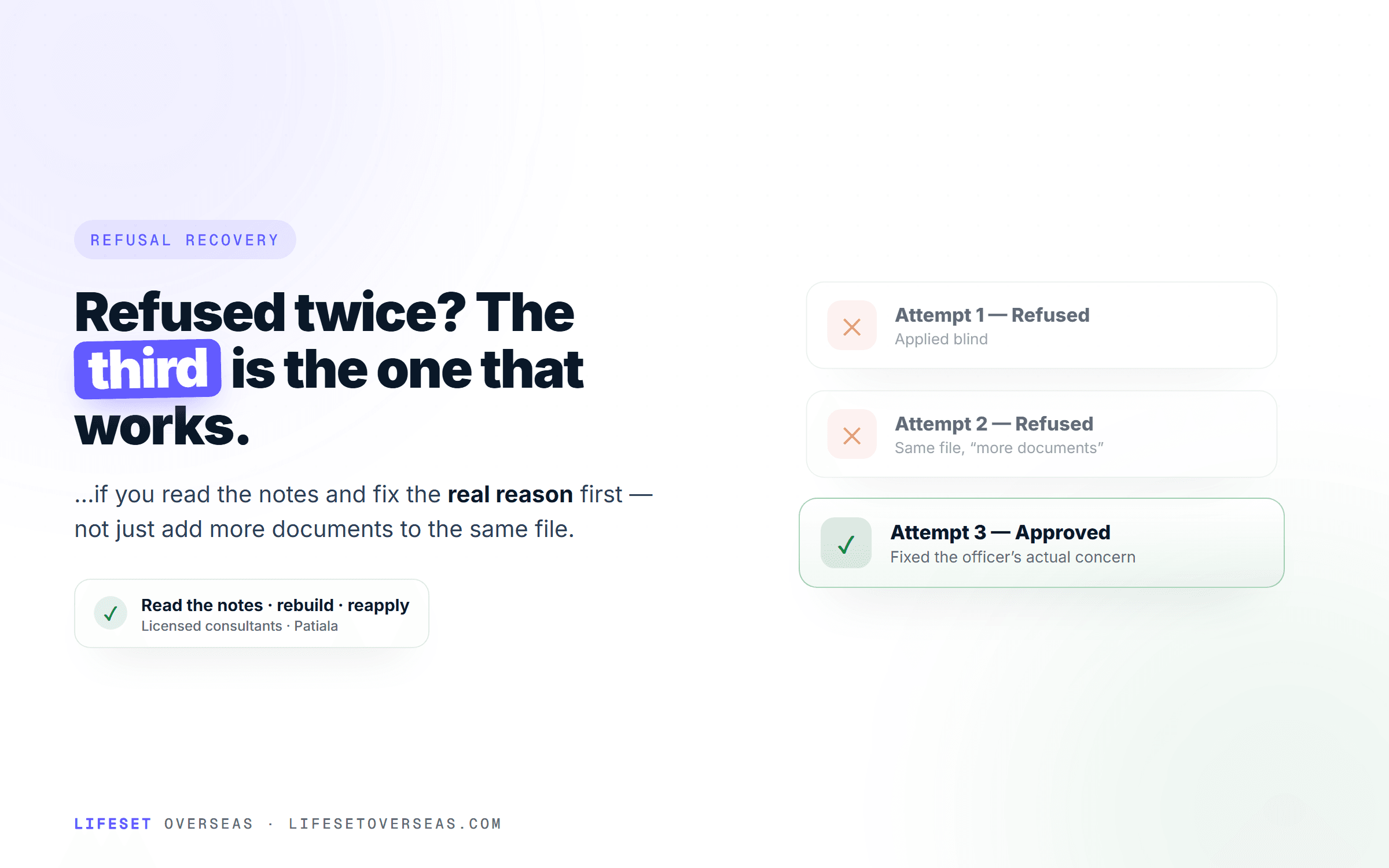
A Schengen refusal letter cites the specific Article 32 grounds — and "justification for the purpose and conditions of the stay was not provided" or "means of subsistence not reliable" are among the most common for Indian applicants. Don't reapply the next week with the same statements. Read the exact ground, fix the weak point, and let the account season before you file again.
1
Read the exact ground
Find the ticked Article 32 reason on your refusal letter — funds, insurance, intent, or documentation.
2
Let the money season
Give the balance three to six months of genuine, documented activity before reapplying.
3
Document every inflow
Attach proof for salary, business income and any large one-off credit.
4
Rebuild, then reapply
Resubmit a stronger, slower-built file — not the same one with a fresh date.
If your last attempt failed, our Schengen refusal guide walks through each Article 32 ground and how to answer it.
Frequently asked questions
Is there an official minimum bank balance for a Schengen visa?
No. There is no single EU-wide figure. Each Schengen country publishes its own daily "means of subsistence," and you must show enough to cover your whole trip at that daily rate, minus anything prepaid. Always confirm the current figure on your destination consulate's site or France-Visas before you apply.
How many months of bank statements should I submit?
Most consulates ask for the last three to six months. This window exists precisely to test seasoning — it shows whether your funds built up genuinely or appeared suddenly. Submit the full requested period, not a single recent page.
Will a large deposit just before applying get me refused?
It can. A sudden lump sum with no documented source is a classic "means not reliable" trigger under Article 32. If a large credit is genuine — a bonus, sale or gift — attach proof of where it came from. An explained spike is fine; an unexplained one is a risk.
Does prepaying my hotel reduce how much balance I need to show?
Yes, in effect. If accommodation and flights are already paid, the daily figure an officer expects you to hold is lower, because you only need to cover food, local transport and incidentals. Keep the prepaid receipts to prove those costs are already settled.
Is the €30,000 travel insurance amount the same for every country?
Yes. Unlike daily funds, the €30,000 minimum medical coverage is fixed by the EU Visa Code and applies uniformly across every Schengen state. Make sure the policy is valid in all Schengen countries and covers every day of your stay.
Funds questions almost never have a one-line answer — they depend on your country, your trip length and how your account actually looks. The best first step is to find out exactly where your file stands. Start with our ₹499 Visa Risk & Approval Report (refundable, credited if you go on to file with us), and if you've already been refused, get targeted Schengen refusal help before you reapply.
What to do next
Refusal Analysis
Schengen refusal? Refusal Analysis reads your letter, names the documented concern behind it and tells you honestly whether reapplying appears reasonable — from ₹1,499 all-in · GST included.
We never predict an outcome or promise a visa. We tell you what your file says and what can be fixed.
Talk to a consultant about your case
Read this article? Now tell us about your situation.
We’ll WhatsApp you within 4 working hours with an honest read on your file and the realistic next steps. Licensed, fixed-fee, and one consultant from first call to decision.
Read the article? Message us on WhatsApp with your situation — a consultant from our Punjab-licensed consultancy gives you an honest read and the next step.