Refused Twice? The Third Application Is the One That Works — If You Do This First
Two Canada refusals in a row is a pattern, not bad luck. Here is how to read the officer's actual concern, fix THAT, and only reapply when your profile has genuinely changed.
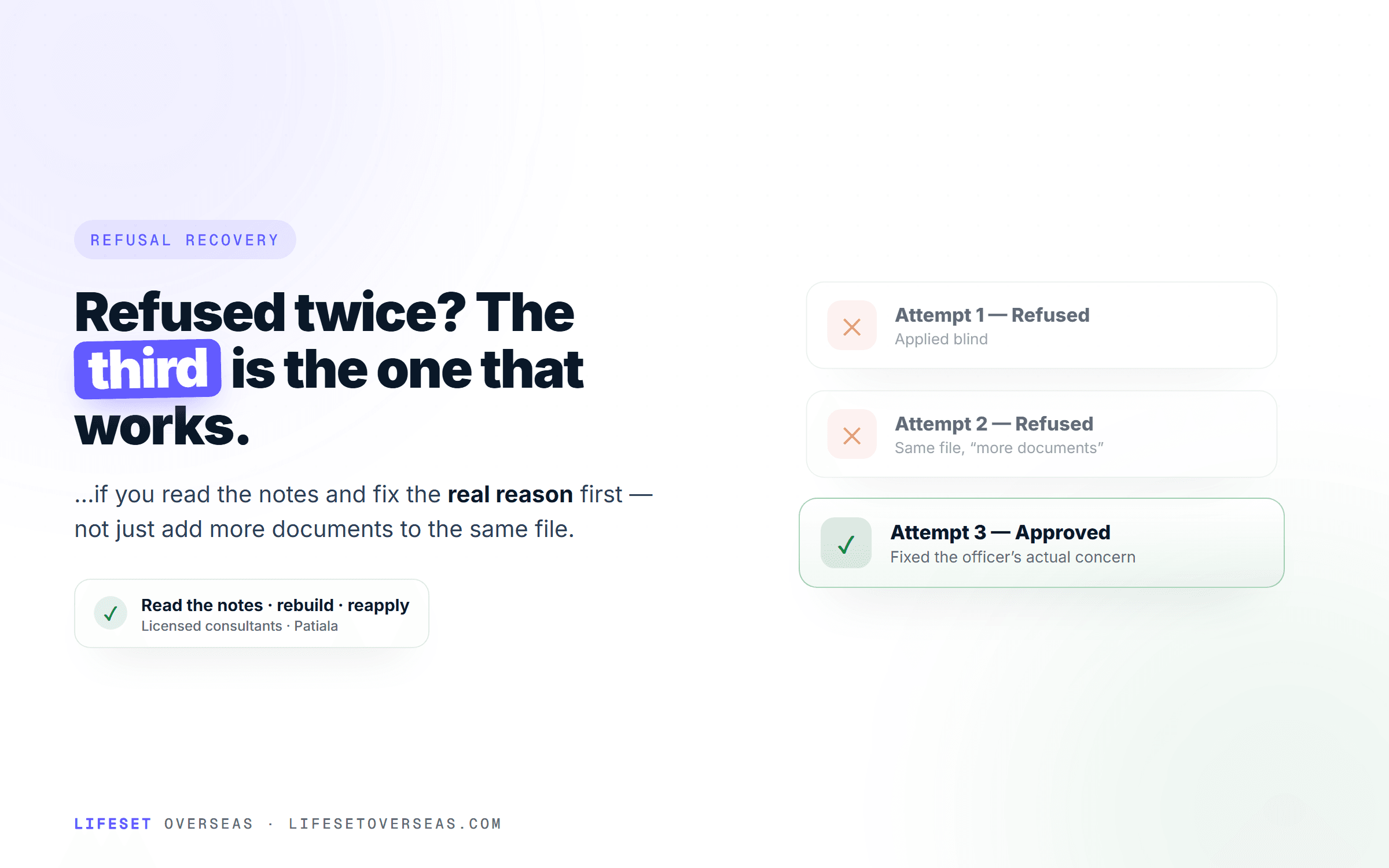
Two refusal letters in a row feel like a wall. The same generic paragraphs, the same tick-box, the same sinking feeling when the email lands. And here is the honest truth most agents in the market won't tell you: if your third application looks like your first two with a few extra papers stapled on, the officer will very likely say no again.
A refusal is not a lottery you keep re-entering until your luck turns. It is a decision, written by a real person, for a reason. The third application works when — and only when — you find that reason and fix that one thing. Let's walk through how to do it properly, the way we do it for walk-in families at our Nabha Road office in Patiala.
The mistake almost everyone makes on the third try
After a second refusal, the instinct is to fight back with volume: more bank statements, more property papers, more affidavits. It feels like effort. It rarely is progress. Here are the three traps we see most often across Patiala, Rajpura, Nabha and Sangrur.
1
Reapplying blind
You never ordered the officer's notes, so you are guessing at what went wrong. A refusal letter only ticks broad boxes — "purpose of visit", "personal assets and financial status". The actual reason is written in the internal notes, and without it you are treating a headache you haven't diagnosed.
2
'More documents' as a strategy
Adding thirty more pages to a file that was refused for a weak reason does not fix the weak reason — it buries it. If funds looked unexplained, ten more statements from the same account change nothing. Officers read for credibility, not weight.
3
Contradicting your own past file
Your new SOP says the course is a career turning point; your first file said something different. IRCC can see every application you have ever filed. A fresh story that clashes with the old one reads as coached, and consistency collapses.
Step zero: order your GCMS notes and actually read them
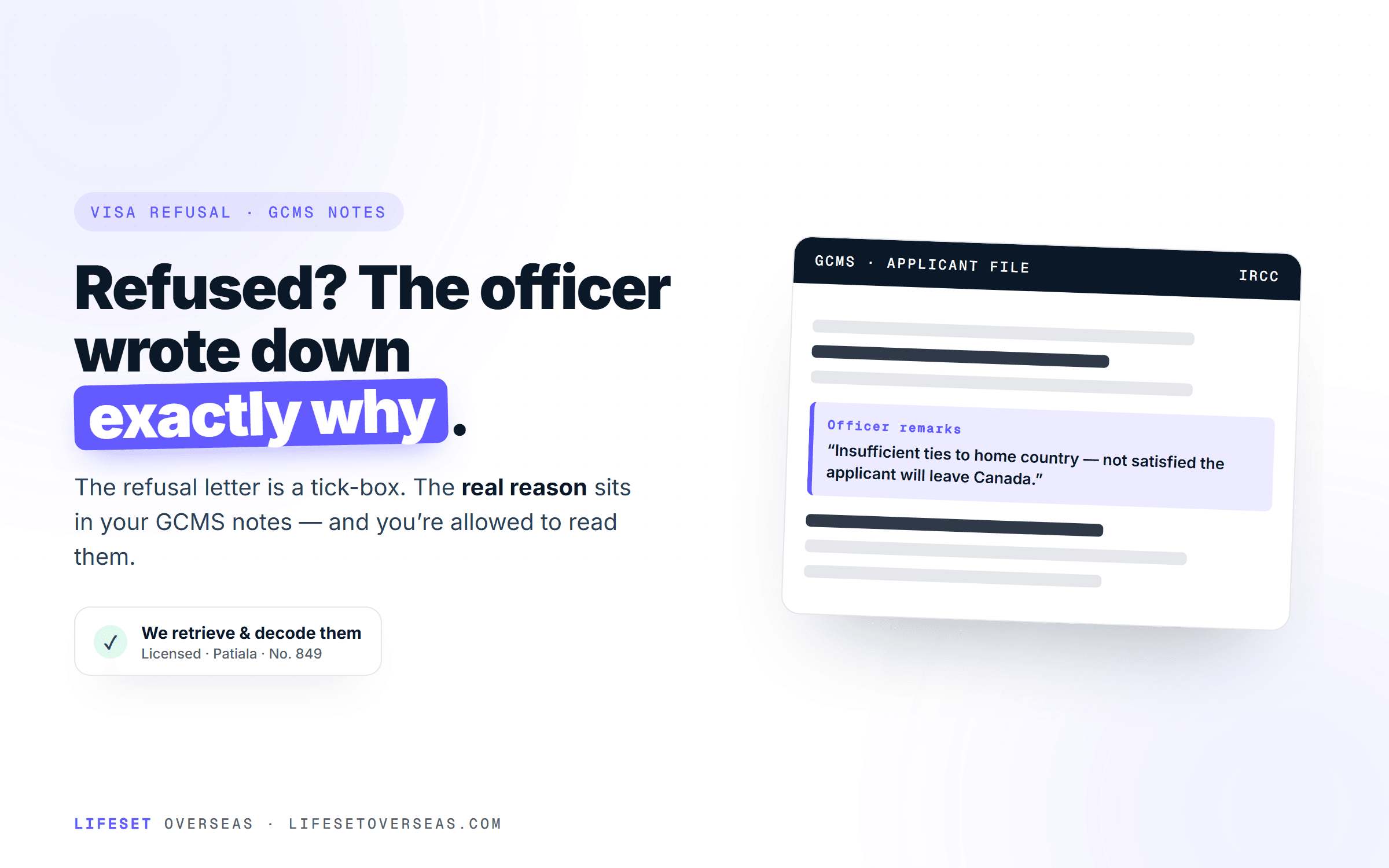
Before you write a single word of a new application, get the officer's notes. For Canada these are your GCMS notes (Global Case Management System — the successor to the old CAIPS system). They are requested from IRCC under the Access to Information Act, and they contain the officer's own remarks: what they doubted, which document didn't convince them, sometimes the exact line that sank the file.
GCMS notes — government fee
→
CAD $5
Source: IRCC, requested under the Access to Information Act (ATIP)
When the notes arrive, read them with a cool head. Look for the phrases officers reuse: "not satisfied applicant will leave Canada at the end of authorized stay", "purpose of visit not consistent with a temporary stay", "funds appear insufficient / source not established", "study plan not reasonable given profile". Those lines are not insults. They are a map. We help clients decode their own notes at our Patiala office every week — see our GCMS/CAIPS notes service for how that read-through works.
The four concerns behind most Canada study and visitor refusals
Almost every study-permit and visitor-visa refusal traces back to one (or a mix) of four things. Once you know which one is yours, the rework becomes obvious.
CAD $23,448
Proof of funds, single student
Outside Quebec, from 1 Sep 2026
CAD $150
Study permit application fee
Base fee per applicant, excl. biometrics
CAD $100
Visitor visa (TRV) fee
Per applicant, max CAD $500/family
Ties to home country. The officer isn't convinced you'll return. Property, a family business, a job to come back to, dependent parents — these are your anchors. A student from a farming family near Nabha has real ties; the file just failed to show them clearly.
Funds credibility. Not "do you have money" but "is this money real, yours, and explainable?" A study-permit applicant must show living costs on top of tuition — currently CAD $23,448 for a single student outside Quebec, effective 1 September 2026. A large deposit that appeared last month with no trail reads as arranged. Seasoned funds with a clear source read as genuine.
Purpose and study plan (the SOP). A weak or generic statement of purpose is the single most common study-permit killer. If your SOP could belong to any of a thousand Punjab students, it convinces no one. This is worth doing properly — SOP writing is where a lot of third applications are won or lost.
Consistency. Dates, names, course names, and your story must line up across every form, letter and past file. One mismatched employment date can unravel the whole thing.
The right way to reapply — a five-step method
1
Diagnose from the notes, not from a guess
Match each line in your GCMS notes to one of the four concerns above. Write the officer's real objection in one sentence. If you can't, you're not ready to reapply.
2
Fix THAT concern — not everything else
If the issue was funds credibility, build a clean, sourced, seasoned money trail. If it was ties, gather genuine evidence of what pulls you home. Resist the urge to "improve" parts that were never the problem.
3
Rebuild the SOP around the real objection
Address the doubt head-on. If the officer questioned why a B.Com graduate wants a diploma in supply-chain management, answer exactly that — with a specific, believable career logic tied to your background.
4
Cross-check against your old files
Pull your previous applications and make sure nothing in the new one contradicts them. Where facts changed (a new job, a marriage, a completed degree), show the change openly rather than hoping no one notices.
5
Only submit when the profile has genuinely changed
If nothing material is different from the last refusal, a new fee and a new date won't help. Submit when you can point to a real, documented change the officer will see.
Reapply now, wait, or change pathway?
This is the part honest consultancies say out loud and salesy ones skip. Sometimes the right move after two refusals is not to reapply this month.
The same file, more paper
Same funds, same account, just more statements.
A re-worded SOP that still dodges the officer's real doubt.
Reapplying within weeks with nothing materially new.
Hoping a different officer sees it differently.
A profile that genuinely changed
Funds now seasoned, sourced and clearly explained.
An SOP that answers the exact objection in the notes.
New, real ties: a completed degree, a job, a business, a marriage.
A pathway that actually fits — sometimes a stronger course, level or intake.
Sometimes the honest advice is: wait a few months and season the money properly. Sometimes it's: finish the degree you're mid-way through so your profile is stronger. Occasionally it's: this particular course-and-college combination will keep drawing doubt, and a different, better-matched programme is the smarter path. And in some cases a visitor visa is genuinely the wrong door and a study route is the right one — or the reverse. Changing pathway is not defeat; reapplying into the same wall is.
“
The third application isn't stronger because it's thicker. It's stronger because it answers the one question the officer actually asked.
Sherbir Grewal, Director & Senior Consultant, Lifeset Overseas
And to be completely clear: no consultant, agent or lawyer can guarantee your visa. Anyone who does is selling you something. The decision belongs to the visa officer, every single time. What we can do is make sure the file finally answers the real objection — honestly, and in your own true story.
Frequently asked questions
Does ordering GCMS notes hurt my chances of reapplying?
No. Requesting your notes is a routine, legal information request under the Access to Information Act and does not go on any "record" against you. It simply lets you see the officer's reasoning so your next application is targeted instead of blind. It is one of the smartest things you can do after a refusal.
How long should I wait before reapplying to Canada?
There is no fixed waiting period — you can technically reapply immediately. But the useful question is not "how soon" but "has anything actually changed?" If your GCMS notes are still pending or your profile is identical to the refused one, wait until you have the notes and a genuine improvement. Rushing an unchanged file just buys another refusal at the same fee.
Can I reapply immediately after a second refusal?
Yes, there is no legal bar to reapplying, and each application is assessed on its own merits. But immediacy is not a strategy. Reapply once you have read the notes, fixed the specific concern, and can show the officer something materially new — not before.
Are two refusals enough to get me 'banned' from Canada?
Two refusals alone do not create a ban. A refusal is different from a misrepresentation finding — the latter (for false documents or lies) can lead to a multi-year inadmissibility. This is exactly why honesty and consistency across files matter so much: a genuine third application is fine; a fabricated one is dangerous.
Should I switch from a study permit to a visitor visa after two study refusals?
Not automatically. They are assessed on different tests — a study permit weighs your study plan and funds, a visitor visa weighs the genuineness of a temporary visit. Switching to dodge a study-plan problem often creates a new "purpose of visit" problem instead. Change pathway only when the new route genuinely fits your real intention, not as a workaround.
Can Lifeset Overseas guarantee my third application will be approved?
No — and we will never say otherwise. Approval is the visa officer's decision alone. What a licensed consultancy can honestly offer is a proper read of your GCMS notes, a file that addresses the real concern, and a candid opinion on whether you should reapply, wait, or change course.
If you've been refused twice for a Canada study permit or visitor visa, the next step is simple: get the notes, and get an honest second opinion before you spend another fee. Start with our GCMS/CAIPS notes service, see how we approach a Canada visa refusal, or strengthen the piece that most often decides it with SOP writing. You can also read more on the Canada study visa route.
Walk in to our Patiala office — Shop No. 2, near PRTC Workshop, Nabha Road — or WhatsApp / call us on +91 91155 80911. We advise in Punjabi, Hindi and English, and we'll tell you plainly whether the third application is worth filing yet.
We never predict an outcome or promise a visa. We tell you what your file says and what can be fixed.
Talk to a consultant about your case
Read this article? Now tell us about your situation.
We’ll WhatsApp you within 4 working hours with an honest read on your file and the realistic next steps. Licensed, fixed-fee, and one consultant from first call to decision.
Read the article? Message us on WhatsApp with your situation — a consultant from our Punjab-licensed consultancy gives you an honest read and the next step.