 Canada visa guide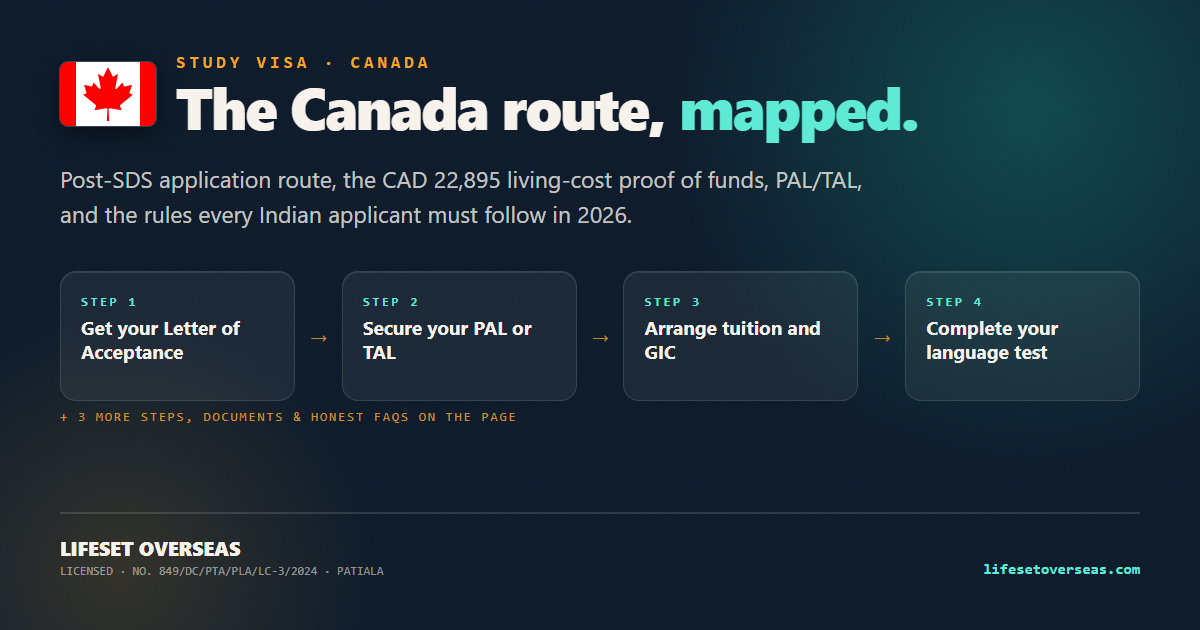
What a study permit is: and who needs one
A study permit is a temporary resident document issued by Immigration, Refugees and Citizenship Canada (IRCC). It authorises a foreign national to study at a Designated Learning Institution (DLI) in Canada. Anyone planning to study for more than six months must hold a valid study permit before classes begin.
Important distinction: the permit itself is not a visa. It only authorises study. Travellers from visa-required countries, including India, are also issued a Temporary Resident Visa (TRV) alongside the permit once the application is approved. For travellers from visa-exempt countries an Electronic Travel Authorization (eTA) is issued instead.
The current application landscape (post-SDS)
IRCC closed the Student Direct Stream (SDS) and the Nigeria Student Express (NSE) on 8 November 2024. Applications submitted after that cutoff are no longer processed through the 20-day SDS fast-track.
What this means in practice: every applicant, regardless of country, now applies through the regular study permit stream. Processing is slower and less predictable than the old SDS target, and there is no country-based fast lane. Build your timeline around that reality: apply as early as your programme allows, and do not commit travel bookings until you have the approval in hand.
Proof of funds: the living-cost amount
For applications made on or after 1 September 2026, a single applicant outside Quebec must show CAD 23,448 for living costs (it was CAD 10,000 before January 2024). A Guaranteed Investment Certificate (GIC) is one accepted way to show it, not a requirement: bank statements, an education-loan sanction or a documented sponsor also work. This is the proof-of-funds minimum for living expenses in the first year, tuition is proved separately. Confirm the current figure on IRCC's website before you open the GIC, as this minimum has moved more than once in recent years.
You open the GIC with a participating Canadian bank and receive an investment certificate. Once you land in Canada and open your local account, the funds are refunded to you in instalments over the first year.
The Provincial or Territorial Attestation Letter (PAL/TAL)
Most undergraduate and college-level applicants now need a Provincial or Territorial Attestation Letter issued by the province or territory where they intend to study. This is an additional gatekeeping step introduced to manage study-permit volume.
From 1 January 2026, Master's and PhD applicants at public designated learning institutions are exempt from the PAL/TAL requirement. Undergraduate, diploma, and private-institution applicants still need one. Your DLI will typically explain how to obtain the attestation once you accept your offer.
Language requirements
You no longer need a specific test like IELTS, CELPIP, TOEFL, PTE, or CAEL to apply: IRCC accepts any English proficiency test that your Designated Learning Institution accepts. In practice most DLIs still require IELTS Academic, TOEFL iBT, or PTE, so your test choice is usually driven by DLI admission requirements rather than IRCC's application form. French-taught programmes accept TEF or TCF.
Core eligibility: a practical checklist
Before you submit an application, you should be able to satisfy the following:
- A valid passport, ideally with at least two years of validity remaining past your intended study period.
- A Letter of Acceptance (LOA) from a Designated Learning Institution. Only DLIs can host international students.
- A PAL or TAL if your programme falls within the requirement (most undergrad and college; exempt for Master's and PhD at public DLIs from 1 January 2026).
- Proof that you have enough money to pay for tuition, living expenses for yourself and any accompanying family members, and return transportation. The headline number: CAD 23,448 for living costs (a GIC is one way to show it), plus first-year tuition and travel proved separately.
- A clean record: no significant criminal history, and no ongoing security concerns.
- Satisfactory health: most applicants from India are required to complete an Immigration Medical Examination (IME) with an approved panel physician.
- A language test result acceptable to your DLI, submitted with the application.
- A statement of purpose that reads honestly: why this programme, why this institution, why now, and a credible plan for after graduation.
The application in practice
A typical application unfolds in this order. Shortlist DLIs and apply to the programme you want, then secure your Letter of Acceptance. Request the PAL or TAL from the province where your institution is located, if required. Open your GIC with a participating Canadian bank and pay your first-year tuition. Take the language test your DLI requires. Book and complete the upfront medical exam with a panel physician. Prepare your statement of purpose, academic transcripts, financial documentation, and ties-to-home-country evidence. Submit on IRCC's online portal, pay the government fees, and provide biometrics at a Visa Application Centre. Receive the decision. If approved, you receive the port-of-entry letter and, if required, the TRV stamped into your passport.
The single most common reason for refusal remains unclear financial documentation. Second most common is a statement of purpose that does not convince the officer of genuine study intent. We spend disproportionate time on those two areas for our clients.
Arrival and the first semester
On arrival, the border officer reviews your port-of-entry letter and issues the physical study permit document. Your study permit automatically includes on-campus work authorisation. A limited number of off-campus working hours per week is also permitted; IRCC has adjusted the weekly cap more than once in recent years, so confirm the current cap before planning on that income.
Refusals and reapplication
If your application is refused, IRCC issues a refusal letter listing the grounds. Common grounds include insufficient funds, weak ties to home country, unclear study plan, and inconsistencies between documents. You can order the GCMS notes for a more detailed picture of the officer's reasoning. A thoughtfully restructured reapplication, with the specific refusal grounds addressed, often succeeds where the first application did not. We handle CAIPS/GCMS retrieval and reapplication strategy as a standalone service.
How we can help
We are a licensed visa consultancy based in Patiala, Punjab. We handle the Canada Study Permit end-to-end under the current post-SDS rules: DLI shortlisting, PAL/TAL coordination, GIC setup, SOP drafting, file preparation, submission, and follow-up. One consultant sees your case from first call to decision, there is no handoff. Book a free 30-minute assessment and we will tell you, honestly, whether this is the right pathway for your profile.
Official checklist: what IRCC's study permit package asks for
From our Knowledge Base (checked against IRCC, 19 September 2026):
- Acceptance letter from a Designated Learning Institution; a Provincial or Territorial Attestation Letter unless an exact exemption applies; Quebec's CAQ where required.
- Passport and identity, your educational history and the study-plan evidence the India checklist requests.
- Proof of tuition, living funds and travel: identifying the sponsor, the relationship, the lawful source and the availability of the money.
- The generated IMM 1294 application, IMM 5707 family information, IMM 5476 if represented, IMM 5409 for a common-law declaration; for minors, parental consent and the custodian declaration IMM 5646 when required.
- Biometrics on instruction and a medical examination where required; translations and any requested police documents.
- Accompanying family apply on their own route with their own forms and fees.
"Usual validity is the programme length plus 90 days; early completion can trigger expiry 90 days after completion notification despite the printed date." Online filing is normal; the paper package linked by IRCC does not mean applicants must file on paper.
Sources: IRCC study permit documents (https://www.canada.ca/en/immigration-refugees-citizenship/services/study-canada/study-permit/get-documents.html); IRCC India application package (https://www.ircc.canada.ca/english/information/applications/student.asp?countrySelect=IN); study permit conditions (https://www.canada.ca/en/immigration-refugees-citizenship/services/study-canada/study-permit/while-you-study.html).
Official sources
- Immigration, Refugees and Citizenship Canada: https://www.canada.ca/en/immigration-refugees-citizenship.html
Fees and rules change; the official page always prevails. The guide above was written from our filing experience for Indian applicants; check the current requirements on the authority’s site before you book.
