UK Visitor Visa Refused from India: Finances, Ties & How to Reapply (No Appeal)
A UK Standard Visitor refusal from India has no appeal — you reapply. Here's how the ECO reads your finances and ties, and how to rebuild a file that gets approved.
A UK Standard Visitor refusal landing in your inbox feels final, but it is not. The hard truth most agents do not explain clearly is that you cannot appeal a visitor refusal from India — you simply prepare a better application and submit again. The good news: once you understand exactly what the Entry Clearance Officer (ECO) doubted, a refusal becomes a checklist of things to fix rather than a closed door.
This guide breaks down the two reasons that drive almost every UK visitor refusal from India — finances and "genuine intention to leave" — and shows you how to rebuild the file so the next decision goes your way.
Refusal recovery
A UK visitor refusal is not a ban. It's feedback.
No appeal, no tribunal — just a stronger second application built on what the officer actually doubted.
First, the fact that changes everything: there is no appeal
For most UK visit visa applicants, there is no right of appeal and no administrative review. The Home Office decision letter says it plainly. This is not a setback — it is direction. Instead of waiting months for a tribunal, you control the timeline: you fix the file and reapply when it is genuinely ready.
No appeal
Standard Visitor refusals
Appendix V
The rules that decide it
Reapply
Your only real route forward
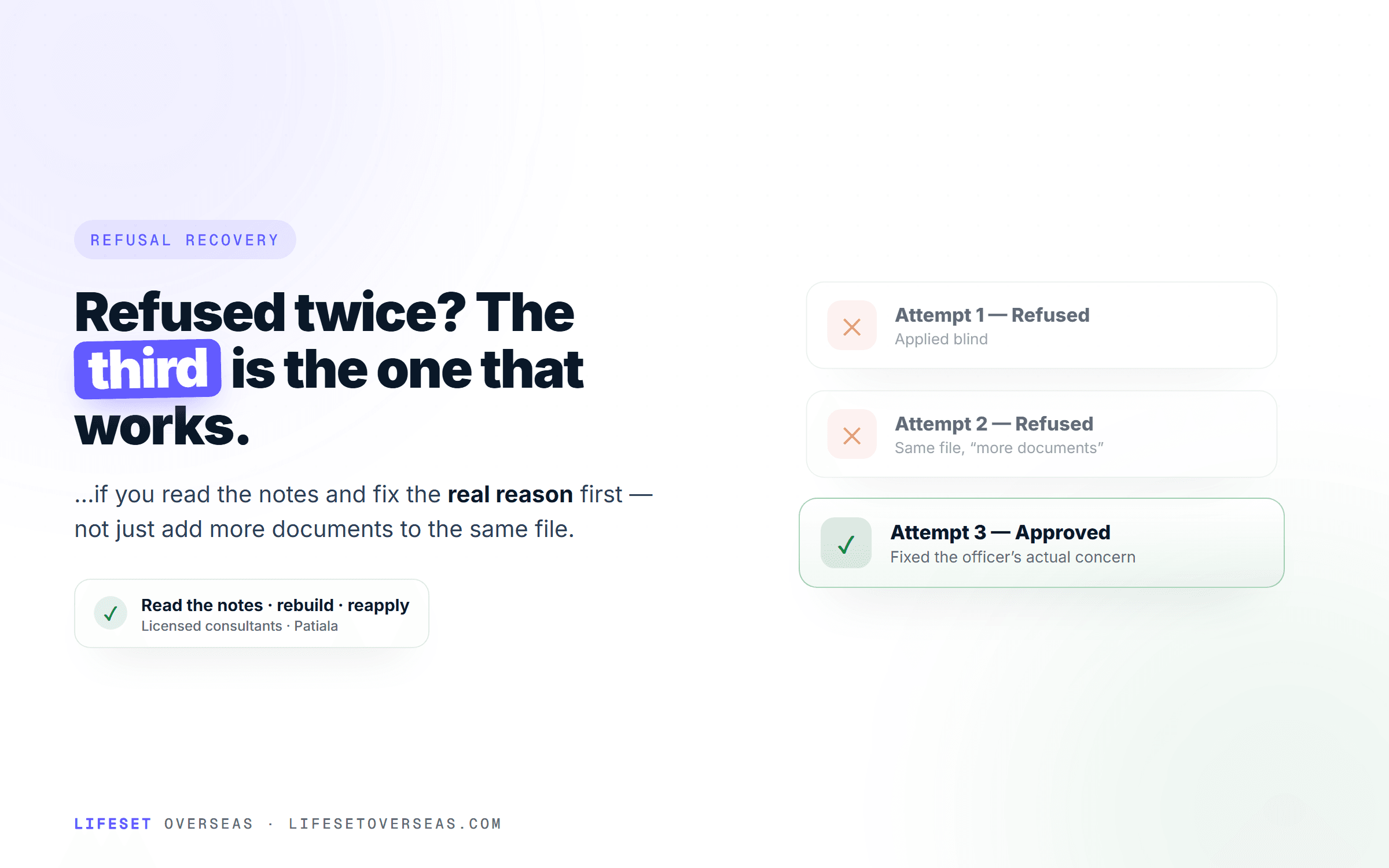
There is no fixed "cooling-off" period for visitors — you can reapply the very next day. But applying again with the same file that was just refused is the single most common mistake, and it almost always earns the same answer. A re-submission only works when something material has changed.
What the ECO is actually weighing
The officer is not looking for reasons to say yes. Under Appendix V (Visitor), they must be satisfied that you are a genuine visitor — that you will leave the UK at the end of your trip, that you can fund it without working illegally, and that your stated purpose is true. Refusal letters from India cluster tightly around finances and intention to return.
What the Entry Clearance Officer checks
Genuine intention to leaveJob, studies, family, property — your reasons to come back
Will you return to India?
FundsNot borrowed or parked just before applying
Genuinely yours and available
Trip purposeItinerary matches stay length and spend
Credible and consistent
Sponsor (if any)Their income and relationship evidenced
Real and able to support you
Immigration historyPast refusals and travel disclosed honestly
No discrepancies or prior breaches
Confirm wording against your own refusal letter and GOV.UK
The phrase you will see again and again is "I am not satisfied" — that finances are genuine, or that you intend to leave. Your whole rebuild is about removing that doubt with evidence.
Finances: the number-one reason files fall apart
This is where most Indian applicants lose. It is rarely that the balance is too low — it is that the money does not look like it is genuinely, reliably yours. A large deposit that appears a week before you apply screams "arranged for the visa," and the ECO is trained to spot exactly that.
“
The officer isn't asking whether you have the money. They're asking whether it's really yours — and whether it'll still be there next month.
Lifeset Overseas
What "genuine funds" looks like
Your bank statements should tell a calm, boring story: regular income landing each month, normal spending, and a balance that grew over time rather than appearing overnight. Six months of clean statements that match your declared income do more than any single big number.
What gets you refused
A large lump sum deposited days before you apply
A balance with no income to explain how it got there
Statements that don't match your stated job or salary
Round-figure transfers in and straight back out
A sponsor with no evidence of their own funds or relationship to you
What gets you approved
A balance that built up steadily over months
Salary or business income credited regularly
Any recent large credit explained with proof (FD maturity, property sale, gift letter)
Funds clearly enough to cover the trip with room to spare
A sponsor's statements, ID and a letter if someone is supporting you
There is no fixed minimum balance published for a UK visitor visa — the test is whether your money credibly covers your trip and your ties at home. For a short holiday from India, plan for funds that comfortably cover flights, accommodation and daily costs with a clear buffer; confirm your specific costs against GOV.UK and your booked itinerary rather than chasing a magic figure. You can sanity-check your end-to-end budget with our visa fee calculator.
Ties to India: proving you'll come back
The second pillar is "genuine intention to leave the UK." The ECO wants evidence that your life is anchored in India — strong enough reasons that staying on illegally would make no sense. This is about your whole picture, not one document.
Strong ties include a stable job with leave approved, a running business, ongoing studies, dependent family who rely on you, and property or assets in your name. Weak or absent ties — no job, no fixed reason to return, vague travel purpose — are what tip a borderline file into refusal.
1
Guessing the refusal reason
Reading "I am not satisfied" and assuming it's about money when it was actually about ties — then fixing the wrong thing.
2
Reapplying the same week
Submitting an identical file in panic. Nothing has changed, so neither does the answer.
3
Leaving discrepancies unresolved
A mismatch between your form, your statements and your travel history is read as a credibility problem — the hardest thing to recover from.
Resolve every discrepancy before you reapply
If the refusal hinted that information did not add up — dates that conflict, a job your statements don't support, an undeclared earlier refusal — treat that as your top priority. A credibility concern is far more damaging than a thin bank balance, because it makes the officer distrust the entire file. Lay out the truth plainly, with documents, and address the point head-on in a short covering letter.
The reapply path, step by step
You are not starting over — you are upgrading a known file. Work through it in order.
1
Read the refusal line by line
Identify the exact grounds — finances, intention to leave, discrepancy, or a mix. Everything else follows from this.
2
Fix the actual cause
Rebuild the weak pillar: clean 6-month statements for funds, fresh proof of ties for intention, documents for any credibility point.
3
Resolve discrepancies in writing
A short covering letter that names each concern from the refusal and answers it with evidence attached.
4
Add what's genuinely new
Updated employment letter, approved leave, a tighter itinerary, sponsor documents — give the next officer a reason to decide differently.
5
Reapply when ready, not when anxious
Submit only once the file answers the refusal. A few extra weeks of seasoning beats a rushed second 'no'.
For a refusal-specific walkthrough and document templates tailored to the UK, see our UK visa refusal guide, and our broader visa refusal help hub if you've been refused elsewhere too. If you're applying fresh, the visitor visa overview covers the basics.
Frequently asked questions
Can I appeal a UK Standard Visitor visa refusal from India?
In almost all cases, no. UK visitor refusals carry no right of appeal and no administrative review. Your route forward is to reapply with a stronger, corrected application that answers the specific reasons in your refusal letter.
How long should I wait before reapplying for a UK visit visa?
There is no mandatory waiting period — you can reapply the next day. But you should wait until the file is genuinely fixed. If the issue was funds, allowing your statements to "season" for a few months so the balance looks established is usually worth the short delay.
Will a previous UK refusal hurt my next application?
A refusal itself does not automatically doom future applications, but you must declare it honestly. What hurts is hiding it, or reapplying without addressing why you were refused. A well-evidenced fresh file can absolutely succeed after a refusal.
How much money do I need in my bank account for a UK visitor visa?
There is no published fixed minimum. The test is whether your funds credibly cover your trip — flights, stay and daily costs — with a sensible buffer, and whether the money is genuinely yours. Confirm your specific budget against GOV.UK rather than relying on a single number from an agent.
Do I need a UK refusal letter or notes to reapply successfully?
You need the refusal letter you were issued — it quotes the exact Appendix V grounds the officer used, and that is what you must answer. Unlike Canada, UK visitor cases don't have GCMS-style notes to retrieve; the decision letter itself is your blueprint.
Start where the cost is lowest and the clarity is highest: our ₹499 Visa Risk & Approval Report reviews your refused file, pinpoints the real reason behind the wording, and maps out exactly what to fix before you reapply — refundable and credited if you go on to file with us. Begin on the pricing page, or jump straight into refusal help and let our team read your letter with you.
What to do next
Refusal Analysis
United Kingdom refusal? Refusal Analysis reads your letter, names the documented concern behind it and tells you honestly whether reapplying appears reasonable — from ₹1,499 all-in · GST included.
We never predict an outcome or promise a visa. We tell you what your file says and what can be fixed.
Talk to a consultant about your case
Read this article? Now tell us about your situation.
We’ll WhatsApp you within 4 working hours with an honest read on your file and the realistic next steps. Licensed, fixed-fee, and one consultant from first call to decision.
Read the article? Message us on WhatsApp with your situation — a consultant from our Punjab-licensed consultancy gives you an honest read and the next step.