Refused? The Visa Officer Wrote Down Exactly Why — and You Can Read It.
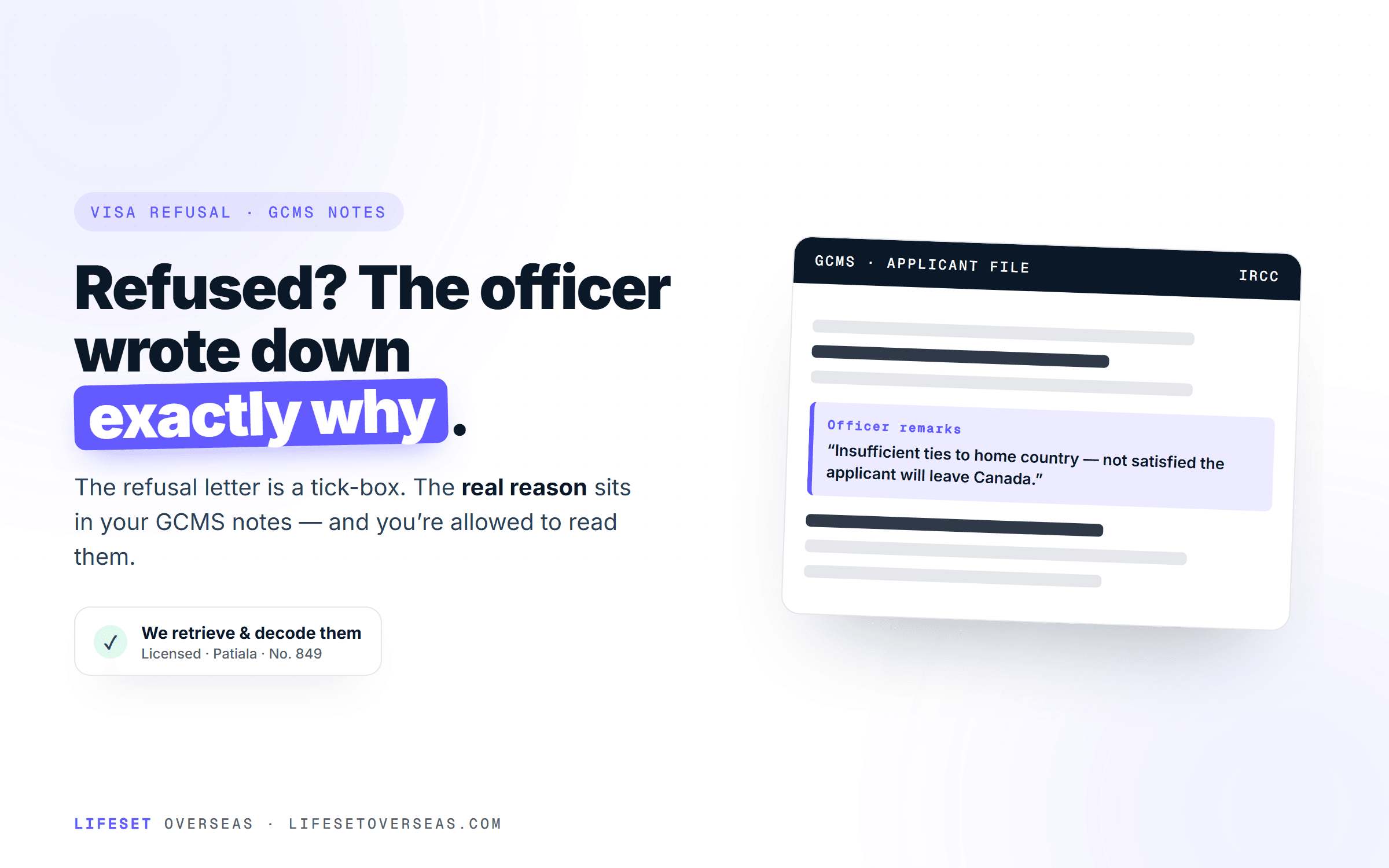
Your Canada refusal letter only says "no." The officer's GCMS notes (formerly CAIPS) say why — and you have a legal right to read them. Here's how to get them and use them honestly.
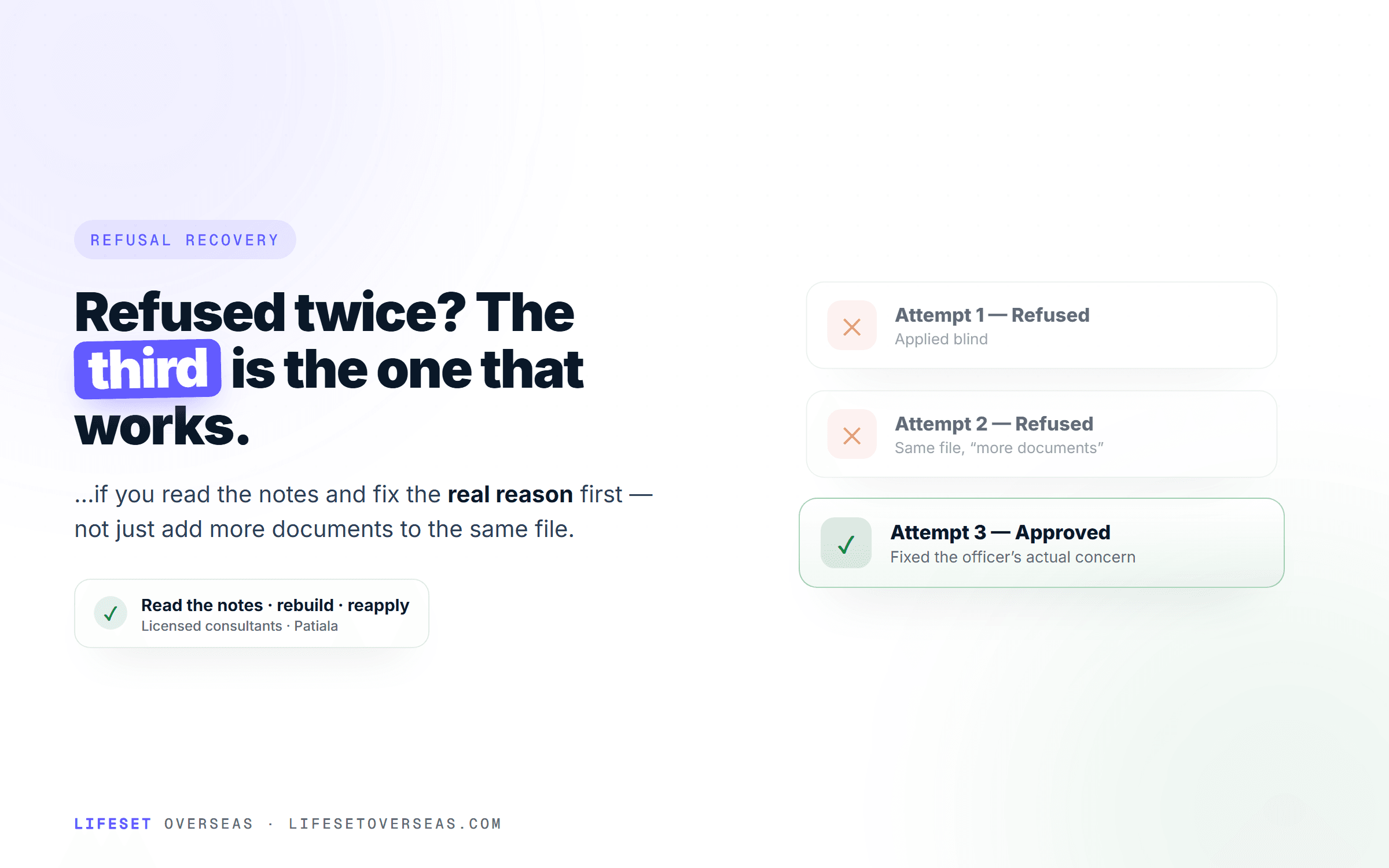
Your Canada refusal letter is a page of tick-boxes. "I am not satisfied that you will leave Canada at the end of your authorised stay." It tells you the officer said no. It never tells you why. That silence is exactly what keeps Patiala families guessing, reapplying blind, and getting refused a second time for the very same reason they were refused the first.
Here is what most applicants are never told: the officer typed the real reason into your file. Every doubt about your bank statement, every line about your "purpose of visit," every note that your story did not add up — it is all sitting in an internal IRCC database. And by law, you are allowed to read it.
What GCMS notes actually are
GCMS stands for the Global Case Management System — the internal software every IRCC visa officer uses to process applications. As an officer reviews your study permit, visitor visa or PR file, they type notes as they go: what they verified, what they doubted, and the reasoning behind the final decision.
Those typed entries are your GCMS notes. You will still hear them called CAIPS notes — that was the older Computer Assisted Immigration Processing System IRCC used before switching to GCMS. Same idea, same request route, only the name of the system changed. When a Rajpura student walks into our Nabha Road office asking for "CAIPS notes," they mean exactly this.
The refusal letter vs what the officer really wrote
The refusal letter recycles the same generic phrases for thousands of files. The notes translate those phrases into the specific doubt about your case. This is the gap that decides whether your reapplication succeeds.
How a generic refusal phrase maps to the officer's real note
'Purpose of visit'Reads as weak home ties or dual intent
Officer was not convinced your trip was genuinely temporary
'Personal assets and financial status'Large lump sum with no paper trail
Funds looked recently deposited, borrowed, or unexplained
'Family ties in Canada and country of residence'Sibling in Canada, thin ties at home
More pull to Canada than reasons to return to Punjab
'Purpose of studies not reasonable' (study permit)Officer doubted the study plan / SOP
Course did not fit your past study or work history
'Other' with no detailDates or facts that did not match
An inconsistency between your form, documents and interview
Composite of common IRCC refusal grounds — illustrative, not from a specific file
What the notes usually reveal
Across the GCMS files we read for applicants in Patiala, Nabha, Sangrur and beyond, the same handful of real reasons come up again and again. The refusal letter hides them behind one tick-box; the notes name them.
1
Funds that did not look credible
Not that you lacked money — that the money looked parked. A sudden large deposit days before applying, an unexplained sponsor, or income that does not match the bank balance. Officers are trained to spot funds arranged only to pass the file.
2
Weak home ties / dual intent
The officer was not satisfied you would leave at the end of your stay. Property, a running business, a job, dependent parents in Patiala — if these were not shown clearly, the file reads as someone who might not return.
3
A study plan or SOP the officer did not believe
For study permits, the notes often say the course did not make sense against your past education or work — a step backwards, an odd switch, or a Statement of Purpose that read as generic and templated.
4
Inconsistencies across the file
A date on the form that contradicts a document. A travel history that does not match the story. Small mismatches quietly destroy credibility, and the notes are where the officer records them.
Notice what these have in common: none of them appear on the refusal letter. Reapply without the notes and you are almost certainly rewriting the wrong problem.
How to order your GCMS notes
The notes are obtained through an ATIP request — Access to Information and Privacy. Here are the fixed facts, all set by Canadian law, not by any agent.
$5 CAD
Access to Information Act fee
Per request; a Privacy Act request for your own file is free but only for citizens/PRs/those in Canada
30 days
Legal deadline for IRCC to respond
Extensions are allowed but must be flagged within that window
IMM 5744
Consent form to request on your behalf
One signed form per person over 18 listed on the file
There is one rule that trips up almost every applicant in Punjab: you cannot file for your own notes from India. If you are not a Canadian citizen or permanent resident, you can only request from outside Canada through a representative who is a Canadian citizen, a permanent resident, or a person present in Canada. So a refused applicant sitting in Patiala needs a Canadian-based requester to file on their behalf — with your written consent.
1
Gather your file details
You will need your UCI (Unique Client Identifier), application number, full name as on the passport, date of birth, application type and the refusal date. Keep the refusal letter in front of you.
2
Line up a valid requester
Because you are outside Canada, the request goes in through a Canadian citizen, a permanent resident, or someone present in Canada — often a relative already there, or a licensed representative. There is no legal way around the residency rule.
3
Sign the consent (IMM 5744)
The Consent for an Access to Information and Personal Information Request form authorises that requester to see your personal records. One form per adult over 18 on the file.
4
Submit online and pay the $5 fee
The request is filed through the federal ATIP online portal, with the $5 application fee paid to the Receiver General for Canada.
5
Wait for the PDF
IRCC must respond within 30 days. When ready, your notes arrive as a PDF — sometimes clean, sometimes with sections withheld under privacy exemptions. Complex files can take longer if IRCC claims an extension.
Getting the PDF is only half the job. GCMS notes are written in officer shorthand — abbreviations, code references, terse one-liners like "PA funds not satisfied" or "ties weak, refused." An applicant reading them cold often misses the exact sentence that sank the file.
At our Patiala office we sit with you in Punjabi, Hindi or English and go through the notes line by line. We separate what the officer actually doubted from what you assumed they doubted — and those are frequently different things. Then we rebuild the next application around the real gap: a cleaner, documented funds trail; genuine home ties shown properly; a Statement of Purpose that answers the specific doubt rather than a generic template; and every inconsistency reconciled before the file goes back in.
We will also tell you honestly when the notes show a weak underlying case that needs time to strengthen before reapplying — not a rushed second refusal. And to be completely clear: no one can guarantee a visa. The decision is always the officer's, every single time. What the notes give you is the one thing you never had the first time — the truth about why, so your next application is built on fact instead of guesswork.
Frequently asked questions
Are GCMS notes and CAIPS notes the same thing?
Effectively yes. CAIPS was the older IRCC system; GCMS replaced it. People still search for "CAIPS notes," but the current records are GCMS notes, and the request process is identical. If someone offers you "CAIPS notes" today, they are simply using the old name for the same thing.
Will requesting my notes delay or damage my application?
No. Filing an ATIP request is a legal right and is completely separate from your immigration file. IRCC officers do not see that you made the request, and it has no bearing on any current or future application. The only real risk is not requesting them and repeating the same mistake.
I'm in India with no relative in Canada — can I still get my notes?
Yes. Because you cannot file from outside Canada yourself, the request goes through a Canadian citizen, a permanent resident, or a person present in Canada — a relative, or an authorised representative — using your signed IMM 5744 consent. We help you line up a valid requester and handle the reading and strategy once the notes arrive.
How long do GCMS notes take to arrive?
By law IRCC must respond within 30 days. In practice, straightforward files often come back around that mark, but IRCC can claim an extension on complex cases, so plan for it to sometimes take longer. Build the timeline into your reapplication schedule rather than rushing.
Can GCMS notes overturn my refusal or guarantee approval next time?
No. The notes do not reverse anything and they do not guarantee a future approval — the decision always rests with the visa officer. What they do is show you precisely why you were refused, so your next application actually addresses the real reason instead of guessing.
Do I even need the notes, or can I just reapply?
You can reapply without them, but you would be reapplying blind. Since the true reason is almost never spelled out on the refusal letter, most repeat refusals happen because the applicant fixed the wrong thing. The notes are the cheapest insurance against a second refusal.
If you have a Canada refusal letter in hand, do not reapply until you know what the officer actually wrote. Bring your refusal letter and application details to our Patiala office on Nabha Road, or start with our GCMS / CAIPS notes service. Once we know the real reason, we can rebuild your study visa or visitor visa file properly — often alongside honest SOP writing that answers the officer's specific doubt. Walk in, WhatsApp, or call us on +91 91155 80911 — Punjabi, Hindi or English, whichever is easiest for you.
What to do next
Refusal recovery
Find the real reason, pull your CAIPS/GCMS notes, and refile a corrected, stronger application.
We never predict an outcome or promise a visa. We tell you what your file says and what can be fixed.
Talk to a consultant about your case
Read this article? Now tell us about your situation.
We’ll WhatsApp you within 4 working hours with an honest read on your file and the realistic next steps. Licensed, fixed-fee, and one consultant from first call to decision.
Read the article? Message us on WhatsApp with your situation — a consultant from our Punjab-licensed consultancy gives you an honest read and the next step.