Canada Visitor Visa (TRV) Refused: How to Reapply from India in 2026
A Canada visitor visa (TRV) refusal letter rarely tells you the real reason — the GCMS notes do. Here's how Indian applicants find the true gap and reapply stronger in 2026.
A refusal email from IRCC lands the same way for almost everyone: a single page, a few ticked boxes, and no real explanation of what went wrong. If your Canada visitor visa (TRV) was refused, the worst thing you can do is panic, change nothing, and reapply two weeks later. The letter you received is deliberately generic — the actual reason your officer refused you is recorded somewhere else, and getting it is the first real step toward an approval.
This guide is for Indian applicants — visitors, not students — who were refused a TRV and want to reapply the right way in 2026.
Refusal recovery
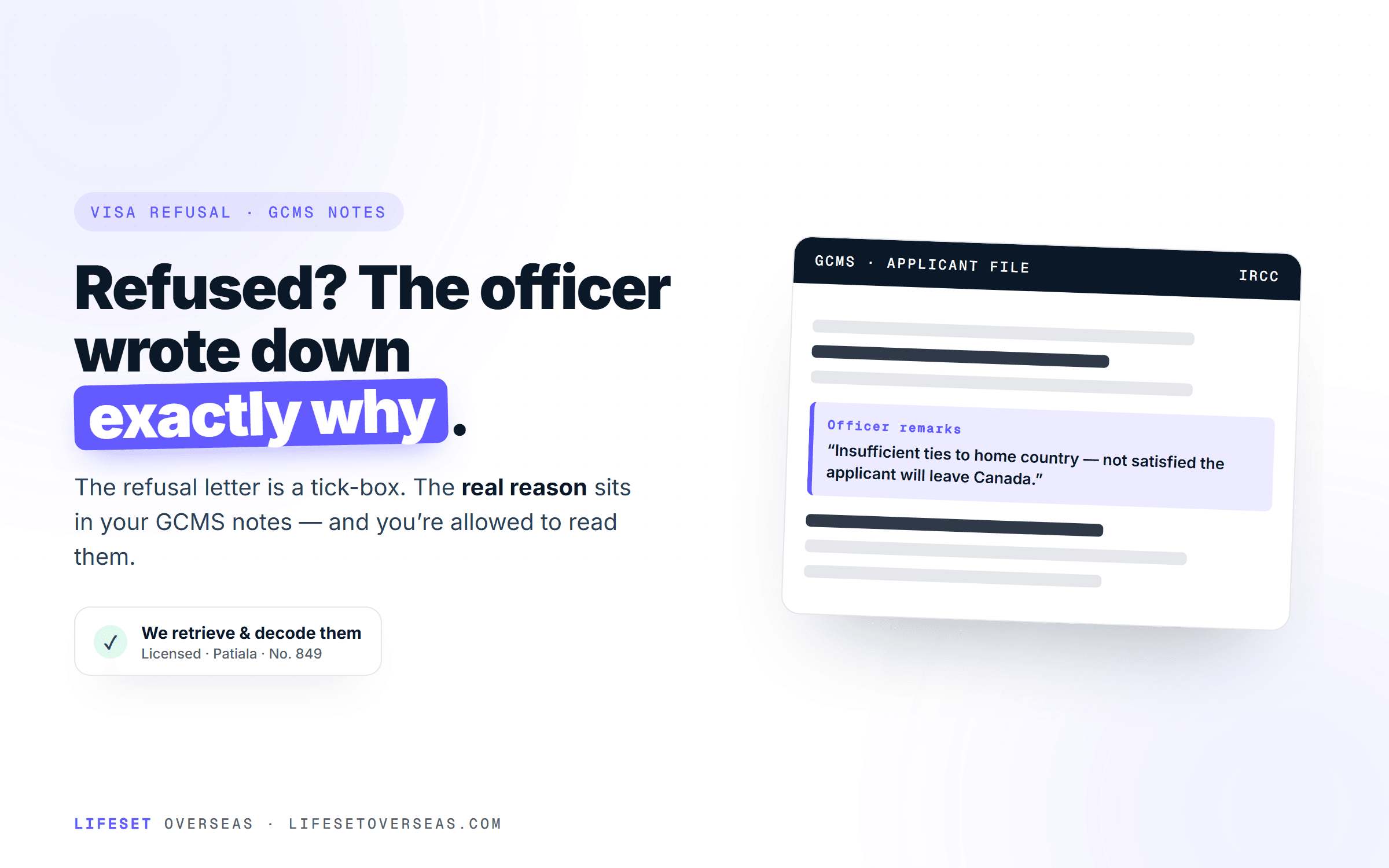
The refusal letter is not the reason.
Your real ground for refusal is in the GCMS notes — find it, fix it, then reapply.
Why the refusal letter tells you nothing
IRCC refusal letters use a standard checklist. The officer ticks one or more boxes — "travel history", "purpose of visit", "personal assets and financial status", "family ties in Canada and country of residence" — and the system generates your letter. It looks official and final, but it is intentionally vague.
The detailed reasoning — the officer's actual notes, the specific doubt they had about your file — is stored in the GCMS (Global Case Management System), historically called CAIPS. Those notes are where you learn whether the officer doubted your funds, your ties, your stated purpose, or something in your forms that didn't add up.
You can order GCMS notes yourself through an ATIP request, or have someone retrieve and read them for you. The point is the same: do not reapply until you know which line of your file actually failed. Our GCMS / CAIPS notes service exists precisely for this — to turn a vague tick-box letter into a specific, fixable problem.
The facts that surprise most applicants
No appeal
TRV refusals can't be appealed
GCMS
Where the real reason lives
Dual intent
Most common refusal theme
Reapply
The only real path forward
A visitor visa is a discretionary decision. Unlike some immigration decisions, a refused TRV has no appeal to a tribunal. You cannot demand a review and force a different outcome. Your remedy is to submit a fresh, stronger application that answers the officer's specific concern. That sounds harsh, but it's actually good news: you are not stuck with one bad decision forever — you get a clean slate every time you reapply, as long as the file improves.
The grounds that actually get TRVs refused
Most Indian TRV refusals fall into a handful of themes. Reading them honestly against your own file is half the work.
What the officer is really weighing on a TRV
Home ties / dual intentJob, family, property, dependants in India
Will you leave Canada?
FundsNot a lump sum parked days before
Genuine, available, explained
Purpose of visitVague 'tourism' invites doubt
Clear, specific, time-bound
Family in CanadaA close relative there raises stay-back concerns
Can cut both ways
Confirm specifics in your GCMS notes
Weak ties and "dual intent"
This is the most common refusal theme for Indian visitors. The officer must be satisfied you will leave Canada at the end of your visit. If your ties to India look thin — no stable job, no dependants, no property, or a profile that looks like you might want to stay — the officer leans toward refusal. Having a spouse, children, a steady income, or business assets in India strengthens you.
Funds that don't look credible
Showing "enough money" is not the same as showing credible money. A bank balance that jumped right before you applied reads as borrowed-for-the-application, not as your genuine financial position. Officers want to see funds that built up naturally and are clearly yours.
What raises doubt
A large lump sum deposited a week before applying
Balance with no matching income or salary history
"Tourism" with no itinerary, dates, or reason
Sponsor in Canada but no proof of your own ties to India
What reassures the officer
A balance that grew steadily over months
Funds matched to salary slips and tax records
A specific purpose with dates and a return plan
Clear ties: job, family, property, dependants in India
Unclear purpose of visit
"I want to travel" is not a purpose. A strong file says why now, for how long, who you're visiting or what you're seeing, and why you'll come home. If you're visiting family, an invitation letter helps — but it does not replace your own ties and your own funds.
“
A refusal is not a verdict on you — it's a verdict on your file. Files can be rebuilt.
Lifeset Overseas
The mistakes that cause a second refusal
1
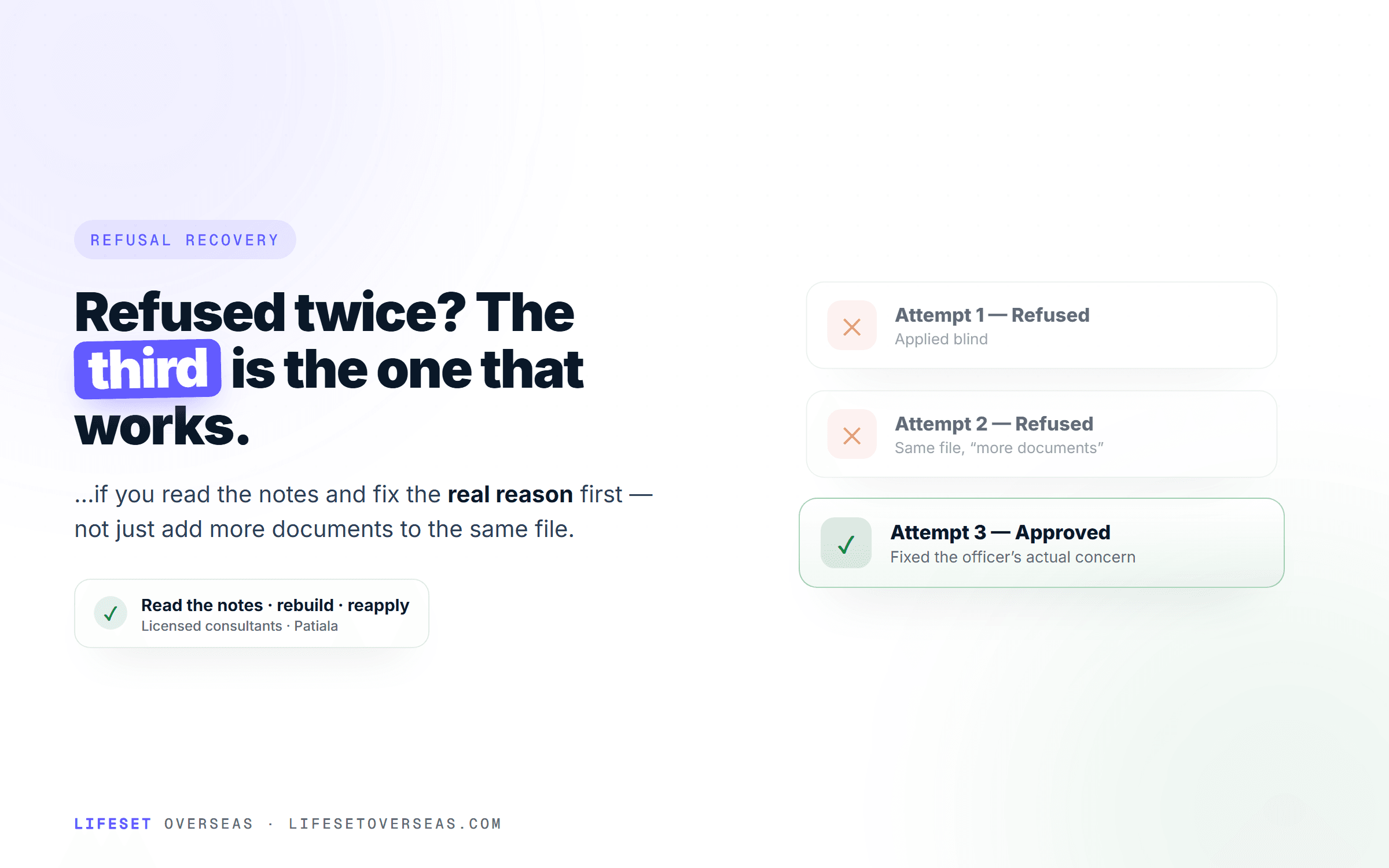
Treating the symptom, not the cause
Adding more bank statements when the real doubt was your ties to India. If you don't order the GCMS notes, you fix the wrong thing.
2
Reapplying too fast
Resubmitting within days, before anything has actually changed in your file, signals desperation rather than a genuine, improved application.
3
Hiding the previous refusal
You must declare prior refusals. Concealing one is a misrepresentation risk far more serious than the refusal itself.
4
Over-relying on the Canada sponsor
Leaning entirely on a relative's invitation while your own India ties and funds stay weak. The officer judges you, not your host.
How to reapply the right way
1
Get the real reason
Order and read your GCMS notes. Identify the exact concern — ties, funds, purpose, or a form inconsistency — before touching the new application.
2
Fix that specific gap
If it was funds, build and document a credible balance over time. If it was ties, strengthen and prove your India anchors. Match the evidence to the doubt.
3
Rebuild the file, not just resend it
Update forms, write a purpose-of-visit letter that addresses the prior concern directly, and declare the earlier refusal honestly.
4
Reapply when the file is genuinely stronger
There is no fixed waiting period, but reapply only when something material has actually changed — not on the calendar, on the evidence.
Can I appeal a Canada visitor visa refusal?
No. A TRV (visitor visa) refusal carries no right of appeal to a tribunal. Your only practical route is to reapply with a fresh, stronger application that fixes the specific concern the officer had. That's why diagnosing the real reason first matters so much.
How do I find out the real reason I was refused?
The generic refusal letter only ticks boxes. The detailed officer notes sit in the GCMS (formerly CAIPS) system and are obtained through an ATIP request. You can order them yourself or use our GCMS notes service to retrieve and interpret them.
How long should I wait before reapplying?
There is no mandatory waiting period — you can reapply once your file is genuinely improved. Reapplying within days with the same package usually leads to another refusal. Wait until something material has changed, not just the date.
Do I have to tell IRCC about my previous refusal?
Yes, always. The application asks whether you've been refused a visa before, and you must answer honestly. Hiding a prior refusal is treated as misrepresentation, which is far more damaging — and longer-lasting — than the original refusal.
My parents were refused a TRV to visit me in Canada — what now?
First read the GCMS notes to see the actual ground. If the purpose is a long family visit, also weigh the Super Visa, which is designed for parents and grandparents and allows longer stays per entry, subject to insurance and sponsor-income requirements you should confirm on the official site.
Start with the real reason, not a guess
A refusal feels final, but for a Canada TRV it almost never is — it's a fixable file with a hidden diagnosis. Don't reapply on hope. Begin with our ₹499 Visa Risk & Approval Report, which reviews your situation and tells you honestly where your file is weak before you spend money on a fresh application — it's refundable and credited if you go on to file with us (see pricing). If you've already been refused, our Canada refusal help and broader visa refusal support walk you through getting the GCMS notes, fixing the real gap, and reapplying with a file that finally answers the officer's question.
What to do next
Refusal recovery
Find the real reason, pull your CAIPS/GCMS notes, and refile a corrected, stronger application.
We never predict an outcome or promise a visa. We tell you what your file says and what can be fixed.
Talk to a consultant about your case
Read this article? Now tell us about your situation.
We’ll WhatsApp you within 4 working hours with an honest read on your file and the realistic next steps. Licensed, fixed-fee, and one consultant from first call to decision.
Read the article? Message us on WhatsApp with your situation — a consultant from our Punjab-licensed consultancy gives you an honest read and the next step.