
Czech Republic · Visa guide
 Czech Republic · Visa guide
Czech Republic Study & Research Visa
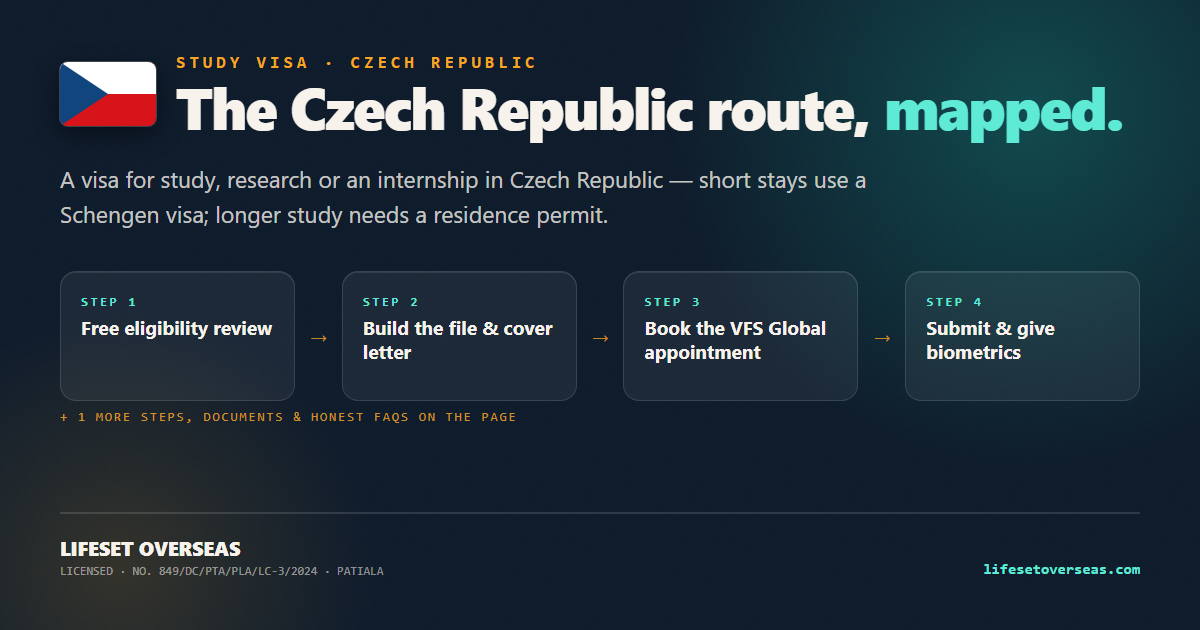
A visa for study, research or an internship in Czech Republic — short stays use a Schengen visa; longer study needs a residence permit.
- ProcessingUsually about 15 calendar days from submission
- Visa categoryStudy & Research Visa
- Your guideOne consultant
Your offer letter is only the start. Funds, SOP and the interview decide the visa. Call us with your course and intake. We tell you if the money and the story hold up.
Monday–Saturday, 9:00 AM – 7:00 PM IST
8
Documents mapped
5
Steps explained
3
Questions answered
Usually about 15 calendar days from submission
Typical processing
Start here
Czech Republic Study & Research Visa — overview
The Czech Republic Study & Research Visa is for study, research or an internship in Czech Republic. Short stays of up to 90 days use a Schengen Type C visa; longer study requires a national long-stay visa or residence permit.
Beyond the standard Schengen documents, the embassy expects a certificate of admission or registration at an educational establishment in Czech Republic, or a cover letter from the inviting institution.
Lifeset Overseas confirms whether your stay needs a short-stay visa or a residence permit and builds the file so your study or research purpose is clearly evidenced.
Czech study: free in Czech, priced in English, and a low funds bar either way
Two facts make the Czech Republic stand out for Indian students. First, if you study in the Czech language at a public university, there is no tuition at all, for any nationality. Second, the amount of money you must prove for the visa is one of the lower figures in the Schengen area. Most Indian students, though, choose English-taught programmes at Charles University, the Czech Technical University or the Brno universities, and those carry fees.
Below is the student visa explained plainly, with only the figures we have checked.
The visa
For a degree you need a long-term visa for the purpose of study, a type D national visa. It is applied for at the Czech consulate through VFS Global in India. The consulate forwards the file to the Ministry of the Interior in Prague, which decides. This means Czech processing can be slower than some other countries, so timing matters.
The Czech VFS centres are in Bengaluru, Chennai, Mumbai and New Delhi. From Punjab, New Delhi. You attend once for biometrics (fingerprints and photo) and, in many cases, a short interview about your study plan.
Verified money figures
The proof of funds for a student visa is €4,809 a year, as published by the Czech immigration office. Our confidence in this figure is high. It is shown through a bank statement in your name or a sponsor's, or a scholarship letter.
Tuition at public universities for a non-EU student runs from €0 to about €25,000 a year. The zero is real: Czech-taught study is free by law. The upper end reflects a few high-priced English-taught programmes. Private universities charge between about €3,542 and €12,913 a year. Some examples from the universities' own pages: Czech Technical University in Prague charges by faculty, with the Faculty of Electrical Engineering at about €4,400 to €5,300 a year; Brno University of Technology's electrical faculty charges non-EU students €4,500; Masaryk University runs from about €3,000 to €14,000; Prague University of Economics and Business charges €6,000; the Czech University of Life Sciences charges non-EU students €1,000. Charles University sets fees per programme and the range is very wide, from a nominal amount to over €30,000 for some medical programmes. We check your programme's fee with you on the call.
Language
English-taught programmes are widely available. There is no national minimum English score; each university sets its own. If you pick a Czech-taught programme to get free tuition, expect the university to require a Czech language certificate and, often, a one-year preparatory Czech course first, which itself has a fee.
What the file needs
- Admission letter from the Czech university, showing the programme and language.
- Proof of €4,809 a year.
- Accommodation in the Czech Republic: dormitory confirmation or rental contract.
- Health insurance meeting Czech requirements.
- Police clearance from India, with an apostille.
- Passport, photos, the long-term visa form.
- Academic certificates with apostille and certified translation where required.
We prepare it all, including the apostille chain, and book your appointment. You attend the centre for biometrics and the interview.
Where files from India go wrong for the Czech Republic
Underestimating the timeline. Because the decision is made in Prague, not at the consulate, files take longer. A student who applies six weeks before the semester is likely to miss it. We start the apostille and police clearance early for this reason.
Apostille missing or in the wrong order. Czech authorities want an apostille on the police clearance and on academic papers. An attestation from the wrong office is returned.
Weak answers at the consulate interview. Students are asked why this university, why this programme, what they will do after. "My agent suggested it" is a bad answer. We prepare you.
Free Czech-taught study chosen with no Czech. The free option is real but only for those who can study in Czech. A preparatory year is the honest route, and it costs money.
Accommodation letter from a friend, not a contract. The Czech side expects a formal proof of accommodation. A friend's email is not accepted.
If the visa was refused
Czech long-term visa refusals come with a written statement of reasons. You can request a review by the Ministry of Foreign Affairs within 15 days, or submit a new application. For students, reapplying with the specific gap fixed is often faster than the review. We read the reasons, tell you plainly what went wrong, and rebuild the file. If the interview was the problem, we prepare you properly for the second one.
After graduation: information only
The Czech Republic has rules for graduates who want to stay to seek work. We describe them on the call. We do not file work permits; that needs a separate licence we do not hold.
Talk to us
One call settles: whether you should study in English or Czech, your true first-year cost, how early you must start the apostille and police clearance, and how to prepare for the consulate interview. Run the visa readiness score and compare countries on our Study in Europe hub.
Lifeset Overseas, Patiala. Punjab Licence No. 849/DC/PTA/PLA/LC-3/2024. Call or WhatsApp +91 91155 80911, Monday to Saturday, 9 AM to 7 PM.
Verified figures for Czech Republic
What a year in Czech Republic costs — and what you must prove
- Public-university tuition, non-EU student, per year
- €0 – €25,000
- Private universities: €3,542 – €12,913
- Funds the visa authority asks you to show
- €4,809 a year
English-taught courses: widely available. varies by university — no national minimum is published
Read on the official pages below on 27 Aug 2026. Figures change every academic year — check them before you pay anything.
8 items
Documents you need
Schengen application form
Completely filled and signed by the applicant.
Valid passport
Issued within 10 years, valid 3 months beyond return, with 2 empty pages.
Admission / registration certificate
A certificate of admission or registration at an educational establishment in the Czech Republic, or a cover letter from the inviting institution.
Student status proof
For pupils and students, certificates of enrolment and a student ID card.
Travel medical insurance
Schengen-wide cover of at least EUR 30,000 for the trip.
Transport & accommodation
Proof of itinerary, travel booking and confirmed accommodation, including campus residence where applicable.
Financial means
Bank statements for the last 3 months, income-tax returns, or sponsor and scholarship evidence.
Cover letter
Stating the purpose and duration of the study, research or internship.
5 steps
How the process works
Typical processing: Usually about 15 calendar days from submission — may extend up to 45 calendar days. Apply at least 2-3 weeks before travel.
Step 1
Free eligibility review
We assess your profile and build a document checklist matched to the embassy's requirements.
Step 2
Build the file & cover letter
Every document — finances, bookings, insurance and the cover letter — is prepared and verified.
Step 3
Book the VFS Global appointment
Applications in India are submitted through VFS Global — we schedule your slot.
Step 4
Submit & give biometrics
You attend the VFS centre to submit the file and provide fingerprints and a photograph.
Step 5
Decision & passport return
The embassy decides the application and your passport is returned through VFS.
Transparent
Costs & fees
Item
Amount
Schengen visa fee (adult)
EUR 45 for children aged 6 to 11; under 6 exempt. Payable in INR.
EUR 90
VFS Global service charge
Plus optional add-ons such as courier.
Confirmed at booking
Government and third-party fees change often — we confirm the exact current amounts for your case before you pay anything.
3 answers
Frequently asked questions
Short study, research or internship stays of up to 90 days use a Schengen visa. Longer study requires a national long-stay visa or residence permit — we confirm the right route for your case.
A certificate of admission or registration at an educational establishment in Czech Republic, or a cover letter from the inviting institution.
This short-stay route allows up to 90 days. Full courses are handled through the long-stay route.
Why it matters
Going it alone vs filing with us
On your own
- Guessing the document list — one missing or wrongly formatted paper triggers a refusal.
- Generic cover letters copied from the internet that officers recognise and flag.
- No read on peak rejection windows or what this visa post is strict about.
- Government and VFS fees are non-refundable — money lost if you are refused.
- A refusal stamp follows you and weakens every future visa application.
With Lifeset Overseas
- An honest case assessment before you spend a rupee on government fees.
- A file built to the embassy's exact checklist and in the exact order.
- Weak finances, ties or purpose identified and fixed before submission.
- Previously refused? We can rescue and rebuild the file.
- Every case handled by one consultant, end to end.
Refused before?
A refusal isn't the end
A refusal is not a permanent bar — but it only improves if the actual reason is found and answered, and nobody can tell you a second application will succeed. If a Czech Republic visa has been refused, we:
- Read the actual refusal letter and pinpoint the real gaps.
- Advise whether to pull the officer's notes (CAIPS / GCMS) for the true reason.
- Identify which part was weak — funds, employment, purpose or ties.
- Tell you honestly whether to reapply now or strengthen the file first.
- Refused? Your fee back, or a rebuilt application free — your choice.
Other Czech Republic visas
Czech Republic Tourist Visa
A short-stay Schengen visa for tourism and holidays in Czech Republic — up to 90 days in any 180-day period.
Czech Republic Business Visa
A short-stay Schengen visa for business meetings, conferences and training in Czech Republic.
Czech Republic Family & Friends Visit Visa
A short-stay Schengen visa to visit family or friends living in Czech Republic — up to 90 days.
Czech Republic Cultural, Sports & Religious Visa
A short-stay Schengen visa for cultural, sporting and religious events and film crews in Czech Republic.
Start here · One message away
Czech Republic study visa: do not send a weak file. Call first.
- Honest assessment
- Fixed all-in fees
- No handovers between staff
- Licensed in Patiala
Let’s discuss your case
Send your offer letter and sponsor details on WhatsApp. We tell you plainly if the funds and the SOP are strong enough, and what is missing.