214(b) refusal is the most common US visa refusal ground for Indian applicants — and one of the most misunderstood. It is not a permanent ban. It is not a record of misconduct. It is the consular officer's conclusion that on the day of your interview, you did not overcome the legal presumption that you intend to immigrate to the United States.
This guide walks through what 214(b) actually means, what consular officers are evaluating, and how to rebuild your case for the next interview — from Lifeset Overseas, licensed visa consultants based in Patiala, Punjab.
What 214(b) actually says
Section 214(b) of the US Immigration and Nationality Act reads (in essence): every applicant for a non-immigrant visa is presumed to be an intending immigrant unless the applicant establishes to the satisfaction of the consular officer that they qualify for non-immigrant status.
In plain English: when you apply for a US tourist (B1/B2), student (F-1), or exchange visitor (J-1) visa, the default legal assumption is that you intend to immigrate. Your job at the interview is to demonstrate the opposite — that you have strong ties to India, genuine reasons to return, and a credible non-immigrant purpose.
A 214(b) refusal means the consular officer was not persuaded that you overcame that presumption during your 2-5 minute interview.
What it is NOT
It is not a permanent ban. You can apply again immediately, though most experienced applicants wait at least 3-6 months for material change.
It is not a record of misconduct or deception. A 214(b) refusal does not affect future US, UK, Canada, Australia, Schengen applications in the same way a misrepresentation finding (Section 212(a)(6)(C)) would. You can disclose it openly on future applications.
It is not appealable in the traditional sense. There is no formal appeal or administrative review for 214(b). The only path forward is a fresh application with new evidence and a stronger interview.
What the consular officer is actually evaluating
US consular officers in India (New Delhi, Mumbai, Chennai, Kolkata, Hyderabad) make 200-400 decisions per day during peak season. Each interview is typically 2-5 minutes. The officer is making a snap judgement based on:
1. Your stated purpose vs. observable evidence
- For F-1 (student): Is your chosen programme a logical fit with your background and post-study plans? Is your funding documented and credible?
- For B1/B2 (visitor): Is your stated travel purpose specific and credible? Is the duration reasonable? Are your bookings consistent?
- For J-1 (exchange): Does your exchange programme make sense for your career stage? Will you genuinely return?
2. Your ties to India
- Family ties: spouse, children, aging parents, siblings in India.
- Economic ties: employment (with leave approval), business interests, property, financial assets.
- Social ties: community standing, social commitments, planned events in India during your absence.
3. Your travel and immigration history
- Prior US visa refusals (you will be asked).
- Prior US visas (lapsed or current).
- Prior travel to Schengen, UK, Canada, Australia, NZ (developed-country travel with respect for visa terms is positive).
- Any prior visa overstays or violations anywhere.
4. The interview itself
- Confidence and clarity in answering questions.
- Consistency between answers and documents.
- Specificity (vague answers signal lack of genuine intent).
- Body language (officers are trained to read hesitation, evasion).
The interview decision is largely made in the first 30-60 seconds, based on profile + opening answers. The rest of the interview either confirms or shifts that initial assessment.
Step 1 — Diagnose the actual issue
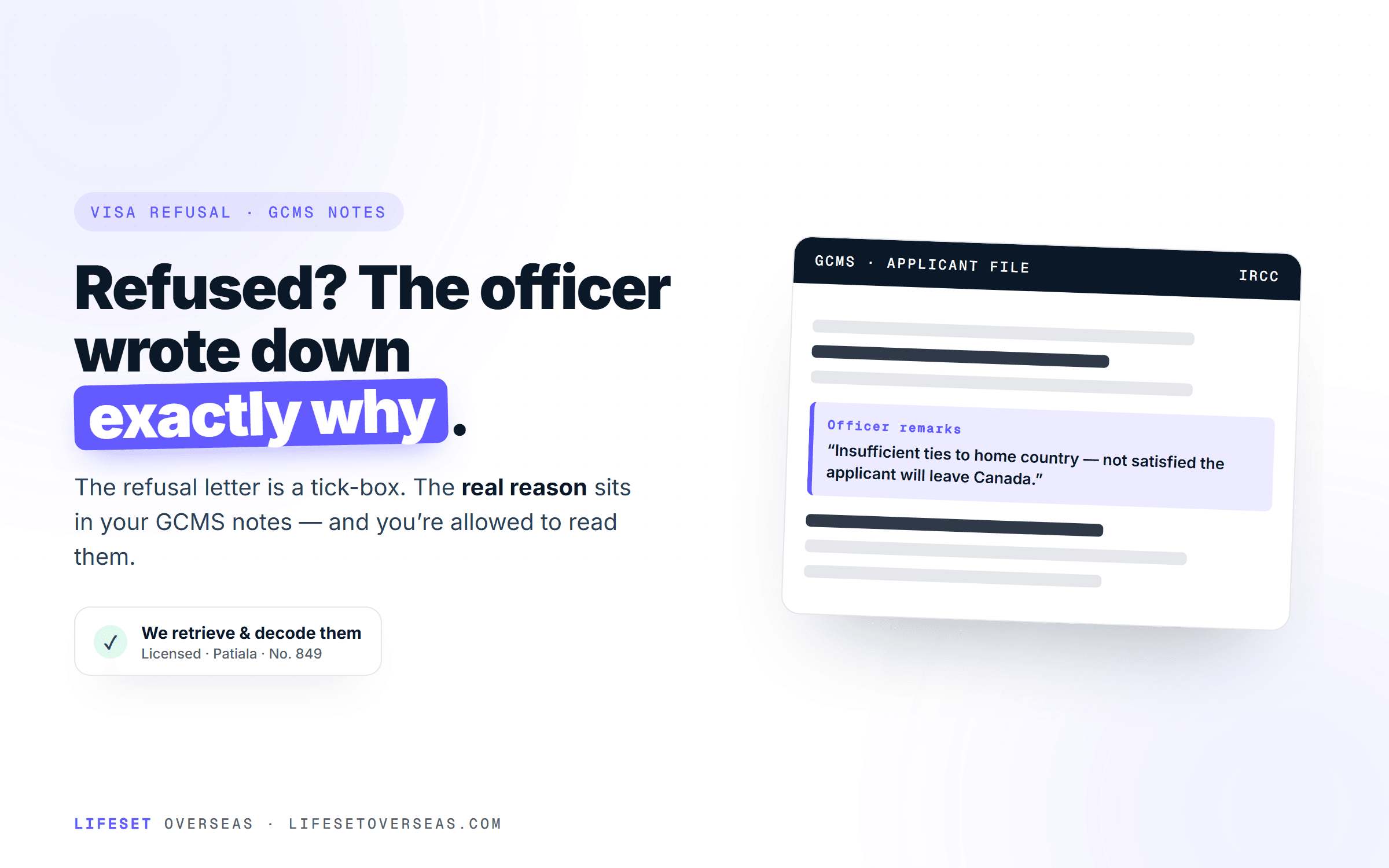
Unlike Canada GCMS notes, the US does not provide officer notes for 214(b) refusals. You have to infer the issue from the interview itself:
- What questions did the officer ask? Long focus on funds = funds concern. Long focus on family in US = ties concern. Long focus on programme choice = genuine-student concern (F-1) or purpose concern (B1/B2).
- What did the officer say at the end? Officers usually give a one-line indication ("Your ties to India are weak", "Your purpose is unclear", "Your funds are insufficient").
- What was on the officer's screen? Some officers verbalise as they review documents. If they spent time on a specific document, that document was a concern.
Common 214(b) patterns by visa category:
F-1 (student visa) 214(b) patterns
- Likely concern
- Programme doesn't fit your past education or stated career plans
- Likely concern
- Choice of mid-tier or unfamiliar institution raises programme-commitment doubts
- Likely concern
- Funds appear borrowed or unstable
- Likely concern
- Concern that you'll overstay to be near US-based family
- Likely concern
- Concern about Optional Practical Training (OPT) being the actual intent
B1/B2 (visitor visa) 214(b) patterns
- Likely concern
- Trip details don't add up or seem vague
- Likely concern
- Weak employment ties to India
- Likely concern
- Concern about family in US providing immigration path
- Likely concern
- Funds source or sponsorship credibility concern
- Likely concern
- First-time international applicant with no proven travel-compliance history
- Likely concern
- Suspicion of intent to overstay
Step 2 — Decide when to reapply
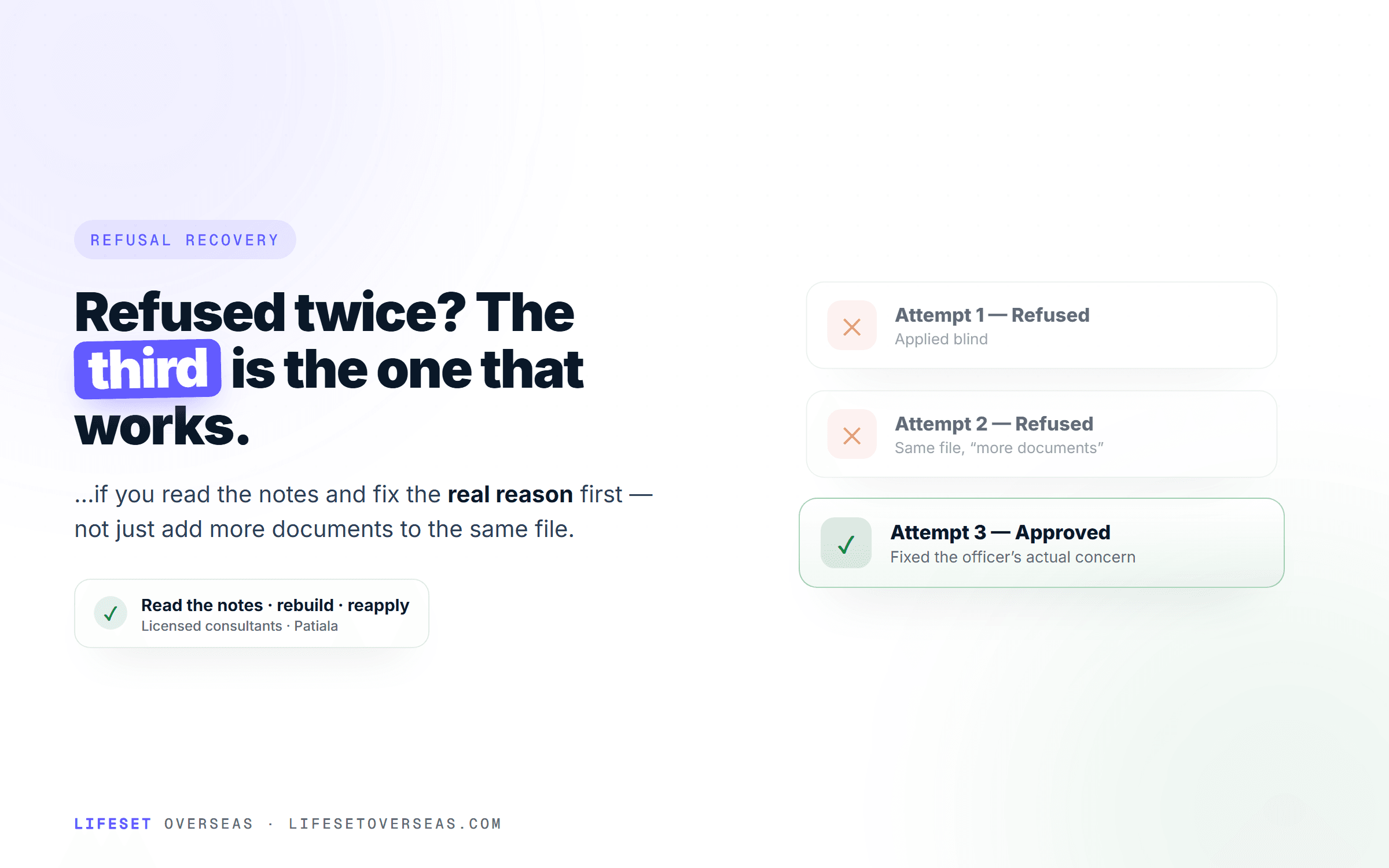
There is no formal waiting period for 214(b) reapplication, but most experienced applicants wait 3-6 months to allow for material change in their profile. Reapplying within 30 days with no material change typically produces a second 214(b) refusal — and consular officers see your application history.
Material change that strengthens a reapplication includes:
- Career progression — promotion, salary increase, new responsibilities.
- Documented funding source — sustained funds growth, ITRs showing rising income.
- New ties evidence — property purchase, business registration, family event commitments.
- New developed-country travel — Schengen, UK, Canada, Australia trip completed with timely return.
- For F-1: improved IELTS / TOEFL / SAT / GRE scores, additional academic credentials, clearer programme-to-career story.
- For B1/B2: specific reason for visit (new conference, family wedding, child's graduation in US) that adds concrete purpose.
Material change does NOT include:
- Same profile, just 3 months later.
- Same SOP with minor edits.
- Same financial position.
Step 3 — Rebuild the interview
The single most important difference between a successful and an unsuccessful reapplication is the interview itself.
Preparation for F-1 reinterview
- Programme logic story: Be able to explain in 30 seconds why this specific programme, at this specific university, after your specific background, will lead to specific post-study plans.
- Funding story: Specific sources, specific amounts, specific bank accounts, ITRs to back up income.
- Post-graduation story: Return to India is the default narrative. If you mention OPT or US work, do so as a possibility, not a plan.
- Family-in-US handling: Disclose openly. Explain why their presence doesn't change your return intent.
Preparation for B1/B2 reinterview
- Specific purpose: Tourist trip to specific places, business meeting at specific company, family wedding on specific date.
- Employment commitment: Leave approval letter with explicit return date and continuing position.
- Return ties: Property, business, family responsibilities, return ticket purchased.
- Funding clarity: Self-funded or sponsored, with specific source documentation.
Interview behavioural tips
- Answer the question asked, briefly and specifically. Don't over-explain.
- Eye contact and clear voice.
- Don't memorise scripted answers. Officers detect rehearsed responses immediately.
- Don't volunteer information not asked. Less is more.
- Have documents ready but expect the officer to ask for very few or none.
- Don't argue with the officer or push back on their conclusions.
Common Indian-applicant 214(b) patterns
Pattern 1: First-time F-1 applicant from non-target school
A BCom graduate from a non-IIT/NIT/IIIT/Tier-1 institution applying for a Masters at a mid-tier US university. Officer questions programme-school-cost trinity (why pay USD 50k for a programme that doesn't materially advance your career). Fix: A clearer programme-to-career story, scholarships if available, or a more focused choice of programme that demonstrably advances your specific career path.
Pattern 2: B1/B2 applicant with US-resident family
Most-common B1/B2 refusal pattern. Sibling or cousin lives in the US, applicant claims tourism. Officer concludes the actual intent is extended family visit / overstay. Fix: Acknowledge the family relationship openly. Frame visit purpose specifically (wedding, graduation, parent meeting grandchildren), with a clear return date and commitment.
Pattern 3: Young single male, working professional
Mid-twenties, single, mid-career engineer applying for B1/B2 for "tourism". The classic ties-thin profile. Fix: Wait until you have substantial Schengen / UK / Australia developed-country travel completed and returned on time. Apply again with that travel history demonstrating compliance.
Pattern 4: Repeat 214(b) refusal
Two or more 214(b) refusals on the same profile. Each subsequent refusal compounds. Fix: Substantial profile change is essential — promotion, marriage, property purchase, business establishment, multiple developed-country trips. Continuing to reapply on the same profile usually produces continued refusals.
Pattern 5: F-1 applicant with US-resident sibling
A common profile — sibling on H-1B in the US, applicant applying for F-1. Officer concludes the underlying intent is family reunification via OPT-then-H-1B. Fix: Choose a programme genuinely aligned with India career plans. Have a clear post-study return narrative. Family-in-US disclosure is mandatory; framing matters.
How Lifeset can help
We handle US visa interview preparation for Indian applicants:
- Interview-focused preparation — mock interviews matched to the F-1 / B1/B2 / J-1 visa category, profile-specific question rehearsal, body-language and answer-pacing coaching.
- Document strategy — funds documentation, ties documentation, SOP / cover letter alignment with the interview narrative.
- Profile assessment — honest evaluation of whether the profile is genuinely ready for a US application, or whether material change is needed first.
- Reapplication strategy — timing, material change documentation, interview narrative reframe.
We do not handle H-1B, L-1, O-1, or any employer-sponsored US work visa — those require an MEA Recruiting Agent licence we do not hold. We handle F-1 (student), B1/B2 (visitor), and J-1 (exchange) under our licensed scope.
We are a licensed visa consultancy at Shop No. 2, near PRTC Workshop, Nabha Road, Patiala 147001, Punjab — Licence No. 849/DC/PTA/PLA/LC-3/2024. Book a free 30-minute assessment — we will read your interview experience, identify the likely concern, and outline a realistic reapplication strategy.