How to Prove Strong Ties to India for a Visitor Visa (the #1 Refusal Reason)
Weak ties to India is the single most common visitor-visa refusal reason worldwide. This guide shows how to make your ties visible and documented by applicant profile.
Almost every visitor-visa officer is asking one quiet question behind all the paperwork: will this person actually go home? When the answer is not obvious from your file, you get refused — and "weak ties to your home country" is the single most common reason visitor and tourist visas are turned down, across Canada, the United States, the United Kingdom, Schengen and Australia. The frustrating part is that most refused applicants genuinely do have strong reasons to return. They just never made those reasons visible on paper.
This guide is about fixing exactly that. Not about having ties — you almost certainly already do — but about documenting them so a stranger reading your file for ninety seconds reaches the same conclusion you already know is true.
Where "weak ties" refusals actually happen
Different countries dress up the same suspicion in different legal language, but it is the same underlying test everywhere.
214(b)
US — presumption of immigrant intent
No appeal
UK visitor refusals
Article 32
Schengen refusal grounds
Dual intent
Canada — must overcome it
For the United States, Section 214(b) of the Immigration and Nationality Act presumes every visitor intends to immigrate until you prove otherwise — your ties are the proof. For Canada, the officer must be satisfied you will leave at the end of your authorised stay. For the UK, a visit-visa refusal carries no right of appeal, so the file you submit is effectively your only shot. For the Schengen area, "the information submitted regarding the justification for the purpose and conditions of the stay was not reliable" and "intention to leave could not be ascertained" are standard Article 32 refusal boxes the consulate simply ticks.
What "ties to India" actually means
Ties are the gravitational pull that brings you back. Officers group them into a few buckets, and a strong file touches more than one.
The buckets an officer weighs
Economic tiesSomething you would lose by overstaying
Job, business, income, assets
Family tiesPeople who depend on you here
Spouse, children, dependent parents
Property tiesRegistered in your name or jointly
Owned home, land, agricultural holding
Ongoing commitmentsThings you must return for
Studies, contracts, court matters, EMIs
Confirm wording on the relevant official visa portal
No single tie is magic. A young, single, unemployed applicant with no property is genuinely a harder case — but even then, the goal is to assemble the strongest honest picture available, not to invent one.
Visible ties vs invisible ties
This is the heart of it. Two applicants can have identical lives and get opposite decisions, purely because one made the ties documentable and the other left the officer guessing.
Invisible ties (gets refused)
"I have a good job" — but no employment letter or leave approval attached
A family business you run, with nothing in your name on paper
Land you own, but no registry document or jamabandi in the file
A spouse and kids staying back — never mentioned in the cover letter
"I'll obviously come back" stated as a feeling, not shown as evidence
Visible ties (gets approved)
Employer letter stating role, salary, tenure and approved return date
Business registration, GST returns and a partnership/proprietor proof
Property registry, mutation record or agricultural land papers in your name
A cover letter naming dependants who rely on you in India
Ongoing commitments — EMIs, a running lease, enrolled children — documented
“
Officers don't refuse you for not having ties. They refuse you because they couldn't see the ties you do have.
Lifeset Overseas
Evidence by applicant profile
The exact documents that prove your ties depend entirely on who you are. Here is what carries weight for the profiles we see most often from Punjab and across India. Treat this as a starting checklist, not a guarantee — every consulate sets its own document list.
What proves your ties, by profile
Salaried employeeLetter must state your return-to-work date
Farmer / agriculturistOwned land is a strong, durable tie
Land records, jamabandi, crop income
Always cross-check the official document checklist for your destination
Salaried and self-employed
If you are salaried, the most underused document is a clear leave-approval letter with your return date — it tells the officer a specific job is waiting. If you run a business, your registration, recent ITR or GST filings and operating bank statements show there is something that needs your hands back in India.
Students, retired and agricultural applicants
Students should foreground an enrolment letter, paid fee receipts and upcoming exam or semester dates — a course in progress is a powerful reason to return. Retired applicants lean on pension records, owned property and family in India. For farmers and agriculturists, registered land in your name (with jamabandi / fard records) is one of the most durable ties there is — make sure the papers are in the file, not just mentioned.
The mistakes that quietly sink files
Most ties-based refusals trace back to the same avoidable errors.
1
Claiming ties instead of proving them
Saying "I have strong ties" in a cover letter does nothing. Attach the registry, the leave letter, the GST return — the document is the argument.
2
A bank balance with no story
A lump sum that appeared days before applying looks borrowed. Funds that built up over months, matched to your stated income, read as genuinely yours.
3
Reapplying with the identical file
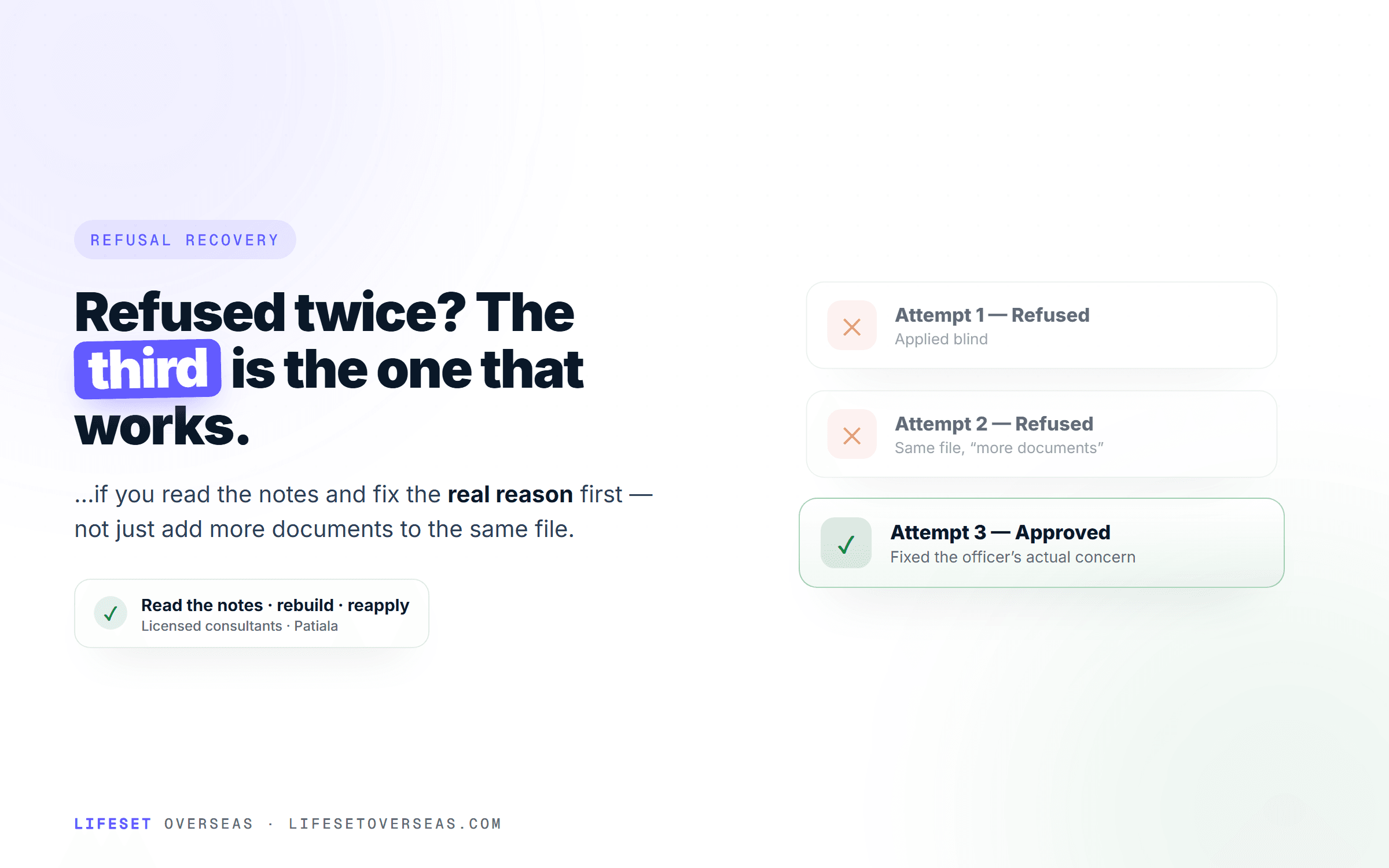
Resubmitting the same documents after a refusal usually earns the same refusal. You must change what the officer sees, not just try again.
4
Hiding a relative abroad
If close family lives in the destination country, declare it and explain your reason to return. A discovered omission damages credibility far more than the relationship itself.
If you were already refused for weak ties
A refusal is the most fixable thing in this whole process, because it tells you exactly where your file fell short. The path back is methodical, not magical.
1
Get the real reason
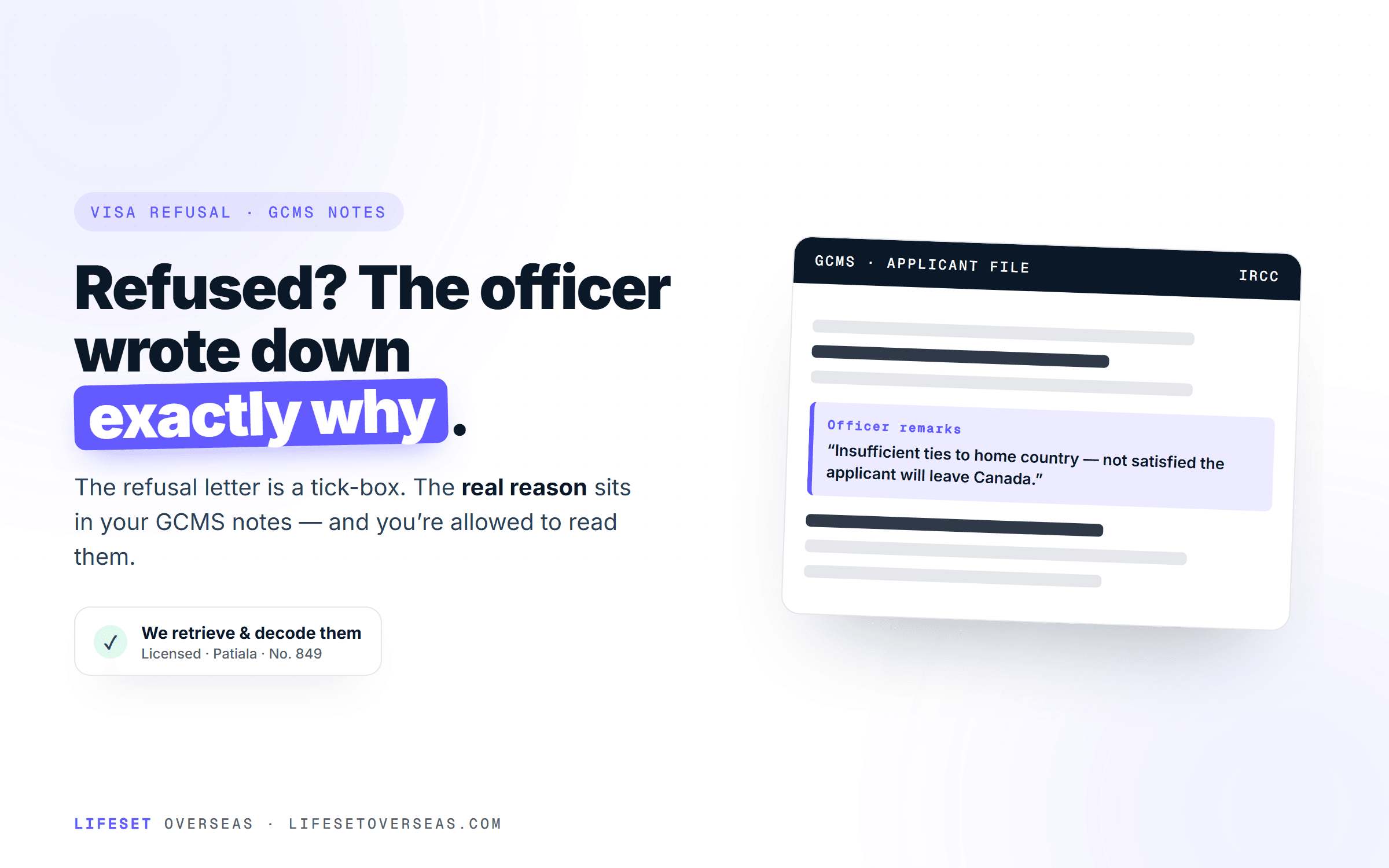
Read the refusal grounds carefully; for Canada, order your GCMS/CAIPS notes to see the officer's actual concern.
2
Map the gap
Identify which tie the officer couldn't see — usually employment, funds or family — and gather the missing proof.
3
Rebuild, don't repeat
Submit a materially stronger file: new documents, a clearer cover letter, and any change in circumstances since.
4
Reapply when the file is ready
Apply once the evidence is genuinely stronger — not the next day, and not with the same package that was just refused.
For Canada cases, the GCMS notes are often the single most useful thing you can obtain — see our CAIPS/GCMS notes service. For a country-by-country breakdown of refusal grounds and how to answer them, start at our visa refusal hub. If you are not sure your destination is even the right fit, the visitor visa overview walks through the common routes.
Frequently asked questions
Is weak ties really the most common visitor visa refusal reason?
Yes. "Not satisfied you will leave at the end of your stay" and its equivalents — US 214(b) immigrant-intent, Schengen Article 32 grounds, UK and Canadian return-intent concerns — are the most frequently cited reasons visitor and tourist visas are refused. It outranks money problems in most files because even well-funded applicants get refused when their reasons to return aren't documented.
Can I get a visa if I'm single, young and unemployed?
It is harder, but not impossible. With no job, property or dependants, you have fewer ties to show — so you lean on whatever is genuine: family who depend on you, ongoing studies, a sponsoring parent's settled life, and a short, specific, well-funded trip with a fixed return. Honesty about your situation, paired with strong supporting evidence, beats inventing ties that fall apart under scrutiny.
Will a big bank balance fix a weak-ties refusal?
No. Money proves you can afford the trip; it does not prove you will return. Officers refuse plenty of applicants with large balances precisely because the balance appeared suddenly or the return reasons were missing. Genuine, seasoned funds plus documented ties work together — money alone does not.
Should I write a cover letter explaining my ties?
Yes, a concise one helps. A good cover letter names your job or business, your property, your dependants and your fixed return date, and points the officer to the documents that back each claim. It should guide the officer through your evidence — never replace it. Keep it factual and short.
How soon can I reapply after a ties-based refusal?
There is usually no fixed waiting period for visitor visas, but reapplying immediately with the same file almost always fails. Wait until you have genuinely strengthened the file — new documents, a clearer return rationale, or a real change in circumstances. A stronger file matters far more than how much time has passed.
Not sure which of your ties the officer couldn't see? Start with our ₹499 Visa Risk & Approval Report — a licensed review of your profile and documents that pinpoints the weak spots before you spend on fees again. It's refundable and credited if you go on to file with us. Get your ₹499 report, or if you were already refused, begin at our refusal help hub.
What to do next
Refusal recovery
Find the real reason, pull your CAIPS/GCMS notes, and refile a corrected, stronger application.
We never predict an outcome or promise a visa. We tell you what your file says and what can be fixed.
Talk to a consultant about your case
Read this article? Now tell us about your situation.
We’ll WhatsApp you within 4 working hours with an honest read on your file and the realistic next steps. Licensed, fixed-fee, and one consultant from first call to decision.
Read the article? Message us on WhatsApp with your situation — a consultant from our Punjab-licensed consultancy gives you an honest read and the next step.