
In this article
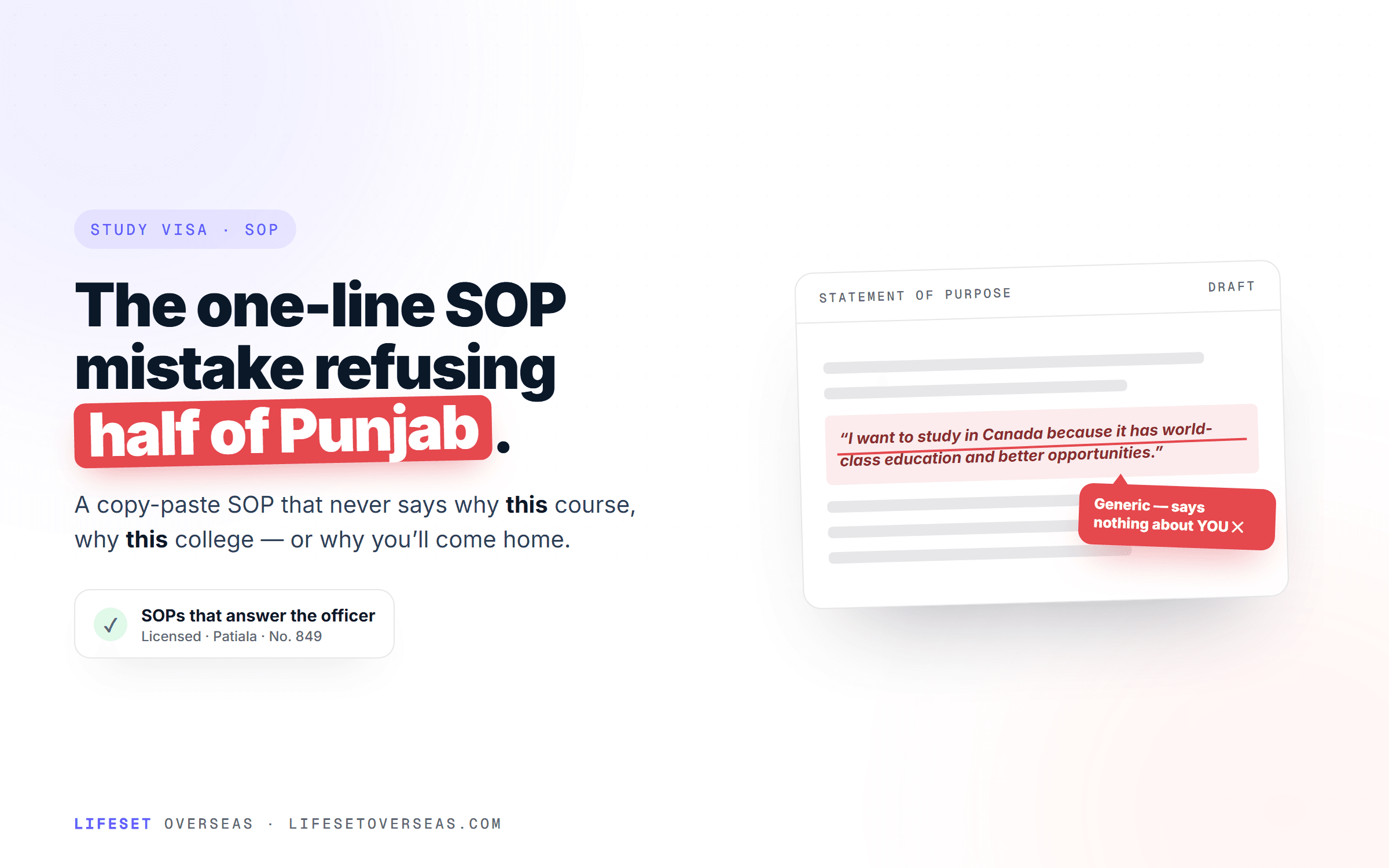
Half the study-visa files that come back to our Patiala desk with a "refused" stamp share one thing, and it is not the bank balance. It is the Statement of Purpose.
A visa officer reads your SOP in barely two minutes. If those two minutes sound like a template someone else filled in, the rest of your file hardly gets a fair hearing. This is the quietest, most common, and most fixable reason bright students from Patiala, Rajpura, Nabha and Sangrur get turned down.
The SOP quietly decides your file
Every study-permit decision turns on one silent question in the officer's head: is this a genuine student who will actually study, and then leave when the visa ends? Your marks, your loan sanction, your IELTS band, those are just inputs. The SOP is where you tie them into a believable story about one specific person: you. Get that story wrong and even a strong profile gets refused.
And the numbers are not gentle right now.
52%
Canada study-permit refusal rate, 2024
Up from 38% the year before
CAD $23,448
Proof of funds, single applicant
From 1 September 2026, outside Quebec
4 × 150 words
Australia's Genuine Student questions
In place since 23 March 2024
Verified from ICEF Monitor / IRCC data on 2024 study-permit refusals · checked 2025-03
When more than half of Canada's applicants are being refused, you cannot afford to hand the officer an easy reason to say no. A weak SOP is exactly that.
The one-line mistake
The single mistake behind most SOP refusals fits in one line: the SOP could belong to anyone.
Swap out your name and it would sit just as comfortably on a stranger's file. It never answers the four questions the officer is actually asking: why this course, why this college, why this country, and why leave what you have at home to chase it. Instead it recites ambitions ("I have always been passionate about business and management") that a thousand other applicants wrote the same week.
If your SOP would still make sense with someone else's name on top, the officer has already found their reason to refuse.
The SOP mistakes we see on Patiala desks
Across the files we review, the same handful of mistakes come up again and again. Recognise any of these in your own draft.
It never answers 'why THIS course'
Vague passion is not a reason. "I want to grow in the IT field" tells the officer nothing about why a Diploma in Cloud Computing at a specific college fits your B.Sc, your job, and your plan. Name the subjects, the skills gap you are closing, and the exact role it leads to.
'Why this college' is pasted marketing
Copying the college's own tagline ("world-class faculty and state-of-the-art labs") is a red flag, not a strength. It shows zero real research. Point to the specific modules, the co-op option, the credential level, or the pathway you personally chose it for.
The job or the study gap is unexplained
Left a stable job? Have a two-year gap after graduation? If the SOP stays silent, the officer fills the silence with suspicion. Explain the gap or the switch honestly and show how this course is the logical next step, not an escape route.
It contradicts the rest of the file
The SOP says one field, the transcripts say another, the funds affidavit names a sponsor the SOP never mentions. Inconsistency reads as fabrication. Every claim in the SOP must match your marksheets, IELTS, funds and forms exactly.
No plan for coming back
Canada assesses whether you will leave at the end of your authorised stay, and "the officer is not satisfied you will leave" is the most-cited study-permit refusal ground. An SOP that never mentions what you return to (family responsibility, land, a business, a career at home), quietly fails that test.
What a convincing SOP actually proves
A strong SOP is not better English or longer paragraphs. It is one that proves a few specific things to a busy officer. Here is the difference between a draft that gets refused and one that gets read seriously.
Refused
The generic SOP
- Opens with a movie-style childhood dream
- "Why this college" is lifted from the brochure
- Career goal is a vague "better future abroad"
- Skips the gap, the job switch, the earlier refusal
- Never mentions returning home
- Nothing in it is checkable against your documents
Convincing
The genuine-student SOP
- Opens with your real academic and work history
- Names the exact modules and pathway you chose
- Career goal is a specific role in India after study
- Faces the gap or job change head-on, with dates
- Shows concrete ties: family, property, obligations
- Every claim lines up with your marksheets and funds
Put simply, a convincing SOP proves you are a genuine student, with a credible plan, who has real reasons and ties to return. Miss any one of the three and the officer's doubt grows.
Build a real SOP, step by step
You do not need flowery language. You need honesty, specifics and consistency. Work through it in this order.
- 1
Start with your real history
Write your actual education and work timeline first, dates, results, roles. Everything else in the SOP must grow out of this, not float above it.
- 2
Justify the exact course and college
Read the actual course page. Name two or three modules, the credential level, and the specific outcome it gives you. Say why this provider over a cheaper option at home.
- 3
Explain the money plainly
State who is funding you and how they earn it. Match it to your proof of funds to the rupee. Unexplained large deposits invite more doubt than they remove.
- 4
Face the awkward parts head-on
A gap, a job resignation, a past refusal, low early marks: address each one in a sentence or two. Silence looks like hiding; a calm explanation looks like a genuine applicant.
- 5
Show what you return to
Spell out your specific ties: family you support, land or a business, a defined career path back home that this qualification unlocks. Be concrete, not sentimental.
- 6
Cross-check against every document
Read the SOP beside your transcripts, IELTS, funds and application forms. Fix every mismatch. This one step catches most self-inflicted refusals.
Canada says "SOP", Australia says "Genuine Student": same test
The label changes across the counter; the test does not. Australia retired the old Genuine Temporary Entrant statement and now asks four Genuine Student questions, 150 words each, covering your ties at home, why this course and provider, and how it benefits you. Canada keeps the free-form SOP. Both are the officer's tool to decide the exact same thing.
Australia's GTE became the Genuine Student (GS) requirement on
→23 March 2024
Source: Department of Home Affairs, immi.homeaffairs.gov.au
Frequently asked questions
Talk it through before you submit
If your draft reads like it could belong to anyone, come and fix that before it costs you an application. Our team helps students across Patiala, Rajpura, Nabha and Sangrur shape honest, specific SOPs that answer the questions officers actually ask, for both Canada and Australia.
See how we handle a study visa, and if you have already been refused, start with your GCMS/CAIPS notes and our visa refusal help so the next SOP answers the real reason. You are also welcome to walk into our Patiala office on Nabha Road, near the PRTC Workshop, or WhatsApp/call us on +91 91155 80911: Punjabi, Hindi or English, whatever is easiest for you.
What to do next
Study abroad services
From a quick file review to the full student journey — shortlisting, SOP, IELTS and visa.
We never predict an outcome or promise a visa. We tell you what your file says and what can be fixed.