
In this article
Every autumn our Nabha Road office fills with the same happy problem. A son in Brampton or a daughter in Surrey wants to bring Mummy-Papa over for the winter, for the grandchildren's first steps, or for a back-to-back wedding season. They walk in asking for a "Canada visitor visa for parents." Nine times out of ten, that is not the visa they actually want.
Canada built a completely separate document just for parents and grandparents, the Super Visa, and most Punjab families never hear its name until a six-month stamp is already running out. Below is the honest comparison: the real numbers, the traps, and how to choose the right one before you spend a single rupee.
Two visas that look the same on paper: and behave very differently
Here is the confusion. A regular Canada visitor visa (officially a Temporary Resident Visa, or TRV) can itself be issued as a 10-year, multiple-entry sticker. So can the Super Visa. Families see "10 years" on both and assume they are the same thing. (Since late 2024 that 10-year validity is no longer handed out automatically, the officer sets it, but both visas can still carry it.)
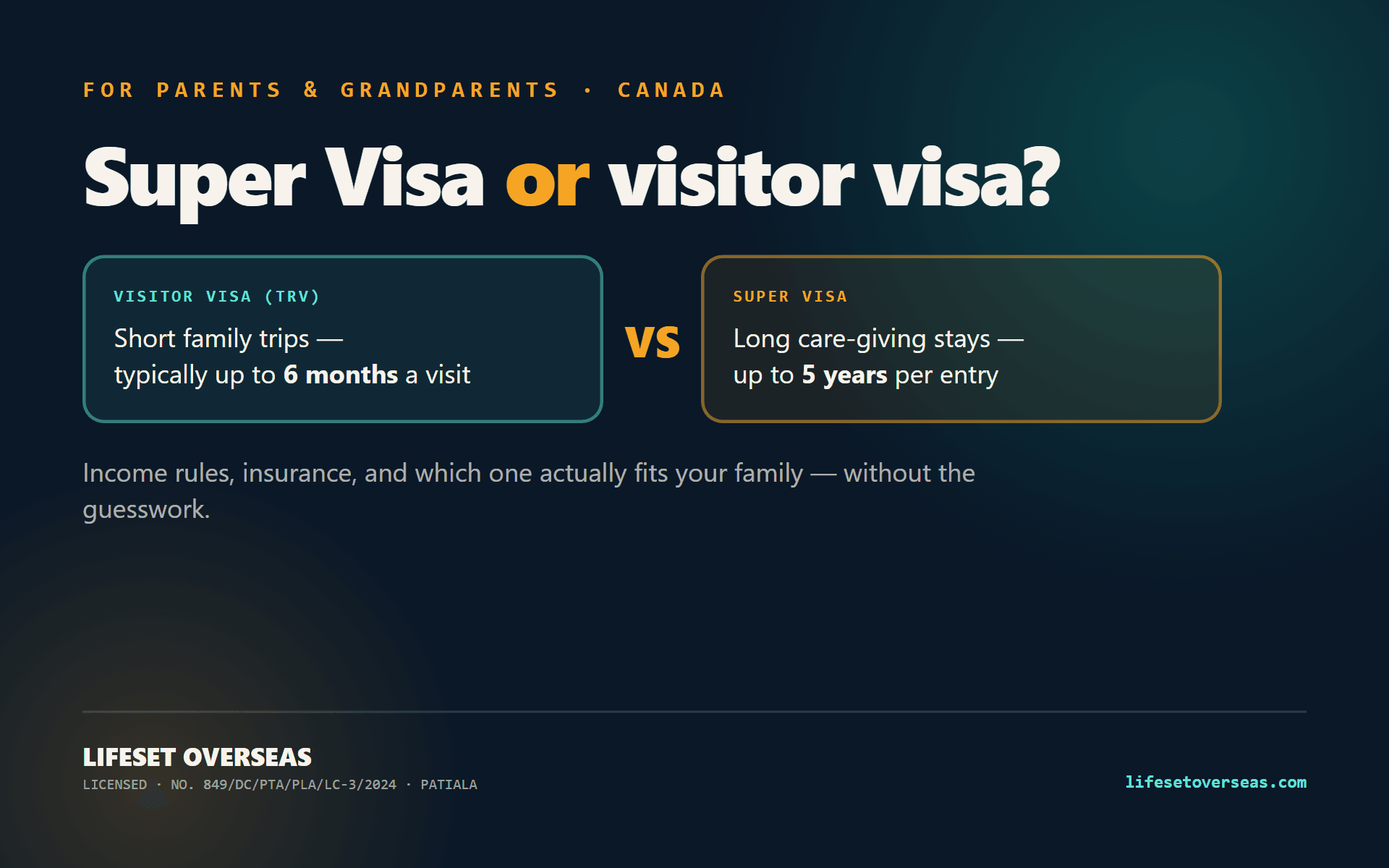
They are not the same. The number that matters is not how long the visa is valid. It is how long your parents may stay each time they land. A visitor visa usually allows a stay of about six months per entry. A Super Visa allows a stay of up to five years per entry.
Up to 5 yrs
Super Visa stay per visit
For entries from June 22, 2023, was 2 years before
Up to 6 mo
Typical visitor visa stay
Officer sets the exact date at the airport
Up to 10 yrs
Multiple-entry validity
Possible on BOTH, no longer automatic
CAD $100k
Super Visa insurance floor
Emergency medical, valid 1 full year
So if your parents plan a two- or three-month trip for a wedding and to see the grandchildren, a visitor visa does the job cleanly. If they want to spend a full Canadian winter with you, or move in for a couple of years to help with a new baby, the visitor visa forces them to keep applying for extensions from inside Canada, with no guarantee. The Super Visa was designed exactly for that long stay.
Side by side: visitor visa vs Super Visa
Option A
Visitor Visa (TRV)
- Open to any genuine visitor: parents, siblings, friends, in-laws
- Each stay usually up to 6 months; officer decides at the port of entry
- No medical insurance requirement
- No host income requirement
- Usually no immigration medical exam for a short visit
- Extending a longer stay means applying again from inside Canada
Option B
Super Visa
- Only for parents and grandparents of a Canadian citizen or PR
- Each stay up to 5 years. No re-application needed for years
- Mandatory medical insurance of at least CAD $100,000
- Host (you) must meet a minimum income (LICO) for your family size
- Immigration medical exam is required
- One document covers years of back-and-forth visits
Notice who the Super Visa is closed to. If the person you want to invite is your brother, your bua, a father-in-law of a spouse who is not yet a citizen or PR, or a family friend, the Super Visa is simply not available to them. Only a visitor visa is. This one fact settles a large share of the cases we see.
What the Super Visa actually asks of you
The Super Visa's power, those long stays, comes with three tests the visitor visa never applies. This is where Punjab families get caught out, usually after the tickets are already booked.
What IRCC checks before granting a Super Visa
- Who can applyNot siblings, in-laws, dependants or friends
- Parent or grandparent of a Canadian citizen or PR
- Medical insuranceCanadian OR an OSFI-authorised foreign insurer since Jan 28, 2025
- At least CAD $100,000, valid 1 year from entry
- Host income (you)From March 31, 2026: use either of the last 2 tax years
- Meet the LICO minimum for your family size
- Invitation letterPromises support; states your household size
- Signed letter from the child or grandchild
- Immigration medicalUsually not needed for a short visitor trip
- Required
IRCC (canada.ca), verified July 2026
There is good news on the income side. As of March 31, 2026, IRCC eased the host income rule in two ways that help ordinary working families: you can now qualify using either of the last two tax years (a help if you had a lay-off, a seasonal job or a slow year), and for the first time the visiting parent's own income can be added to top yours up to the line. The catch worth knowing: you, the host, must still meet a minimum share of the threshold on your own before your parent's income counts, IRCC has said this applies but has not yet published the exact percentage.
Super Visa medical insurance: the hard floor
→CAD $100,000 for 1 year
Source: IRCC, rules in force 2026
When the plain visitor visa is genuinely the smarter choice
We are not here to upsell. For a large number of Patiala, Rajpura, Nabha and Sangrur families, the visitor visa is the right call, and pushing them toward a Super Visa would only add cost and paperwork.
If your parents want to come for a wedding, a two-month holiday, or to help for one season and then head home to Punjab: a clean visitor visa is faster, cheaper and perfectly sufficient.
Choose the visitor visa when the trip is short, when you are still on a work or study permit yourself (so the Super Visa is not even an option), or when you would rather not tie up money in a full year of medical insurance for a two-week Diwali visit. Choose the Super Visa when your parents want to live with you for a long stretch (a new baby, a health situation, or simply the winters), and you can comfortably clear the income line and the insurance.
A simple way to decide
- 1
Is the traveller your parent or grandparent?
If it is a sibling, cousin, in-law or friend, stop here. Only a visitor visa is possible. The Super Visa is closed to them. - 2
Are you a Canadian citizen or PR?
The Super Visa needs the inviting child or grandchild to be a citizen or permanent resident. If you are still on a temporary permit, apply for a visitor visa for now. - 3
Do they want to stay longer than about 6 months at a stretch?
If yes, the Super Visa avoids repeated extensions. If a few weeks or a couple of months is enough, a visitor visa is simpler and cheaper. - 4
Can you meet the LICO income line and buy the CAD $100,000 insurance?
If yes, the Super Visa is within reach. If the income is tight this year, remember the new two-year lookback and the option to top up with your parent's income.
Whichever route you take, the two applications share the same foundation: your parents must convince a visa officer that the visit is genuine and that they will return to India. That means clear ties back home (property, pension, other family, a business), and a straightforward, believable itinerary. A weak, vague file gets refused on either visa. This is the part most walk-in clients underestimate, and the part we spend the most time getting right.
Frequently asked questions
Talk it through before you apply
Choosing between a Super Visa and a visitor visa is not about picking the "better" visa. It is about matching the visa to the length of the visit and to your own status in Canada. Get that right and the rest of the file becomes far easier.
If you would like a straight answer for your family's situation, come in and see us. We are a licensed consultancy (licence No. 849/DC/PTA/PLA/LC-3/2024) at Shop No. 2, Nabha Road, near PRTC Workshop, Patiala: walk in, or WhatsApp / call +91 91155 80911. We advise in Punjabi, Hindi and English. Read more about the Canada Super Visa and the Canada visitor visa, find us at our Patiala office, and if a past application was refused, ask us about visa refusal help and ordering your GCMS/CAIPS notes so we know exactly what went wrong before you re-apply.
What to do next
Family & long-stay visas
Canada Super Visa, spouse / dependent and long-stay filing — handled end to end, payable in parts.
We never predict an outcome or promise a visa. We tell you what your file says and what can be fixed.