

Italy · Visa guide
 Italy · Visa guide
Italy Study Visa
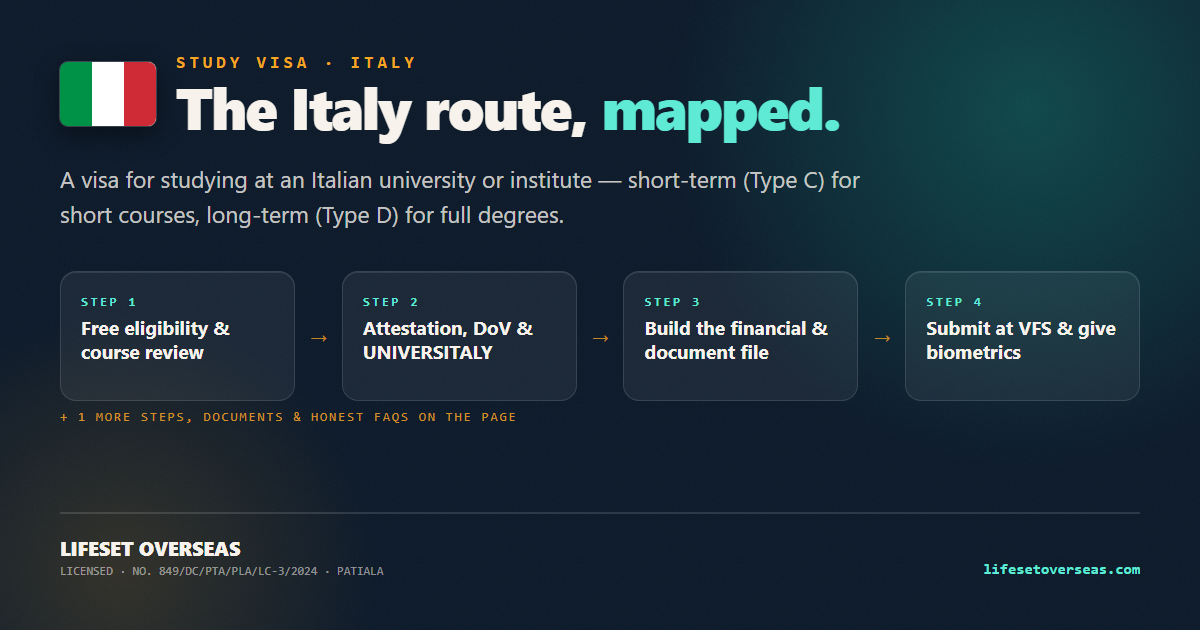
A visa for studying at an Italian university or institute — short-term (Type C) for short courses, long-term (Type D) for full degrees.
- ProcessingUp to 90 days under Italian law
- Visa categoryStudy Visa
- Your guideOne consultant
Your offer letter is only the start. Funds, SOP and the interview decide the visa. Call us with your course and intake. We tell you if the money and the story hold up.
Monday–Saturday, 9:00 AM – 7:00 PM IST
10
Documents mapped
5
Steps explained
3
Questions answered
Up to 90 days under Italian law
Typical processing
Start here
Italy Study Visa — overview
The Italy Study Visa lets Indian students attend a university or institute in Italy. Students whose admission depends on an entrance test at the Italian university, or who are joining a full degree programme, apply for a Long-Term (Type D) visa; shorter courses are covered by a Short-Term (Type C) visa.
Italy requires your study certificates to be HRD-attested and apostilled by the MEA, plus a Declaration of Value (DoV) or a CIMEA certificate, proof of enrolment on the UNIVERSITALY portal and proof of paid enrolment fees. Funds of at least EUR 534 per month must be shown.
Lifeset Overseas guides you through attestation, the DoV/CIMEA route, UNIVERSITALY enrolment and the financial documentation so the file is complete the first time.
Earliest slot we saw
Checked by hand · 21 September
- Mumbai
- 29 Oct
- Bengaluru
- No slots open
Tourist / short-stay appointments only. A snapshot from the portal on the date above, not a live feed. Slots move hour to hour and we never hold or sell them. All centres & jurisdictions
Italian study at world-class institutions, often at very low tuition
Italy is one of the few major European study destinations where public university tuition is genuinely low — many Italian public universities charge income-linked fees that leave international students paying close to zero after means-testing. The University of Bologna (the oldest in the Western world), Sapienza University of Rome, the Politecnico di Milano, the University of Padova, the University of Pisa, and dozens more all operate on this basis.
The trade-off is bureaucracy. Italian admissions and visa processes are document-heavy and have several distinctly Italian steps that are easy to miss without preparation. We walk Indian students through the full pathway — Universitaly pre-enrolment, Declaration of Value, national D visa, and the Permesso di Soggiorno on arrival.
The Universitaly portal — Italy's mandatory pre-enrolment route
For most degree-level programmes, Indian applicants apply for Italian university admission through Universitaly (universitaly.it), the national portal operated by the Italian Ministry of University and Research. The portal is not optional — Italian universities accept pre-enrolment only through Universitaly for international applicants. Once the university confirms admission, the pre-enrolment is validated on the portal, and the system forwards the case to the Italian embassy or consulate of your jurisdiction.
Pre-enrolment windows typically open in February-March and close in mid-July for autumn intake. Programmes have programme-specific deadlines on top of the portal-wide window. Plan to start the Universitaly process at least four months before the desired start date.
Italian-medium versus English-medium
Italian universities now offer a substantial number of English-medium programmes, particularly at Masters level — Politecnico di Milano in engineering, Bocconi in economics and management, Sapienza in selected fields, the University of Bologna across multiple programmes. Some PhD programmes are also conducted in English.
For Italian-medium programmes, you typically need B1 or B2 Italian evidenced by CILS, CELI, or PLIDA certification. For English-medium, IELTS 6.0-6.5 or TOEFL 80-90 is typical, varying by programme.
The Declaration of Value (Dichiarazione di Valore)
The Dichiarazione di Valore is a document issued by the Italian embassy in Delhi that attests how your Indian academic qualifications translate into the Italian academic system. It confirms that your degree is recognised, what level it sits at in Italy, and that it qualifies you for the programme you are applying to.
The Declaration takes two to four weeks at the embassy, with its own documentation requirements (originals, photocopies, sometimes apostilled translations). For most degree-level admissions to Italian universities, the Declaration is mandatory and must be obtained before the visa appointment.
The national D visa — your study visa
The Italian long-stay national D visa is the visa category for study lasting more than 90 days. It is distinct from the Schengen short-stay Type C — different application form, different supporting documents, longer processing time. The D visa allows entry into Italy and the first stay; on arrival you convert it into a Permesso di Soggiorno residence permit.
Required documents centre on the admission letter, Universitaly pre-enrolment, Dichiarazione di Valore, financial proof for at least the first year (approximately EUR 6,000-7,500 per year indicative minimum), health insurance valid in Italy, and accommodation evidence. The cover letter and study plan explain why you chose this programme and university, and how it fits your longer-term plans — Italian consulates read these letters carefully on student files.
Permesso di Soggiorno — within 8 days of arrival
After entering Italy on the D visa, you have eight working days to apply for the Permesso di Soggiorno — the Italian residence permit. The application is initiated at an Italian post office using the kit giallo (yellow kit), forwarded to the local Questura (police headquarters) for biometrics and final issuance.
The Permesso typically takes 2-3 months to physically issue, but the receipt from the post-office submission is your proof of legal residence during the wait. Missing the eight-day window is a serious issue — late applications attract fines and complications. We brief every Italian student in detail on this step before departure.
Tuition and living costs
Italian public university tuition is famously low for international students. The standard pattern is an income-linked fee structure: students from lower-income families (assessed via the ISEE Parificato declaration) pay close to zero, while higher-income brackets pay up to EUR 3,000-4,000 per year. Specific bands vary by university.
Private universities — Bocconi, LUISS, IULM, the Catholic University, Politecnico di Milano (which is public, but with some higher international tuition tiers) — charge EUR 6,000-25,000 per year, in line with international private-university norms.
Living costs vary sharply by city. Milan and Rome are the most expensive Italian student cities, with student accommodation costing EUR 500-800 per month centrally. Bologna, Padova, Pisa, Trento, and Turin are significantly more affordable at EUR 350-500 per month. Total living costs (rent, food, transport, books) typically run EUR 8,000-13,000 per year for students living independently.
Top Italian universities for Indian applicants
- University of Bologna — oldest university in the Western world, broad programme offering across humanities, sciences, engineering, medicine.
- Sapienza University of Rome — one of Europe's largest universities, with English-medium programmes in business, engineering, and the sciences.
- Politecnico di Milano — engineering and architecture, heavily English-medium at Masters level, strong industry links.
- University of Padova — historic university, strong in medicine, sciences, engineering. Many English-medium programmes.
- Bocconi University (private) — premier private business and economics school in Milan, fully English-medium for most international programmes.
- Politecnico di Torino — engineering, with strong English-medium offering and automotive industry links.
- University of Pisa, University of Florence, University of Trento — strong second-tier publics, particularly in sciences and engineering.
How we can help
We are a licensed visa consultancy based in Patiala, Punjab. We handle Italian student visa pathways end-to-end: programme shortlist, Universitaly pre-enrolment, Declaration of Value coordination at the Italian embassy in Delhi, financial documentation strategy, insurance, accommodation, VFS Italy submission, and on-arrival Permesso di Soggiorno briefing. One consultant sees your case from first consultation to landing in Italy. Book a free 30-minute assessment and we will tell you, honestly, whether your Italian study plan stacks up and which universities to target.
Verified figures for Italy
What a year in Italy costs — and what you must prove
- Public-university tuition, non-EU student, per year
- €900 – €4,000
- Private universities: €6,000 – €20,000
- Funds the visa authority asks you to show
- €10,180 a year
English-taught courses: widely available. CEFR B2 in the language of instruction is the MUR/consular MINIMUM, a...
Read on the official pages below on 27 Aug 2026. Figures change every academic year — check them before you pay anything.
10 items
Documents you need
Application form (C or D)
Duly filled and signed; for minors, signed by both parents.
Passport
Issued within 10 years, valid beyond the visa duration, with 2 blank pages.
Photograph & passport copy
One recent white-background photo and a copy of the passport.
Personal cover letter
Explaining your study plans in Italy.
Study certificates
Original certificates HRD-attested and apostilled by the MEA (SDM attestation is not accepted).
DoV or CIMEA certificate
Declaration of Value, or a CIMEA certificate where the Italian institute accepts it.
Proof of enrolment
Confirmation downloaded from the UNIVERSITALY portal and/or an admission letter, plus the enrolment-fee payment receipt.
Language certificate
B2-level English (IELTS/TOEFL) or B2-level Italian, depending on the course language.
Financial means
Proof of support of at least EUR 534.41 per month (EUR 6,947 a year) — income, sponsor documents or an education loan visible on bank statements.
Accommodation & insurance
Proof of lodging in Italy and medical insurance with at least EUR 30,000 cover including repatriation.
5 steps
How the process works
Typical processing: Up to 90 days under Italian law — apply well before your course start date.
Step 1
Free eligibility & course review
We confirm whether your case needs a Type C or Type D visa and map out the attestation route.
Step 2
Attestation, DoV & UNIVERSITALY
We guide HRD attestation and apostille, the DoV or CIMEA certificate and UNIVERSITALY pre-enrolment.
Step 3
Build the financial & document file
Every certificate, fee receipt, language score and funds document is verified before submission.
Step 4
Submit at VFS & give biometrics
You attend VFS Global to submit the application and provide biometrics.
Step 5
Embassy decision & passport return
The Embassy of Italy assesses the file and your passport is returned through VFS.
Transparent
Costs & fees
Item
Amount
National (type D) visa fee
Short-term study (type C) is EUR 90. Payable in INR at submission.
EUR 116
VFS Global service charge
Plus optional courier and add-on services.
Confirmed at booking
Government and third-party fees change often — we confirm the exact current amounts for your case before you pay anything.
3 answers
Frequently asked questions
Students joining a full degree, or whose admission depends on an entrance test in Italy, apply for a Long-Term (D) visa. Short courses use a Short-Term (C) visa. We confirm the right category for your case.
A Declaration of Value (Dichiarazione di Valore) is an embassy document confirming the value of your Indian qualification. Some institutes accept a CIMEA certificate instead — we guide whichever your university requires.
At least EUR 534.41 per month (about EUR 6,947 a year). This can be your own income, sponsor support, a scholarship or an education loan visible on bank statements.
Why it matters
Going it alone vs filing with us
On your own
- Guessing the document list — one missing or wrongly formatted paper triggers a refusal.
- Generic cover letters copied from the internet that officers recognise and flag.
- No read on peak rejection windows or what this visa post is strict about.
- Government and VFS fees are non-refundable — money lost if you are refused.
- A refusal stamp follows you and weakens every future visa application.
With Lifeset Overseas
- An honest case assessment before you spend a rupee on government fees.
- A file built to the embassy's exact checklist and in the exact order.
- Weak finances, ties or purpose identified and fixed before submission.
- Previously refused? We can rescue and rebuild the file.
- Every case handled by one consultant, end to end.
Refused before?
A refusal isn't the end
A refusal is not a permanent bar — but it only improves if the actual reason is found and answered, and nobody can tell you a second application will succeed. If a Italy visa has been refused, we:
- Read the actual refusal letter and pinpoint the real gaps.
- Advise whether to pull the officer's notes (CAIPS / GCMS) for the true reason.
- Identify which part was weak — funds, employment, purpose or ties.
- Tell you honestly whether to reapply now or strengthen the file first.
- Refused? Your fee back, or a rebuilt application free — your choice.
Guides
Italy guides worth reading first
- The "Schengen Study Visa" Doesn't Exist — Here's What You Actually Apply For
- Study in Europe vs Canada: What a First Year Really Costs
- Schengen Visa Rejection from India: Reasons, Appeal vs Reapplication, How to Recover (2026)
- Germany vs Italy for Indian Students (2026): Tuition, Visa, Universities — Honest Comparison
Other Italy visas
Italy Tourist Visa
A short-stay Schengen visa for tourism and sightseeing in Italy — up to 90 days within any 180-day period.
Italy Business Visa
A short-stay Schengen visa for meetings, conferences, negotiations and other business visits to Italy.
Italy Family & Friends Visit Visa
A short-stay Schengen visa to visit family or friends already living in Italy — up to 90 days.
Italy Family Reunion Visa
A long-stay (Type D) visa to join a close family member legally residing in Italy — spouse, parent or child.
Start here · One message away
Italy study visa: do not send a weak file. Call first.
- Honest assessment
- Fixed all-in fees
- No handovers between staff
- Licensed in Patiala
Let’s discuss your case
Send your offer letter and sponsor details on WhatsApp. We tell you plainly if the funds and the SOP are strong enough, and what is missing.