
 United Kingdom visa guide
What the Student route is
The UK Student route, which replaced the old Tier 4 (General) student visa in October 2020, is the immigration permission for foreign nationals coming to the UK to study at an institution licensed as a Student sponsor by UK Visas and Immigration (UKVI). The route covers degrees, postgraduate study, foundation programmes, and certain pre-degree courses, depending on the sponsor's licence rating.
Unlike the old Tier 4 system, there is no points score to memorise or count. Every requirement is pass-or-fail: you have a CAS or you do not, you have the maintenance funds for the required 28 days or you do not, you have the TB certificate or you do not. UKVI's job is to check the file against the CAS and the published rules.
The CAS: what it actually does
The Confirmation of Acceptance for Studies (CAS) is the single most important document in a UK student visa application. Your sponsor issues it through the UKVI Sponsor Management System after you accept the offer and meet any pre-CAS conditions (deposit, language proof, document verification). The CAS contains a unique reference number you enter on the visa application form.
Critically, the CAS records the exact programme name, course code, level, dates, tuition fee, any scholarship, the deposit you have paid, and how the sponsor assessed your English. UKVI compares your visa application against the CAS and refuses any application that does not match. We routinely catch CAS errors (wrong course code, wrong fees, missing scholarship), before submission, because UKVI will not fix them after refusal.
A CAS is valid for six months. Plan your visa application within that window: too early and the funds may not be held long enough; too late and the CAS expires.
English language requirements
Most degree-level applicants need CEFR B2 across all four skills (reading, writing, speaking, listening). The standard route is to take an approved Secure English Language Test (SELT): IELTS UKVI Academic is the most common in India, but other tests on the SELT list are also accepted.
Some sponsors are permitted to assess English internally: for example, if you have a recognised English-medium degree from an approved country. In those cases your CAS records the assessment method and you do not take a SELT. If you are unsure, look at the CAS your sponsor issued: the English assessment method is listed there.
Maintenance funds: the 28-day rule
This is where many otherwise-strong applications get refused. The maintenance fund requirement has three components and a strict timing rule:
- Tuition fees for the first year of the course (or the full course if it is shorter than a year). If your CAS records that you have already paid some tuition as a deposit, that amount is deducted from what you need to show.
- Living costs at GBP 1,529 per month for courses in London (maximum 9 months (GBP 13,761), or GBP 1,171 per month outside London (maximum 9 months), GBP 10,539). UKVI upgrades these rates periodically, so check gov.uk before you move money.
- The total must be held in an accepted account for 28 consecutive days, ending no more than 31 days before you submit the visa application.
The funds may be in your name or in a parent's name with a consent letter and a proof-of-relationship document. They cannot be in someone else's name (an uncle, a friend, a sibling), UKVI does not accept those arrangements. The account type must allow you to access the money: ordinary current and savings accounts qualify; some fixed-term deposits do not, depending on early-withdrawal terms. We verify this at the file-build stage, not at the visa decision stage.
If the funds dip below the required threshold even briefly during the 28-day window, the application fails on maintenance: even if the average balance was well above the requirement. We move with care here.
Tuberculosis test, ATAS, and other specifics
Applicants applying from India must complete a TB test at a UKVI-approved clinic. The certificate is valid for six months. Without it, the application is refused on a single procedural ground.
Some postgraduate courses and research programmes in sensitive scientific subjects require an Academic Technology Approval Scheme (ATAS) certificate. Your sponsor will tell you whether your programme is in ATAS scope when they prepare your CAS. ATAS applications are made directly to the Foreign, Commonwealth and Development Office and take time, start early.
The application in practice
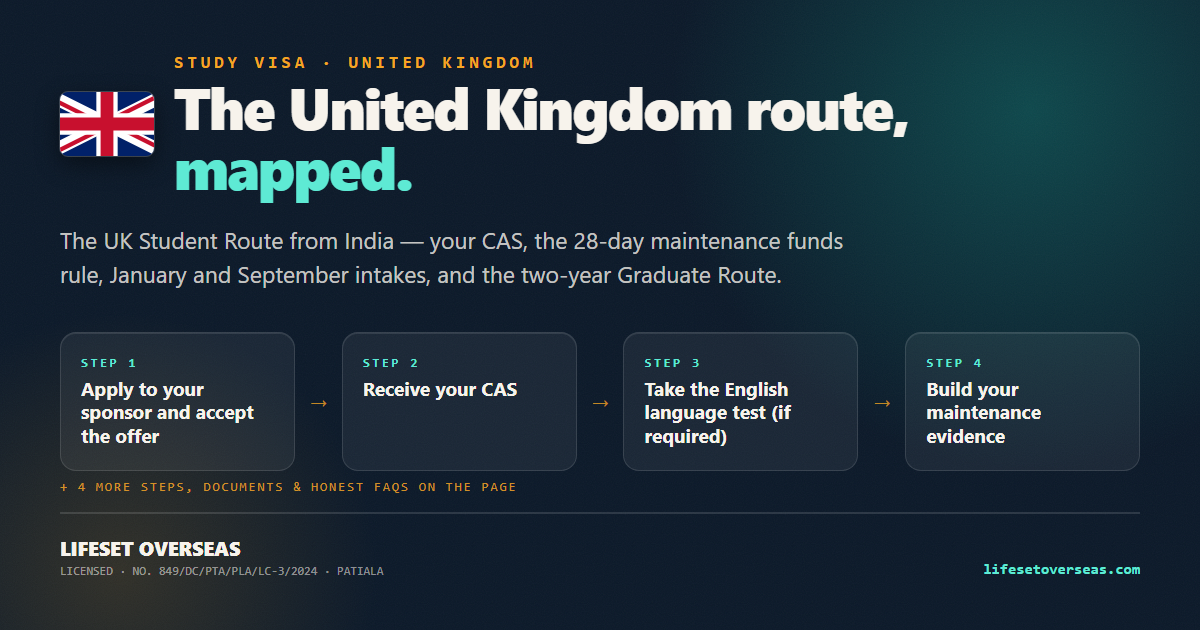
A typical UK student visa application unfolds in this order. You apply to one or more licensed sponsors and accept the offer that fits. You meet any pre-CAS conditions (deposit, language test, document verification), and your sponsor issues the CAS. You take an approved SELT if your CAS does not record an internal assessment. You build your maintenance evidence over the required 28-day window and check that the total covers tuition plus living costs at the correct London / outside-London rate. You complete the TB test in India.
You submit the online visa application via the UKVI portal, pay the application fee, and pay the Immigration Health Surcharge (IHS) for the full visa length up-front. You attend a Visa Application Centre for biometrics and submit the supporting documents. UKVI processes the file against their service standard: three weeks from outside the UK for the standard service, with priority and super-priority options for an additional fee. If approved, you receive an eVisa linked to your passport (new vignettes stopped from 1 July 2026). Follow the decision letter, which may ask you to collect a Form for Accompanying an eVisa (FAV) from the visa centre before you travel.
Bringing dependants: the 2024 restriction
A significant rule change in January 2024 restricted student visa dependants to postgraduate research courses (typically PhDs) and government-sponsored students on courses of six months or more. Taught Master's and undergraduate students can no longer bring dependants on the Student route. This was a hard, fast change that caught many families off guard, and the restriction remains in force at the time of writing: verify the current rule on the UKVI website if your situation depends on it.
If your spouse or children would be applying as your dependants, this rule decides whether the route is realistic for your family at all. We assess dependant eligibility upfront.
Costs: what to budget
The IHS is often a surprise. It is paid upfront at the visa application stage for the full visa length: for a four-year course, that is GBP 776 × 4 = GBP 3,104, due in one payment. Add the application fee, the optional priority service if you need a faster decision, the TB test, the English test, tuition, and the held maintenance funds. The held funds are not spent, but they must exist in an accepted account for the full 28 days. They are an opportunity-cost, not a sunk cost.
Refusals and what to do next
The most common refusal grounds we see for UK student visas are: maintenance funds not held for the full 28 days, funds in an unaccepted account type, missing TB certificate, missing ATAS certificate where required, mismatch between the visa application and the CAS, and, less commonly, concerns about genuine student intent flagged at interview.
If your application is refused, UKVI issues a refusal letter listing the grounds. There is generally no formal appeal for student visa refusals, but you can apply for an Administrative Review where applicable, or, more commonly, submit a fresh application that addresses the specific grounds. We help with both.
The Graduate route: what comes after
The Graduate route, introduced in 2021, lets successful UK graduates stay on to work or look for work without sponsorship. Its length is changing: applications made up to 31 December 2026 get two years, while applications from 1 January 2027 get 18 months. PhD graduates keep three years either way. If you are only starting your course now, plan around the 18-month version, because that is the rule you will graduate into. It is a separate application made from inside the UK after course completion. We do not file Graduate route applications as a routine service, most students do this themselves once they have their degree certificate, but we will tell you in the assessment whether the route is something to plan for.
We do not handle the Skilled Worker route or any UK work visa. Those require a Recruiting Agent licence which we do not hold.
How we can help
We are a licensed visa consultancy based in Patiala, Punjab. We handle the UK Student route end-to-end on the visa side: sponsor selection guidance, CAS verification, English test guidance, maintenance funds planning across the 28-day window, TB test and ATAS coordination where relevant, file assembly, online submission, biometrics scheduling, and reapplication strategy where needed. One consultant sees your case from first call to decision, there is no handoff. Book a free 30-minute assessment and we will tell you, honestly, whether the file is ready or whether the maintenance evidence needs another month to mature.
Official checklist: the Student visa filing packet
From our Knowledge Base (checked against GOV.UK, 19 September 2026):
- Current passport and the CAS reference from a licensed sponsor.
- Course and qualification evidence and the English evidence the sponsor and the rules require.
- Tuition and maintenance evidence unless an exact exemption applies, applying "the 28-day holding and 31-day recency rules" for funds.
- An ATAS certificate if the subject and nationality require it; a TB certificate from an approved clinic.
- Under 18: parental consent covering the application, travel and care, with relationship evidence.
- Written consent from an official financial sponsor where recent sponsorship triggers it.
- Dependants: establish eligibility first, then relationship and separate maintenance evidence. "A taught master's course does not generally establish new dependant eligibility."
Child Student is a separate route for ages 4 to 17 at eligible independent schools. Student work rights depend on the course, the sponsor and the grant conditions; no universal allowance should be assumed.
Sources: GOV.UK Student visa documents (https://www.gov.uk/student-visa/documents-you-must-provide); money you need (https://www.gov.uk/student-visa/money); family members (https://www.gov.uk/student-visa/family-members).
Official sources
- GOV.UK, Visas and immigration: https://www.gov.uk/browse/visas-immigration
Fees and rules change; the official page always prevails. The guide above was written from our filing experience for Indian applicants; check the current requirements on the authority’s site before you book.
