

China · Visa guide
 China · Visa guide
China Study Visa
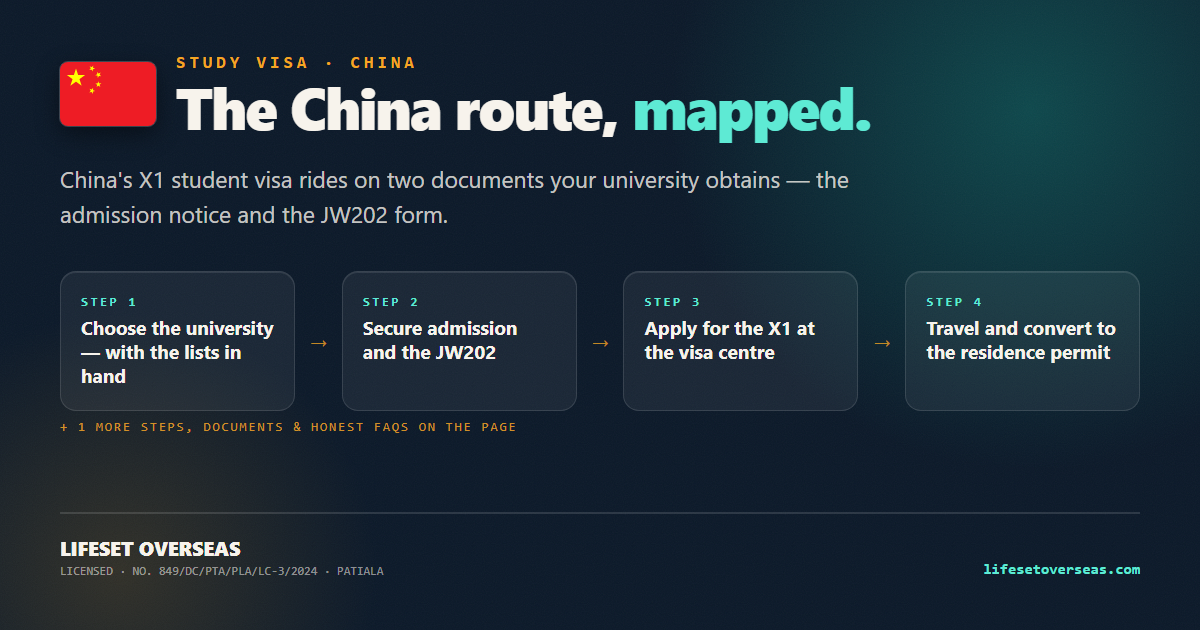
China's X1 student visa rides on two documents your university obtains — the admission notice and the JW202 form. For medical aspirants there is a decisive extra: only degrees from institutions on the recognised lists clear India's machinery, so the university choice IS the career decision.
- ProcessingUniversity admission cycles close months before the September intake; once the JW202 and admission notice are in hand
- Visa categoryStudy Visa
- Your guideOne consultant
Your offer letter is only the start. Funds, SOP and the interview decide the visa. Call us with your course and intake. We tell you if the money and the story hold up.
Monday–Saturday, 9:00 AM – 7:00 PM IST
6
Documents mapped
5
Steps explained
5
Questions answered
University admission cycles close months before the September intake; once the JW202 and admission notice are in hand
Typical processing
Start here
China Study Visa — overview
Two documents, one visa
China's student route is refreshingly mechanical: the Admission Notice plus the JW202 form, both produced through your university, are the pillars the X1 visa stands on. No interview gauntlet, no essay theatre — machinery. The corollary: everything depends on the institution operating that machinery competently and honestly, which is why university selection carries the whole weight of the China decision.
For medical aspirants: the list IS the decision
The bulk of Indian demand for China is MBBS, and here one fact towers over every brochure: India's recognition machinery cares which university you attended. Official lists, NMC criteria and screening examinations decide whether a Chinese medical degree becomes an Indian medical career — and each of these has been revised in living memory. Our rule is absolute: we show you the current lists and notifications from the official sources, we help you verify the university against them, and we never promise a recognition outcome. The agent who guarantees one is quoting a decision that is not his to make.
The money, honestly
Chinese public universities price international programmes moderately, and the CSC scholarship system plus provincial schemes fund real numbers of students — sometimes tuition, sometimes everything. Living costs vary enormously between a first-tier city and a provincial capital; the same degree can carry very different total budgets. Every figure is university-specific and revised: we verify them per file rather than printing numbers here that will quietly rot.
After landing: the conversion deadline
The X1 visa is an entry ticket with a fuse: within the post-arrival window you must convert it to a residence permit at the public security bureau. Universities shepherd this, but the legal duty is yours, and missing the window is the kind of mistake that follows a file around. Our arrival checklist exists because the paperwork does not end at immigration — it ends at the residence permit.
6 items
Documents you need
Admission Notice from the university
The formal acceptance, issued after the university's screening.
JW202 form
The foreign-student authorisation the university obtains from the education authorities — the X1's second pillar.
Financial evidence
Funding proof at the level the mission expects; scholarship award letters count directly.
Physical examination record
The standardised health form, done at approved centres.
Visa application via the Chinese visa centre
With passport, photographs and both pillar documents.
Residence permit conversion after arrival
Within the deadline at the local public security bureau — the step that actually legalises the long stay.
5 steps
How the process works
Typical processing: University admission cycles close months before the September intake; once the JW202 and admission notice are in hand, the visa itself typically takes days to weeks. The residence-permit conversion happens after arrival.
Step 1
Choose the university — with the lists in hand
For medicine especially, the institution's standing on official recognition lists decides your future; verify before applying.
Step 2
Secure admission and the JW202
The university runs both; your job is a complete, honest dossier.
Step 3
Apply for the X1 at the visa centre
Days to weeks with both pillar documents in hand.
Step 4
Travel and convert to the residence permit
Within the post-arrival deadline — miss it and the visa's validity evaporates.
Step 5
Register and study
University and local registration complete the arrival paperwork.
5 answers
Frequently asked questions
It is the authorisation for a foreign student issued through China's education authorities, obtained by your university. The X1 visa application stands on the JW202 plus the Admission Notice together. An "admission" that comes without JW202 machinery behind it is not an admission you can use.
Only conditionally — and the conditions are the whole game. India's machinery recognises medical degrees from listed institutions meeting defined criteria, and the NMC's rules plus screening examinations apply to everyone returning. Lists and rules have both changed. We check the current position with you, we show you the official sources, and we never promise a recognition or licensure outcome. The university choice here is not a detail; it IS the decision.
Yes — the national CSC scheme and provincial programmes fund significant numbers of international students, sometimes fully. They are free to apply for through defined channels. As always: anyone charging to "arrange" a government scholarship is selling you a form.
X1 is the long-term study visa (programmes over six months) and converts to a residence permit after arrival; X2 covers short courses. Degree students travel on X1 — and the residence-permit conversion deadline after landing is a real deadline, not a formality.
Chinese student-visa processing resumed and normalised, but institutional lists, health requirements and procedures saw revisions along the way. We verify the current checklist at filing time rather than trusting anything printed earlier — including by us.
Why it matters
Going it alone vs filing with us
On your own
- Guessing the document list — one missing or wrongly formatted paper triggers a refusal.
- Generic cover letters copied from the internet that officers recognise and flag.
- No read on peak rejection windows or what this visa post is strict about.
- Government and VFS fees are non-refundable — money lost if you are refused.
- A refusal stamp follows you and weakens every future visa application.
With Lifeset Overseas
- An honest case assessment before you spend a rupee on government fees.
- A file built to the embassy's exact checklist and in the exact order.
- Weak finances, ties or purpose identified and fixed before submission.
- Previously refused? We can rescue and rebuild the file.
- Every case handled by one consultant, end to end.
Refused before?
A refusal isn't the end
A refusal is not a permanent bar — but it only improves if the actual reason is found and answered, and nobody can tell you a second application will succeed. If a China visa has been refused, we:
- Read the actual refusal letter and pinpoint the real gaps.
- Advise whether to pull the officer's notes (CAIPS / GCMS) for the true reason.
- Identify which part was weak — funds, employment, purpose or ties.
- Tell you honestly whether to reapply now or strengthen the file first.
- Refused? Your fee back, or a rebuilt application free — your choice.
Start here · One message away
China study visa: do not send a weak file. Call first.
- Honest assessment
- Fixed all-in fees
- No handovers between staff
- Licensed in Patiala
Let’s discuss your case
Send your offer letter and sponsor details on WhatsApp. We tell you plainly if the funds and the SOP are strong enough, and what is missing.