

South Korea · Visa guide
 South Korea · Visa guide
South Korea Study Visa
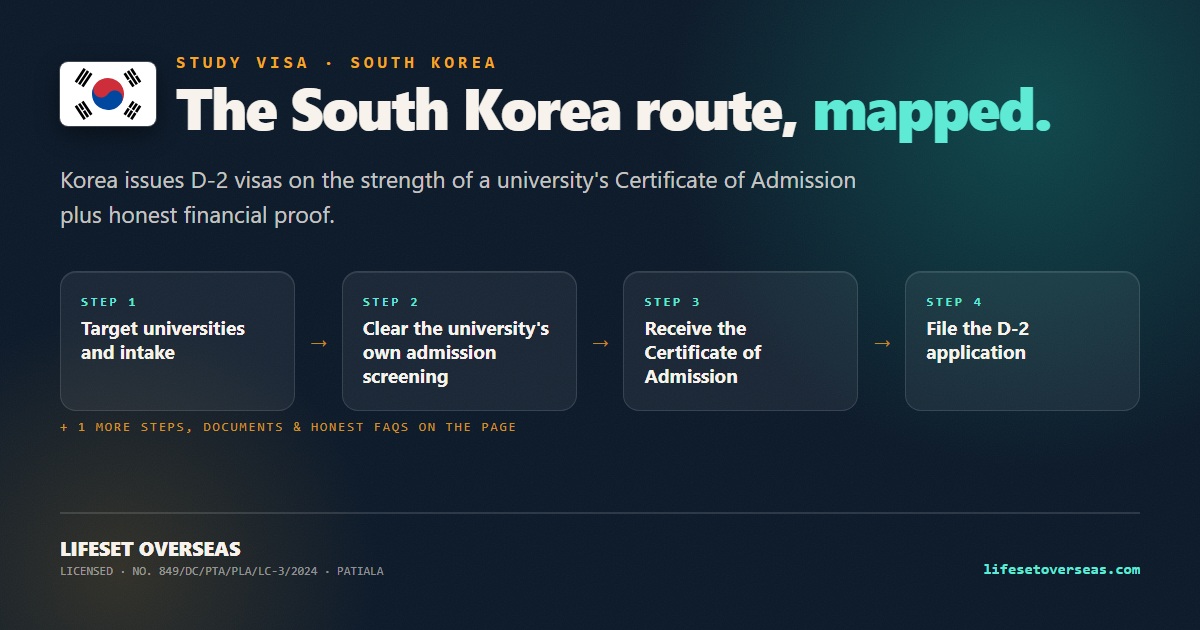
Korea issues D-2 visas on the strength of a university's Certificate of Admission plus honest financial proof. English-taught programmes are real, scholarships are structural, and the post-study D-10 gives graduates a genuine runway.
- ProcessingVisa processing after the Certificate of Admission is typically measured in weeks via the Korean embassy/KVAC; university admission cycles for March and September intakes run months earlier
- Visa categoryStudy Visa
- Your guideOne consultant
Your offer letter is only the start. Funds, SOP and the interview decide the visa. Call us with your course and intake. We tell you if the money and the story hold up.
Monday–Saturday, 9:00 AM – 7:00 PM IST
6
Documents mapped
5
Steps explained
5
Questions answered
Visa processing after the Certificate of Admission is typically measured in weeks via the Korean embassy/KVAC; university admission cycles for March and September intakes run months earlier
Typical processing
Start here
South Korea Study Visa — overview
The university is the visa office
Korea's system concentrates the real decision inside the university: its international office screens your academics, language and finances, and issues — or doesn't — the Certificate of Admission on which the D-2 visa rides. The embassy stage afterwards checks money and papers; it rarely re-litigates a strong university's judgement. So the Korea strategy is an admissions strategy: win the university, and the visa usually follows.
English in, Korean up
The old idea that Korea requires Korean from day one is outdated at the top of the system: leading universities run genuine English-taught degrees, densest at master's level. But Korea embeds a quiet incentive everywhere — work permission hours scale with TOPIK level, employability after graduation scales with it harder. The pattern that works: enter in English, then treat Korean as a second degree running in parallel. The system literally pays you for it.
Money: reference amounts and resting funds
The D-2 file must show funding for tuition and living at levels Korean missions reference by city and programme — figures revised periodically, which is why we verify them per file rather than printing them here. What consistently matters more than the amount is its history: statements showing funds that have lived in the account, a sponsor whose income makes sense, a story the numbers corroborate.
GKS: the scholarship worth planning around
The Global Korea Scholarship is among the most complete packages any government offers — full degrees with stipend, and a built-in Korean language year that solves the TOPIK problem as part of the deal. It runs on embassy and university tracks with annual cycles. It is competitive and it is free to apply for; we help structure applications, and we tell you honestly that nobody can promise selection.
The runway: D-10
Graduation in Korea opens the D-10 job-seeker status — dedicated time to convert your degree into skilled employment, with a clean pathway to work status on hiring. Korea's demographics keep that door open in a way few destinations match. As with every future-facing rule: we state the current terms, never tomorrow's.
6 items
Documents you need
Certificate of Admission from a Korean university
The core document — issued after the university's own screening of academics, language and finances.
Financial capacity proof
Bank balance or sponsorship at the level Korean missions expect for your programme and city, evidenced cleanly. The reference amounts are revised; we verify current ones.
Academic records, consistent and verifiable
Korean universities verify credentials seriously; apostille or consular legalisation appears at several points.
Language evidence matching the programme
TOPIK for Korean-taught; IELTS/TOEFL or equivalent for English-taught programmes.
Visa application via embassy/KVAC
The application rides on the Certificate of Admission plus finances; interviews are possible rather than routine.
Alien Registration after arrival
The residence card process at Korean immigration within the deadline — your real status document.
5 steps
How the process works
Typical processing: Visa processing after the Certificate of Admission is typically measured in weeks via the Korean embassy/KVAC; university admission cycles for March and September intakes run months earlier. Start half a year out.
Step 1
Target universities and intake
March (spring) and September (fall). English-taught availability varies sharply by university and level.
Step 2
Clear the university's own admission screening
Documents, essays, sometimes interviews — the university is the real gatekeeper in the Korean system.
Step 3
Receive the Certificate of Admission
With it, the visa stage becomes concrete.
Step 4
File the D-2 application
Embassy or KVAC, with financial and academic evidence.
Step 5
Arrive, register, unlock work permission
Alien Registration Card first; part-time permission after the qualifying period, tiered by TOPIK level.
5 answers
Frequently asked questions
For admission, often yes — top universities run real English-taught degrees, especially at graduate level. For life, work hours and employability afterwards, TOPIK level is the multiplier on everything. The winning pattern: enter through an English programme, treat Korean as a parallel degree.
Permission-based and tiered: after a qualifying period you apply for part-time permission, and the hours you may work scale with your TOPIK level and programme stage. Rules are enforced through employers and immigration. The structural message is deliberate — Korea pays students to learn Korean.
The Global Korea Scholarship funds complete degrees — tuition, stipend, airfare, language year — for selected international students via embassy and university tracks. Competitive, absolutely real, and free to apply for. Indian students win it every cycle. Anyone selling "GKS assistance" for a fee is charging you for a government form.
Korean missions expect evidence you can fund tuition and living for your programme, with reference amounts that vary by city and are revised periodically. As everywhere, history beats size: funds resting in the account beat a balance assembled last week. We verify the current reference figure before your file goes in.
The D-10 job-seeker visa gives graduates time to hunt for skilled work in Korea, converting to a work status when hired. Korea's demographic mathematics keeps this door genuinely open. Terms are immigration policy and move; we brief the position current at your planning date.
Why it matters
Going it alone vs filing with us
On your own
- Guessing the document list — one missing or wrongly formatted paper triggers a refusal.
- Generic cover letters copied from the internet that officers recognise and flag.
- No read on peak rejection windows or what this visa post is strict about.
- Government and VFS fees are non-refundable — money lost if you are refused.
- A refusal stamp follows you and weakens every future visa application.
With Lifeset Overseas
- An honest case assessment before you spend a rupee on government fees.
- A file built to the embassy's exact checklist and in the exact order.
- Weak finances, ties or purpose identified and fixed before submission.
- Previously refused? We can rescue and rebuild the file.
- Every case handled by one consultant, end to end.
Refused before?
A refusal isn't the end
A refusal is not a permanent bar — but it only improves if the actual reason is found and answered, and nobody can tell you a second application will succeed. If a South Korea visa has been refused, we:
- Read the actual refusal letter and pinpoint the real gaps.
- Advise whether to pull the officer's notes (CAIPS / GCMS) for the true reason.
- Identify which part was weak — funds, employment, purpose or ties.
- Tell you honestly whether to reapply now or strengthen the file first.
- Refused? Your fee back, or a rebuilt application free — your choice.
Start here · One message away
South Korea study visa: do not send a weak file. Call first.
- Honest assessment
- Fixed all-in fees
- No handovers between staff
- Licensed in Patiala
Let’s discuss your case
Send your offer letter and sponsor details on WhatsApp. We tell you plainly if the funds and the SOP are strong enough, and what is missing.