
 United States visa guide
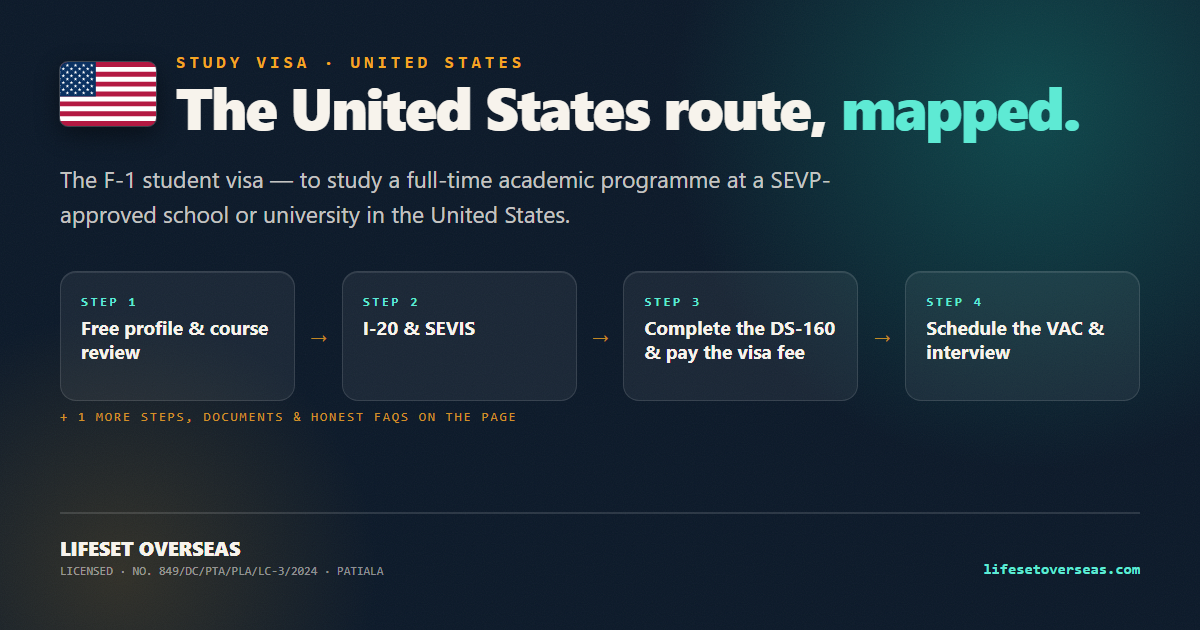
The USA Student Visa (visa category F-1) is for studying a full-time academic programme — a degree, or an English-language course — at a school or university in the United States. The M visa covers vocational study. Your course and institution determine whether you need an F or an M visa.
Before applying you must be accepted by a SEVP-approved institution, receive a Form I-20, and pay the SEVIS I-901 fee. You then complete the DS-160, pay the visa fee, and attend a biometrics appointment and a consular interview. The interview turns on a genuine study plan and proof you can fund your studies.
Lifeset Overseas guides the I-20 and SEVIS steps, the financial documentation and your interview readiness so your case is strong and consistent.
What an F-1 visa is
The F-1 visa is the standard academic student visa for the United States. It authorises you to enter the US to study full-time at a Student and Exchange Visitor Program (SEVP) certified institution — degree programmes, language schools, certain vocational courses, and high school in some cases.
The F-1 is not the only US student visa. The M-1 visa covers vocational and non-academic programmes; the J-1 visa covers exchange visitor programmes including some research scholar and short-term student categories. We focus on F-1 for the great majority of Indian degree-seeking applicants.
This page covers the F-1 only. We do not handle H-1B, L-1, O, P, or any employer-sponsored work visa — those require a different licence and a different agent. We also do not handle the H-4 dependent visa for spouses of work-visa holders.
The system is interview-led
The single most important fact about US visa applications: the interview at the consulate is where the decision is made. Your DS-160 form is a structured starting point; your I-20 establishes that you are admitted to a real programme; but the conversation with the visa officer is what closes the file. Many strong files refuse on a poor interview, and many borderline files approve on a strong one.
What the officer is looking for: that you are a genuine student going to a credible programme that fits your background, that you have the funds to complete it, and that you intend to return to India after — the famous "non-immigrant intent" requirement under section 214(b) of the Immigration and Nationality Act.
Section 214(b) — the immigrant-intent presumption
US law presumes every visitor is an intending immigrant unless they prove otherwise. Section 214(b) is the rejection ground used when the applicant does not overcome that presumption. It is the most common single refusal reason for Indian student visa applicants.
What officers look at to decide whether 214(b) is overcome:
- Programme fit. Does the chosen programme make sense given your prior education and stated career goals? An Indian software engineer pursuing a Master's in Computer Science is an obvious fit; the same applicant pursuing a Diploma in Hospitality at a low-tier institution is not.
- Funding clarity. Can the family demonstrate they can fund the programme without strain — first year fully covered, the rest credibly accounted for through documented sources?
- Ties to home country. Property, family responsibilities, employment to return to, business interests — anything that gives the officer a credible reason to believe you will leave the US after studies.
- Coherent narrative. Does the story you tell at the interview — why this country, why this programme, what you will do after — line up with the documents you submit?
We coach interview preparation as a separate session from the document file build. The two require different skills.
Choosing the right school
SEVP-certification is the threshold — your school must be on the SEVP list, otherwise it cannot issue an I-20. But SEVP-certification is a low bar: many low-quality institutions are SEVP-listed and issue I-20s liberally. The visa officer knows this. Programme reputation, accreditation status, your prior academic level, and the institution's track record all influence how the file reads.
We push back honestly when a client is set on a school whose match with their profile would create credibility problems at the interview. A "yes" from the school is necessary but not sufficient.
Funding the programme
US tuition varies dramatically — from around USD 25,000 per year at moderately-priced public universities to USD 60,000+ at private and Ivy-tier institutions. Living costs add another USD 12,000–25,000 per year depending on the city. The full first-year cost must be demonstrably covered through:
- Family bank statements and fixed deposits showing six months of activity in the parents' or applicant's name. Officers prefer accounts with consistent activity over accounts with a single recent large deposit.
- Education loans from approved Indian or US lenders, with sanction letters specifying disbursement schedule.
- Scholarships evidenced by an award letter from the school.
- Sponsor affidavits from a US-based relative, with the sponsor's tax records and bank statements supporting the commitment.
Funding shown only for the first year is acceptable as long as the rest of the programme is credibly accounted for through any combination of the above.
The application in practice
A typical F-1 file unfolds in this order. You apply to one or more SEVP-certified schools and accept the offer that fits. After you accept and submit any required pre-I-20 documents, the school issues an I-20 with a unique SEVIS ID. You pay the SEVIS fee (USD 350) and keep the receipt. You complete the DS-160 online, paying close attention to consistency with your I-20 and academic records. You pay the visa application fee (USD 185) through the consulate's designated payment portal in India.
You schedule biometrics at a Visa Application Centre and the consular interview at the US consulate covering your jurisdiction (Mumbai, New Delhi, Chennai, Kolkata, or Hyderabad). Wait times for interview slots vary substantially by post and season. You attend the biometric appointment, then the interview a few days later.
At the interview you carry every document — I-20, SEVIS receipt, DS-160 confirmation, passport, photos, complete financial evidence, complete academic records — but the officer typically asks for only a few. The conversation lasts a few minutes. The decision is communicated at the end. If approved, your passport is sent to the VAC pickup point and returned with the visa stamped in within a few business days.
Refusals — what 214(b) means and what to do next
A 214(b) refusal does not bar you from re-applying. It does not become a permanent record affecting future visa applications in the way a finding of misrepresentation would. But repeating the same application without addressing the underlying issues is unlikely to yield a different result.
What you should do after a 214(b) refusal:
- Identify what changed. A genuine change in your circumstances — completion of a stronger programme, a fresh job offer in India, a new business, a documented funding source — gives the officer something material to weigh differently.
- Reconsider programme fit. If the original programme choice raised credibility concerns, a different programme with a clearer fit can be the right adjustment.
- Strengthen ties. Property documents, an employment letter committing to a return, family responsibilities — anything that addresses the immigrant-intent presumption directly.
- Rebuild the interview answer. The officer's reasoning, where it can be inferred, should shape how you answer the same questions next time.
Reapplying immediately after a refusal without any of these changes is rarely useful. We assess refused cases individually before recommending a re-attempt.
Working in the US on F-1
The F-1 visa allows on-campus work up to 20 hours per week during the academic year and full-time during scheduled breaks. Off-campus work is generally restricted, with two structured exceptions:
- Curricular Practical Training (CPT) — internships and co-op placements that are part of the programme, authorised by your Designated School Official.
- Optional Practical Training (OPT) — up to 12 months of work in your field of study after graduation, with an additional 24-month STEM extension for eligible degrees.
OPT and CPT are post-arrival processes handled by your school's international student office, not by us. They are not work permits in the Indian-licence sense.
How we can help
We are a licensed visa consultancy based in Patiala, Punjab. We handle the F-1 student visa end-to-end on the visa side: school shortlisting based on programme-profile fit, financial documentation review, DS-160 preparation, SEVIS coordination, interview preparation across multiple practice sessions, and reapplication strategy where needed. One consultant sees your case from first call to decision — there is no handoff. Book a free 30-minute assessment and we will tell you, honestly, whether the F-1 is realistic for your profile this cycle.
Official checklist — F-1 and M-1 student visas
From our Knowledge Base (checked against the U.S. Department of State, 19 September 2026):
- Admission to a SEVP-approved school and a properly signed Form I-20 with the correct programme and SEVIS identity.
- The I-901 SEVIS fee payment, the DS-160 confirmation, the MRV fee receipt and the appointment confirmation.
- Passport and the required photograph.
- Academic records, qualifications and test scores, funding for tuition, living and travel, and temporary-intent evidence if requested.
- F-2 and M-2 dependants: a separate application and I-20 with relationship proof; dependants do not pay a separate I-901 fee.
"New F/M visas can be issued up to 365 days before course start; entry is no earlier than 30 days before start." A visitor visa is not a workaround for academic study. F-1 students normally have a 60-day departure period after completion, including authorised practical training.
Sources: U.S. Department of State student visa (https://travel.state.gov/content/travel/en/us-visas/study/student-visa.html); ICE I-901 SEVIS fee FAQ (https://www.ice.gov/sites/default/files/documents/Document/2019/SEVP-FinalFeeRule-FAQs.pdf).
Official sources
- U.S. Department of State — U.S. visas: https://travel.state.gov/content/travel/en/us-visas.html
Fees and rules change; the official page always prevails. The guide above was written from our filing experience for Indian applicants; check the current requirements on the authority’s site before you book.
