Which VFS or BLS Centre Covers My City? Visa Jurisdiction in India
Apply at the wrong centre and the file comes back unprocessed. Your jurisdiction is set by where you live — here is how to find yours before you book anything.
The calendar for your own city is full. A centre in another state is showing a date next week, so you take it. On the morning of the appointment the counter reads your address proof and slides the file back across the desk, unprocessed. The slot is gone, the fee usually does not come back, and the trip you booked around it is suddenly in doubt.
At a glance
What decides it
Where you live now, proven on paper — not where you were born
Who sets the map
The embassy or consulate — not VFS, BLS, TLScontact or CVASC
Same city, different answers
Your city can sit under one post for one country and another post for the next
Proof needed
Address proof in your own name — each post publishes its own list
Wrong centre
File returned unprocessed and the slot lost; fees are generally not refunded
Only authority
The mission's own site — partner pages take their instruction from it
Jurisdiction is decided by where you live
Your city decides your centre. The mission publishes the map; the counter checks it.
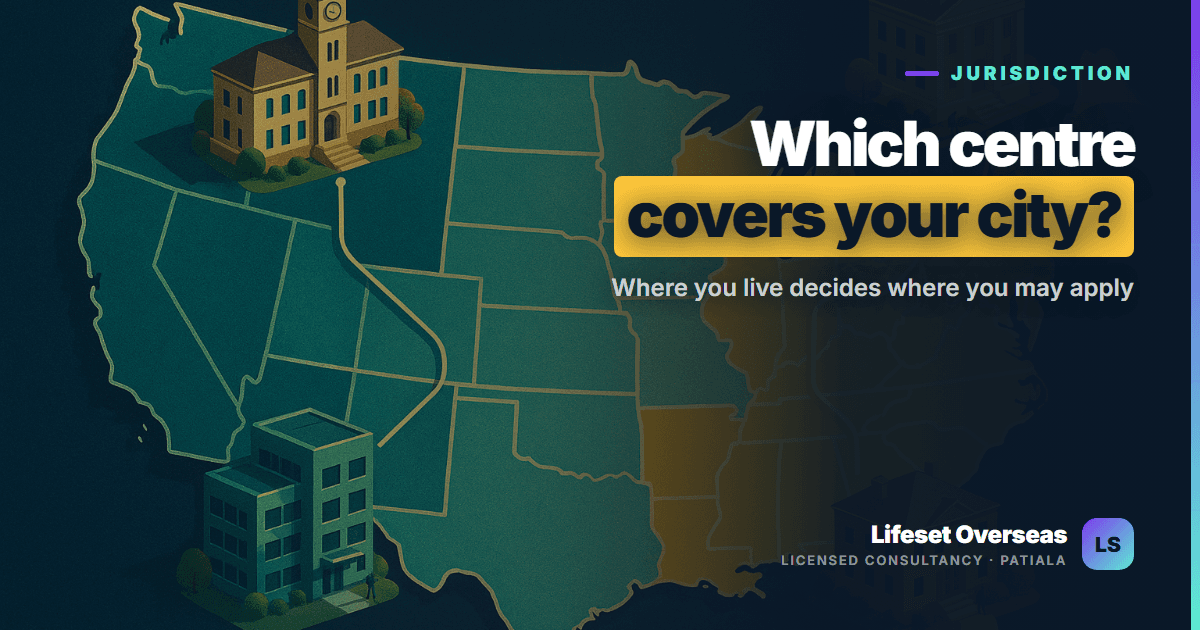
Every mission that issues visas in India divides the country into consular jurisdictions. The rule behind them is a simple one: you apply where you live. Not where you were born, not where your passport was issued, not where a relative stays, and not wherever the earliest appointment happens to be. At the counter, the address on your application form is read against your address proof. If that address does not fall inside the territory the centre serves, expect the file to be handed back.
Jurisdiction is not paperwork for its own sake. It decides which visa officer reads your case. The embassy in Delhi and a consulate elsewhere are separate posts. They apply the same law, but they keep their own appointment calendars, their own document checklists and their own queues. Choosing a centre is really choosing the post that will decide your application. That is why it is not a matter of convenience, and why the post's own guidance — not a booking screen — settles where you belong.
Every country cuts the map of India differently
Each country draws its own map, and no two are identical. Some run everything through the embassy in Delhi, so the whole country is a single jurisdiction. Others add consulates in a few other cities and give each one a block of states. A handful sit where you would not guess, for historical reasons rather than population. So your city can belong to one post for one country and a different post for its neighbour.
The split can also change with the visa category. Short-stay Schengen visas may be handled by one post while national long-stay visas for the same country are taken elsewhere. Student files sometimes route differently from visitor files. This is why an answer from a friend, a forum or an old blog is worth very little. Check per country, per category, on the mission's own page, every time you apply.
Which post covers your state — the embassy in Delhi or a named consulate
Which outsourcing partner runs the counter in your region
Whether your visa category is accepted at that post at all
Whether the branch near you is a full centre or collection-only
VFS, BLS, TLScontact and CVASC are the counter, not the decision
VFS Global, BLS International, TLScontact and CVASC — the Chinese Visa Application Service Centre — are outsourcing partners. They take your form, capture biometrics, collect the fee and move the passport between you and the mission. They do not assess your case, they do not grant visas, and they do not decide jurisdiction. A mission appoints a partner to run a region on its behalf, which is why the same company can serve one country in your city and not another.
Those contracts change. A country can move from one partner to another when a contract is renewed, centres open and close, and a city that had a counter last year may not have one now. That is why a screenshot or an old article proves nothing about today. Partner sites do publish jurisdiction pages, but they take their instruction from the mission — where the two disagree, the mission is the authority.
What counts as proof of residence
Proof of residence is what the counter actually reads.
Whatever address you write on the form has to be provable, in your own name. The list differs by mission and by category, so the checklist published for your post is the one that counts. The documents applicants are usually asked to bring fall into a familiar range.
What is really being tested is consistency. Your name should be spelt as it is in the passport, the address on the proof should match the address on the form line for line, and the document should be recent. If the only proof is in a parent's name, expect to be asked for the relationship and for something in your own name as well. Never enter an address you cannot support — that is a misrepresentation problem, and it is far more serious than standing at the wrong counter.
Aadhaar or another government ID showing your current address
A recent utility bill — electricity, water, gas or landline
A registered rent agreement, ideally with the landlord's ID
A bank statement or passbook printed with the same address
For students, a college bonafide certificate with a hostel or PG letter
Recent movers, students and people working in another city
If you have moved recently, jurisdiction generally follows where you now live, once you can evidence it. The difficulty is that your documents disagree for a while: the Aadhaar still shows the old state while the rent agreement shows the new one. What each post will accept as proof of a new address varies, and it is not something to guess at. Ask the post, or read the checklist it publishes, before you book — not on the morning of the appointment.
Students and transferred employees are one version of this. Someone studying in another state normally applies where they live and study, supported by the documents that post asks for. If the new city cannot yet be proven properly, applying through your home state is usually cleaner than arguing at a counter. If both are genuinely provable, pick the post whose checklist you can satisfy in full — not the one with the earlier date.
One thing to avoid entirely is borrowing an address. Using a cousin's flat in another state to reach a centre with earlier dates means declaring an address you do not live at, on a form you sign. If that unravels, the problem is no longer which counter you chose. It becomes a question about the truth of your application — and later forms tend to ask what happened to your earlier ones.
What actually happens if you turn up at the wrong centre
The better outcome is that the document check catches it and you are turned away before you pay. The more expensive outcome is that the file is accepted, travels to the mission and comes back unprocessed. Fees of this kind are generally not returned — the partner's own terms govern that — the appointment is gone, and your passport was tied up for the whole of it. You start again from the booking screen.
The real cost is time. Rebooking puts you at the back of the current calendar, and in a busy season the next usable date can fall past the trip you were preparing for. Flights and hotel reservations arranged around that first appointment now support nothing. Nothing about the episode helps your application. It is simply lost time, and it was avoidable.
How to confirm your jurisdiction before you book
Check it in this order. First, the mission's own website — search for the embassy or consulate of that country in India, open the consular or visa section, and find the jurisdiction page. Second, the partner's site for your visa category, which lists the centres and the states each one serves. Third, if the two disagree, the mission is the authority: write to the consular section and keep the reply. Take a dated screenshot of whichever page you relied on.
We maintain jurisdiction data for visa centres across India — which post covers which states, and which partner runs the counter — and we confirm yours against the mission's current page before any appointment is booked. Our fees are published and fixed with 18% GST already inside the quoted number, embassy and VFS charges are passed on at cost, one named officer handles your file, and you get an honest verdict before you pay: file it now, fix this first, or do not apply.
Questions people actually ask
Start on the website of that country's embassy or consulate in India, not on a search engine. Open the consular or visa section and look for a jurisdiction, 'areas we serve' or 'which office to apply to' page — it lists Indian states against each post. Then open the outsourcing partner's site for your visa category to see the centres in that region and their addresses. If the two pages disagree, the mission is the authority. Jurisdiction is set country by country and can differ by visa type, so check it fresh for each application instead of reusing what you learnt last time.
No — a full calendar is not a reason to leave your jurisdiction. Your file is checked against your address proof and can be returned if it does not belong to that post. What you can do instead is check whether your jurisdiction contains more than one centre, because some regions have several and applicants book the nearest without realising a second one is open to them. You can also keep watching the official portal for released dates. What you must not do is change the address you declare in order to reach an earlier date.
Because each country decides its own consular map of India independently. A mission with consulates in other Indian cities will divide the states between them and Delhi in whatever way suits its staffing, while a mission with only an embassy in Delhi covers the whole country from there. Nothing obliges two countries to draw the same lines. That is why searching your city plus 'jurisdiction' returns different answers depending on which country's site you land on. Always read the map belonging to the country you are actually applying to.
Apply where you genuinely live now, provided you can prove it — but confirm what that post accepts as proof before you book anything. What satisfies one mission may not satisfy another, and the checklist published for the post is the one that decides. If your Pune address cannot yet be evidenced convincingly, applying through the post that covers Punjab is usually safer, because your Aadhaar and your other documents agree with each other. The one thing not to do is pick whichever answer produces an earlier appointment.
Normally the centre covering the city where you actually live and study, provided you can evidence it. A bonafide certificate from your college, a hostel or PG letter and a local address proof are the usual supporting documents, but read what your post asks for rather than assuming. If your institution will not issue a letter carrying your address, or you are between terms and staying at home, applying through your home state is the cleaner option because all your documents point there. Whichever you choose, the address on the form, the address on your proof and the centre must agree with each other.
The file is not processed. If it is caught at the document check you are turned away on the spot; if it is accepted and reaches the mission, it can come back unprocessed. Fees are generally not refunded, the appointment slot is lost, and your passport was unavailable throughout. You then rebook and join the current calendar, which in a busy period can push you past the travel dates you were preparing for. It is an avoidable loss, and it comes purely from checking the wrong page.
Wherever a physical step exists, yes. An application filed online that still needs biometrics, document submission or an interview ties you to a particular centre or post, and which one that is comes down to jurisdiction. Purely electronic visas that are approved and emailed to you involve no centre at all. Some missions do let applicants choose between their posts in India; where that is allowed, their own guidance says so, which is another reason to read it rather than assume. The simple test: if any step requires you to appear in person, treat jurisdiction as live and check the mission's page first.
Yes — we confirm it against the mission's own current page before any appointment is booked, and we tell you which centre serves your state, which partner runs that counter, and what that post's published checklist asks for. We maintain jurisdiction data across Indian visa centres for exactly this purpose. Booking is always done in your own name on the official portal, never through a third party. Our published fees are fixed and already include 18% GST, while embassy and VFS charges are passed on at cost. Consultancy Licence No. 849/DC/PTA/PLA/LC-3/2024, Patiala.
Want this checked before you file? Message us on WhatsApp and a consultant will read your case and tell you honestly where you stand — file it now, fix this first, or do not apply yet. Fixed published fees, GST already inside the number quoted, and embassy charges passed on at cost.
What to do next
Visa building-block services
Document checklist, financial proof, SOP, mock interview and more — pick just the part you need, free when you file with us.
We never predict an outcome or promise a visa. We tell you what your file says and what can be fixed.
Talk to a consultant about your case
Read this article? Now tell us about your situation.
We’ll WhatsApp you within 4 working hours with an honest read on your file and the realistic next steps. Licensed, fixed-fee, and one consultant from first call to decision.
Read the article? Message us on WhatsApp with your situation — a consultant from our Punjab-licensed consultancy gives you an honest read and the next step.