

Japan · Visa guide
 Japan · Visa guide
Japan Study Visa
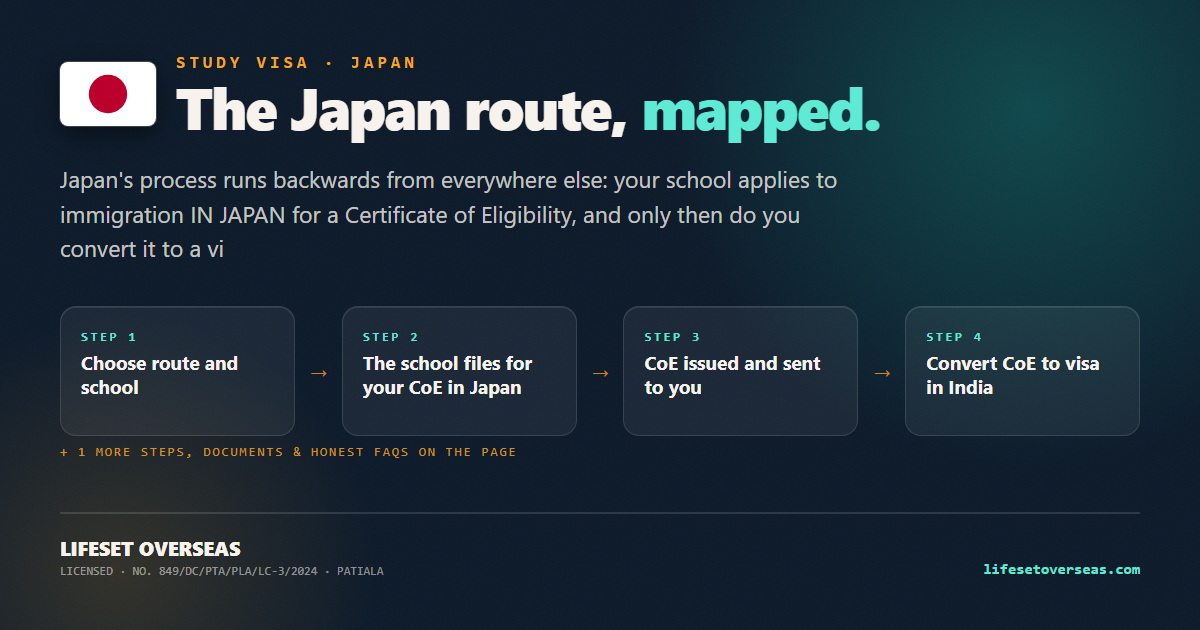
Japan's process runs backwards from everywhere else: your school applies to immigration IN JAPAN for a Certificate of Eligibility, and only then do you convert it to a visa in India — usually within days. Choose the school right and the visa follows.
- ProcessingThe CoE stage in Japan typically takes one to three months and is school-driven; once the CoE arrives
- Visa categoryStudy Visa
- Your guideOne consultant
Your offer letter is only the start. Funds, SOP and the interview decide the visa. Call us with your course and intake. We tell you if the money and the story hold up.
Monday–Saturday, 9:00 AM – 7:00 PM IST
6
Documents mapped
5
Steps explained
5
Questions answered
The CoE stage in Japan typically takes one to three months and is school-driven; once the CoE arrives
Typical processing
Start here
Japan Study Visa — overview
The application that happens without you
Every other major destination has you apply to their consulate. Japan flips it: your school applies to regional immigration in Japan for your Certificate of Eligibility, while you are still in India assembling documents to the school's checklist. When the CoE arrives, the embassy visa step in India is measured in days. Understand this inversion and the whole strategy becomes obvious: the school is your case officer — choose it accordingly.
Choosing the school like it decides your visa — because it does
Immigration tracks each school's sponsorship record. A language school whose past students overstayed or worked illegally gets its future CoEs scrutinised or refused; a school with a clean record moves smoothly. Before any fee is paid, we look at the school's standing, its student outcomes and its honesty about costs — the brochure never mentions the only metric that matters.
Two doors: language first, or degree direct
The language-school route is Japan's classic gateway: one to two years of intensive Japanese, then progression into universities or senmon gakkō vocational colleges. The direct degree route in English exists and is growing, but concentrates in specific universities and programmes. The economics differ, the timelines differ, and pretending one is the other produces mismatched files — the route choice comes first, everything else follows.
The 28-hour reality
Japan pairs generous access to part-time work with strict enforcement: a separate work permission stamp (get it at the airport on landing), a weekly cap, employer-side reporting. Students who treat the cap as a suggestion discover it at renewal time, which is the most expensive place to learn anything. Our budgets assume the cap holds — because it does.
Timing the intakes
April is Japan's academic new year and the main intake; October is the strong second; language schools add January and July. The CoE machinery in front of each intake takes months and cannot be compressed from India — the school controls the clock. Working backwards honestly: a April start means documents moving the previous autumn.
6 items
Documents you need
Admission from a recognised school
University, or a language school in good immigration standing — a school with visa-refusal history hurts every applicant it sponsors.
Financial support evidence for the CoE
Bank statements and a sponsor letter (often a parent) showing capacity to fund study — assembled to the school's exacting checklist, because the school stakes its standing on your file.
Academic documents and study reason
Consistent records plus a clear statement of purpose — for language school routes, evidence of genuine language-learning intent matters.
The Certificate of Eligibility itself
Issued by immigration in Japan to your school; the original historically travels to you for the visa stage.
Visa application at the embassy/VFS in India
With the CoE, passport and photographs — brief and usually quick once the CoE exists.
Part-time work permission after arrival
The separate "Shikakugai" permission stamp — applied for at the airport on landing or at immigration after, BEFORE any work.
5 steps
How the process works
Typical processing: The CoE stage in Japan typically takes one to three months and is school-driven; once the CoE arrives, the visa itself at the embassy/VFS is usually issued in days. Work backwards from April or October intakes.
Step 1
Choose route and school
Language school as gateway, or direct degree admission — different timelines, same CoE machinery.
Step 2
The school files for your CoE in Japan
You supply documents to the school's checklist; the school argues your case to immigration. This is the real application.
Step 3
CoE issued and sent to you
One to three months later, typically.
Step 4
Convert CoE to visa in India
Embassy/VFS stage — days, not months, with a valid CoE.
Step 5
Land, register, get the work permission stamp
Residence card at the airport, municipal registration, and the part-time permission before any job.
5 answers
Frequently asked questions
Because Japan decides your case at the CoE stage, where your school is the applicant. Schools with clean sponsorship records get smooth CoE outcomes; schools with refusal histories poison their own students' files. Vetting the school's immigration standing is the single highest-leverage step in the entire Japan route.
Fully legitimate — it is how most international students historically entered Japanese education, feeding into universities and vocational schools. Immigration polices intent: applicants who can show a real language-learning plan do well; those using it as a disguised work channel are exactly what the CoE screening exists to catch.
Student status alone does not permit work. You apply for a separate permission — routinely granted at the airport on first landing — which caps part-time work at a set weekly limit, with a higher allowance in designated vacation periods. Japan enforces the cap through employers and payroll, and violations damage renewals and future status. Budget as if the cap is real, because it is.
The Japanese government scholarship — tuition, stipend and fees for selected international students, via embassy or university recommendation. Competitive but genuinely transformative, and free to apply for. Anyone charging you to "arrange" MEXT is selling a form.
Japan offers a designated job-hunting status after graduation and clear work-status conversions once hired — the machinery for staying exists and is actively used. Terms are set by immigration policy at the time; we brief the current position rather than promising the future.
Why it matters
Going it alone vs filing with us
On your own
- Guessing the document list — one missing or wrongly formatted paper triggers a refusal.
- Generic cover letters copied from the internet that officers recognise and flag.
- No read on peak rejection windows or what this visa post is strict about.
- Government and VFS fees are non-refundable — money lost if you are refused.
- A refusal stamp follows you and weakens every future visa application.
With Lifeset Overseas
- An honest case assessment before you spend a rupee on government fees.
- A file built to the embassy's exact checklist and in the exact order.
- Weak finances, ties or purpose identified and fixed before submission.
- Previously refused? We can rescue and rebuild the file.
- Every case handled by one consultant, end to end.
Refused before?
A refusal isn't the end
A refusal is not a permanent bar — but it only improves if the actual reason is found and answered, and nobody can tell you a second application will succeed. If a Japan visa has been refused, we:
- Read the actual refusal letter and pinpoint the real gaps.
- Advise whether to pull the officer's notes (CAIPS / GCMS) for the true reason.
- Identify which part was weak — funds, employment, purpose or ties.
- Tell you honestly whether to reapply now or strengthen the file first.
- Refused? Your fee back, or a rebuilt application free — your choice.
Other Japan visas
Japan Tourist Visa
A short-stay visa for tourism, sightseeing and recreation in Japan — for a stay of up to 90 days.
Japan Business Visa
A short-stay visa for business meetings, conferences and short-term business activity in Japan.
Japan Family & Friends Visit Visa
A short-stay visa to visit relatives, friends or acquaintances living in Japan.
Japan Medical Stay Visa
A visa for travelling to Japan to receive medical treatment.
Start here · One message away
Japan study visa: do not send a weak file. Call first.
- Honest assessment
- Fixed all-in fees
- No handovers between staff
- Licensed in Patiala
Let’s discuss your case
Send your offer letter and sponsor details on WhatsApp. We tell you plainly if the funds and the SOP are strong enough, and what is missing.