Which Countries Are in the Schengen Area? All 29, and the Ones People Get Wrong
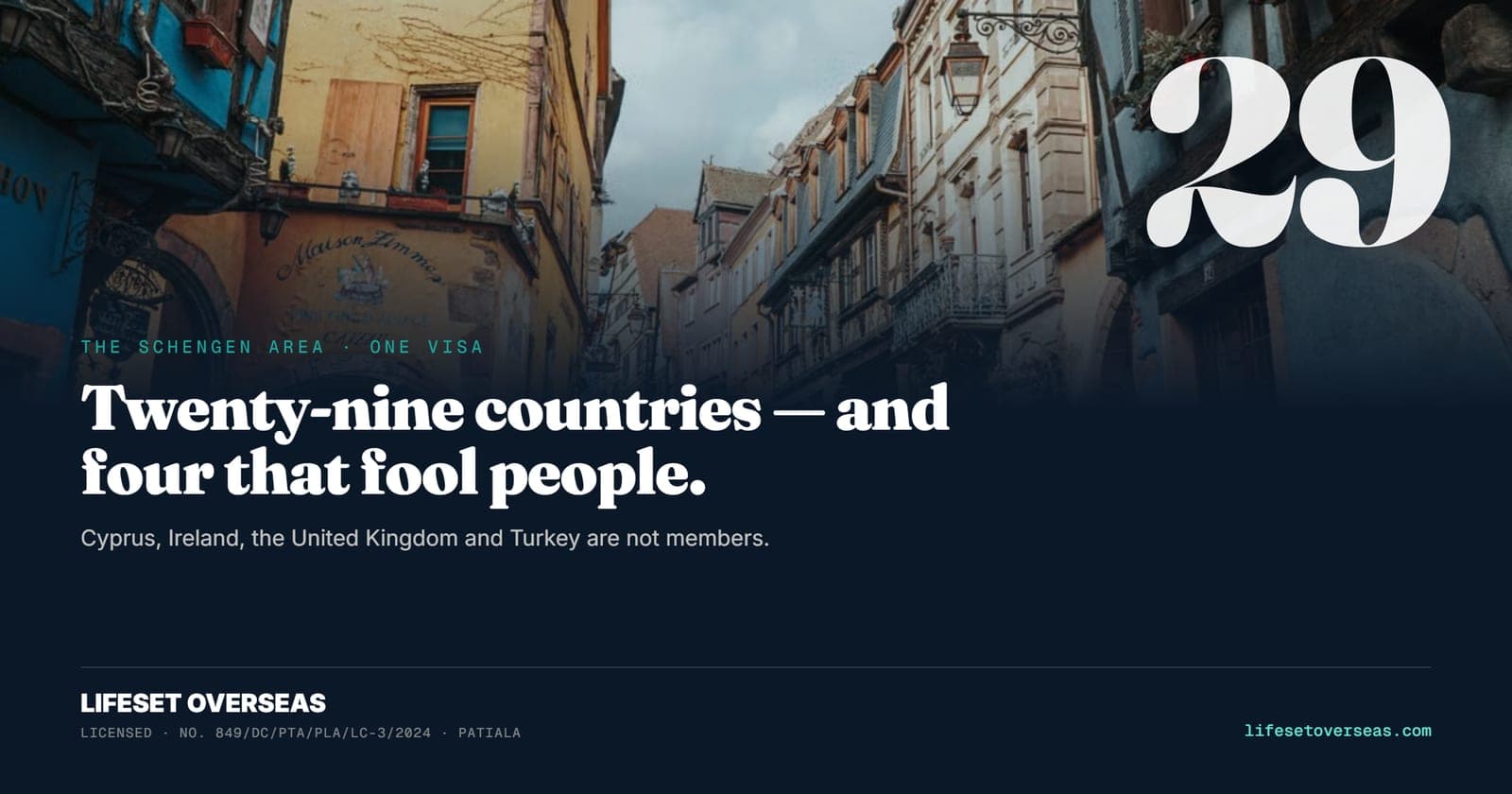
Cyprus is not in it. Ireland never joined. Croatia, Bulgaria and Romania are. The complete 2026 membership list for Indian applicants — and why applying to the wrong country wastes a fee.
Twenty-nine countries are in the Schengen Area in 2026. One short-stay visa, issued by any one of them, lets you move through all twenty-nine without showing your passport again at an internal border.
The confusion is almost never about the list itself. It is that "Europe", "the EU" and "Schengen" are three different things, and most people use the three words as though they meant the same thing. Europe is a continent. The European Union is a political and economic union of 27 countries. The Schengen Area is a separate agreement about borders. A country can sit in one of the three, two of them, or all three.
The 29 members
Grouped so you can actually scan it.
Schengen Area membership · 2026
Western EuropeAustria, Belgium, France, Germany, Liechtenstein, Luxembourg, Netherlands, Switzerland
8
NordicDenmark, Finland, Iceland, Norway, Sweden
5
Southern EuropeGreece, Italy, Malta, Portugal, Spain
5
Central and Eastern EuropeBulgaria, Croatia, Czechia, Estonia, Hungary, Latvia, Lithuania, Poland, Romania, Slovakia, Slovenia
11
Total membersOne short-stay visa covers every one of them
29
European Commission, Schengen Area. Croatia joined in January 2023; Bulgaria and Romania completed accession on 1 January 2025.
The list has moved recently, which is exactly why so many older articles get it wrong. Croatia joined in January 2023. Bulgaria and Romania opened their air and sea borders in March 2024 and their land borders on 1 January 2025, which is the point at which they became full members in practice.
These four come up in our office again and again, and each has cost somebody a fee or a flight.
1
Cyprus is not in Schengen
It is an EU member state and it is still working through Schengen accession. A Schengen visa does not admit you, and Cyprus issues its own national visa. We see this mistake made in both directions every season.
2
Ireland is not in Schengen either
Ireland is in the EU, but it runs its own visa system alongside the UK under the Common Travel Area. An Irish visa and a Schengen visa are entirely separate applications, with their own forms, fees and appointments. Adding Dublin to a Paris and Amsterdam itinerary means two applications, not one.
3
The United Kingdom is in neither
Since Brexit the UK is outside the EU, and it was never in Schengen to begin with. A Schengen visa will not get you past immigration at Heathrow, and a UK visitor visa will not get you into France. If your trip includes London, budget for two applications from the start.
4
Turkey is not in Schengen, whatever the brochure says
Nor are Serbia, Georgia or Albania. Package tours sold as a "Europe tour" quite often include Istanbul, and that leg needs its own permission. Read the itinerary your agent hands you country by country, not as one word.
The four that fool people the other way round
Switzerland, Norway, Iceland and Liechtenstein are in Schengen but are not EU members. Here the surprise runs in your favour: your Schengen visa covers all four.
Your Schengen visa admits you
Switzerland, Norway, Iceland and Liechtenstein, which are in Schengen without being in the EU.
All 25 EU states that are Schengen members, Portugal to Estonia.
Monaco, San Marino and Vatican City in practice, because their borders sit open to the Schengen states around them.
Your Schengen visa does not
Cyprus and Ireland, both EU members outside Schengen, each with its own visa to apply for.
The United Kingdom, outside both since Brexit.
Turkey, Serbia, Georgia, Albania and the rest of non-Schengen Europe, whatever a tour brochure implies.
Which country joins Schengen next
Cyprus. It is the only EU member state whose Schengen integration the European Commission describes as "currently underway": Cyprus already takes part in Schengen cooperation, but the Council has not yet abolished checks at its borders, so it still issues its own national visa (European Commission, the Schengen area). No accession date has been set. Ireland is not in the queue at all: it holds a permanent opt-out under the Schengen Protocol and runs its own visa system, so the count stays at 29 until the Council acts on Cyprus.
For every practical purpose that means treating Cyprus as outside Schengen: a Schengen visa does not admit you to Cyprus, and a Cyprus visa does not admit you to the 29. When the Council does act, the count becomes 30 and the list above changes with it. Bulgaria and Romania were the last to cross that line, on 1 January 2025.
Which country do you actually apply to?
This is the rule that decides more refusals than the membership list ever will.
“
You apply to the country you are going to, not to whichever consulate has an appointment next week.
The rule most applicants get backwards
Work down these steps in order and stop at the first that answers your case.
1
One country on the whole trip? That is your consulate.
If Italy is the sole destination, you apply to Italy. Nothing further to work out.
2
Several countries? Find the main destination.
That is where you will spend the most nights, or where the clear purpose of the trip sits. If you are travelling for a conference in Munich, Germany is the main destination even if you sleep two extra nights in Austria on the way home.
3
Genuinely even split? Country of first entry.
If no single country stands out, three nights each in three countries with no dominant purpose, you apply to the state whose external border you will cross first. That is the first Schengen airport you land at.
4
Book at that country's application centre, even if it is slower.
Your appointment follows your itinerary, not the other way round. If Italy is the answer, wait for the Italian slot rather than filing through Portugal because Portugal is quicker.
This is not a small technical point. A consulate that is not the competent one for your trip can decline to examine the file and hand it back, which costs you the appointment and the weeks it took to get it. Applying where your trip actually takes you is simply the rule, not a tactic.
What one visa actually gives you
A Schengen short-stay visa, called a Type C, allows up to 90 days in any 180-day period across the whole area. The visa sticker itself may be issued for a shorter period, and the number of entries printed on it, single, double or multiple, governs how many times you may go in.
The rolling window catches people whose trip leaves the area and comes back. Italy, then Turkey, then Greece is two entries into the count, and both the Italian and the Greek days go into the same 90. The EU is also moving to electronic entry and exit records at external borders, so the arithmetic is increasingly done by the system rather than read off ink stamps. Assume it will be counted correctly.
One more limit worth saying plainly: a Schengen visa is for short stays only. Studying, joining family or living anywhere in the area for longer than 90 days means a national long-stay visa, a Type D, issued by that one country under its own rules. There is no such thing as a Schengen study visa, which we have written about separately.
Before you book anything
Check the membership position against the official EU source rather than a travel blog, because accession status genuinely does change. Croatia, Bulgaria and Romania are the proof of that within three years. Settle the itinerary and the jurisdiction first, then pay for anything non-refundable.
Questions people actually ask
No. Cyprus is a European Union member state but it is not part of the Schengen Area, and it is still working through accession. It issues its own national visa, which you apply for separately.
If Cyprus is on your itinerary, treat it as a second application with its own documents, not as a stop covered by your Schengen sticker.
No, for either. Ireland is in the EU but outside Schengen, and runs its own visa system with the UK under the Common Travel Area. The UK is outside both.
A London and Paris trip is therefore two applications, two fees and two sets of documents, with two independent appointment queues. Start both early.
The country of your main destination, meaning where you will spend the most nights or where the clear purpose of the trip lies. If the nights are genuinely even and no country stands out, you apply to the country whose border you cross first on entering the area.
You do not apply to whichever consulate has the earliest appointment. A consulate can decline to examine a file it is not competent for, and appointment shopping is visible in the itinerary.
Yes. Switzerland, Norway, Iceland and Liechtenstein are all full Schengen members while sitting outside the European Union. Schengen membership and EU membership are separate things, and it is Schengen membership that decides whether your visa admits you.
It is a rolling window rather than an annual allowance. On any given day, look back over the previous 180 days and add up every day you spent inside any Schengen country. That total must not exceed 90.
Days in different member states are added together, not counted country by country. The count does not reset in January, and leaving the area and coming back does not restart it either.
Not for a full course. Anything longer than 90 days is a national long-stay visa, a Type D, issued by the one country where you will study, under that country's own rules and its own funds requirements. A short summer programme might fit inside a Schengen short-stay visa. A degree never will.
Twenty-nine. That is 25 of the 27 EU member states, all except Cyprus and Ireland, plus Iceland, Liechtenstein, Norway and Switzerland, which are in Schengen without being in the EU. Croatia joined in January 2023, and Bulgaria and Romania became full members when their land borders opened on 1 January 2025.
If you want a second pair of eyes on which country to apply to, that is a conversation worth having before you pay a fee, not after a refusal. Our Visa Risk & Approval Report at ₹499, all-in and inclusive of GST, goes through the itinerary, the documents and the jurisdiction question and tells you where the file is weak. Read alongside it: the Schengen tourist visa guide from Patiala, what the fees add up to, and the travel insurance rule.
Or bring the itinerary to our licensed Patiala office at Shop No. 2, Nabha Road, near PRTC Workshop, or call and WhatsApp +91 91155 80911. The decision always rests with the visa officer. Which officer sees your file rests with you, and that part is worth getting right.
What to do next
Visa building-block services
Document checklist, financial proof, SOP, mock interview and more — pick just the part you need, free when you file with us.
We never predict an outcome or promise a visa. We tell you what your file says and what can be fixed.
Talk to a consultant about your case
Read this article? Now tell us about your situation.
We’ll WhatsApp you within 4 working hours with an honest read on your file and the realistic next steps. Licensed, fixed-fee, and one consultant from first call to decision.
Read the article? Message us on WhatsApp with your situation — a consultant from our Punjab-licensed consultancy gives you an honest read and the next step.