 Bulgaria visa guide
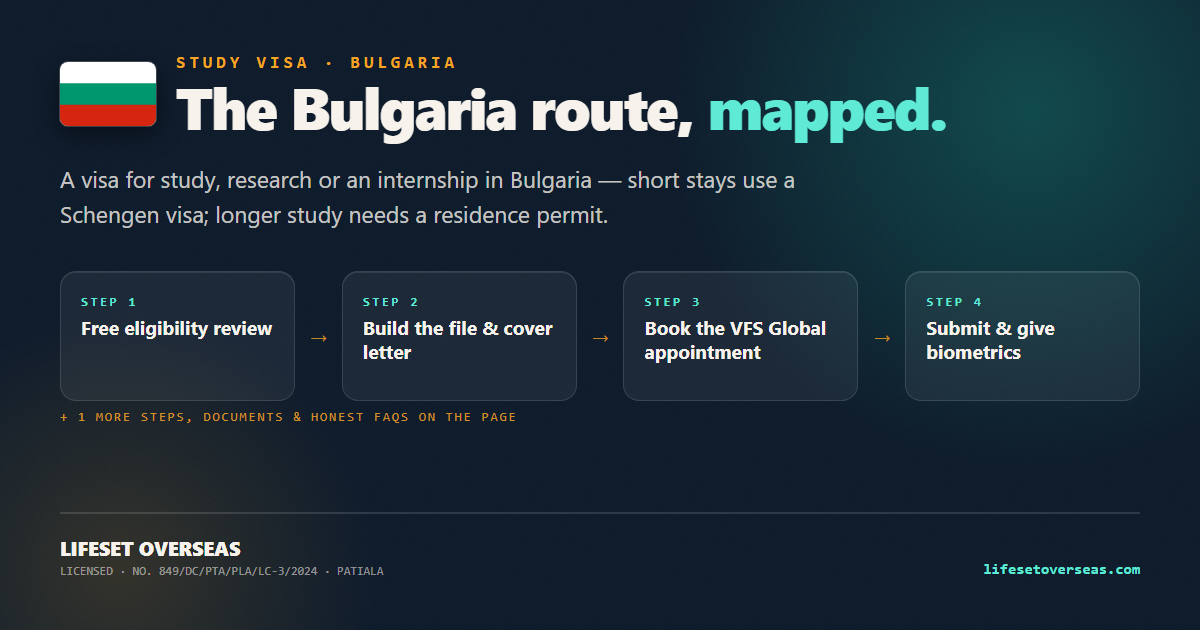
The Bulgaria Study & Research Visa is for study, research or an internship in Bulgaria. Short stays of up to 90 days use a Schengen Type C visa; longer study requires a national long-stay visa or residence permit.
Beyond the standard Schengen documents, the embassy expects a certificate of admission or registration at an educational establishment in Bulgaria, or a cover letter from the inviting institution.
Lifeset Overseas confirms whether your stay needs a short-stay visa or a residence permit and builds the file so your study or research purpose is clearly evidenced.
Bulgaria long-stay (D) student visa from India
Degree study in Bulgaria begins with a type D long-stay visa from the Bulgarian mission, followed by a residence permit after arrival. The Ministry of Foreign Affairs' Visa D guidance states that a visa with validity of up to one year "and a right to stay up to 360 days may be issued to foreigners who perform science research or are students under tuition programmes for up to one year, post-graduate or trainee students". Personal presence of the applicant is required at submission.
Conditions from the Ministry of Foreign Affairs
- The passport "should have a validity of at least 18 months".
- "You can apply not earlier than 3 months before the date of your planned departure."
- All required fields of the application must be filled.
- An insurance policy for the whole period of stay, "issued by an insurance company with a license to carry out insurance activities on the territory of the European Union, with a minimum amount of coverage of 30,000 euros", covering repatriation, emergency medical care and emergency hospital treatment.
Documents for students
For university students the Ministry lists the certificate of acceptance for study in Bulgaria issued by the Ministry of Education and Science and a certificate from the higher-education institution, together with proof of funds for the period of study and accommodation. Exchange and school students provide the admission documents under the exchange agreement or the school's acceptance. The Ministry of Education's acceptance certificate is issued to the university on your admission, so the sequence is admission first, then the certificate, then the visa.
Official sources
- Ministry of Foreign Affairs of Bulgaria — Visa for Bulgaria: https://www.mfa.bg/en/services-travel/consular-services/travel-bulgaria/visa-bulgaria
- Ministry of Foreign Affairs of Bulgaria — Visa D (long term) guidance: https://www.mfa.bg/upload/99380/2_Visa_D.pdf
- Embassy of Bulgaria in New Delhi: https://www.mfa.bg/en/embassies/india
Quotations checked against the Ministry's Visa D document on 30 September 2026. Fees and rules change; the official page always prevails.
Verified figures for Bulgaria
What a year in Bulgaria costs — and what you must prove
- Public-university tuition, non-EU student, per year
- €2,806 – €10,000
- Private universities: €3,840 – €5,400
- Funds the visa authority asks you to show
- €3,721 in total
English-taught courses: widely available. varies by university
Read on the official pages below on 27 Aug 2026. Figures change every academic year — check them before you pay anything.
Where Bulgaria stands among the 29 Schengen study countries
Computed from verified figures
On the lowest published public-university fee for non-EU students, Bulgaria sits 15th of 26 Schengen countries (€2,806 a year at the floor, up to €10,000). English-taught programmes are widely available — Bulgaria is one of 18 Schengen countries where that is true, so the language of instruction is not the filter it is elsewhere.
Closest on tuition: France and Greece. Compare all 29 side by side on Study in Europe.

