

Skip to content

France visa guide

France Study Visa

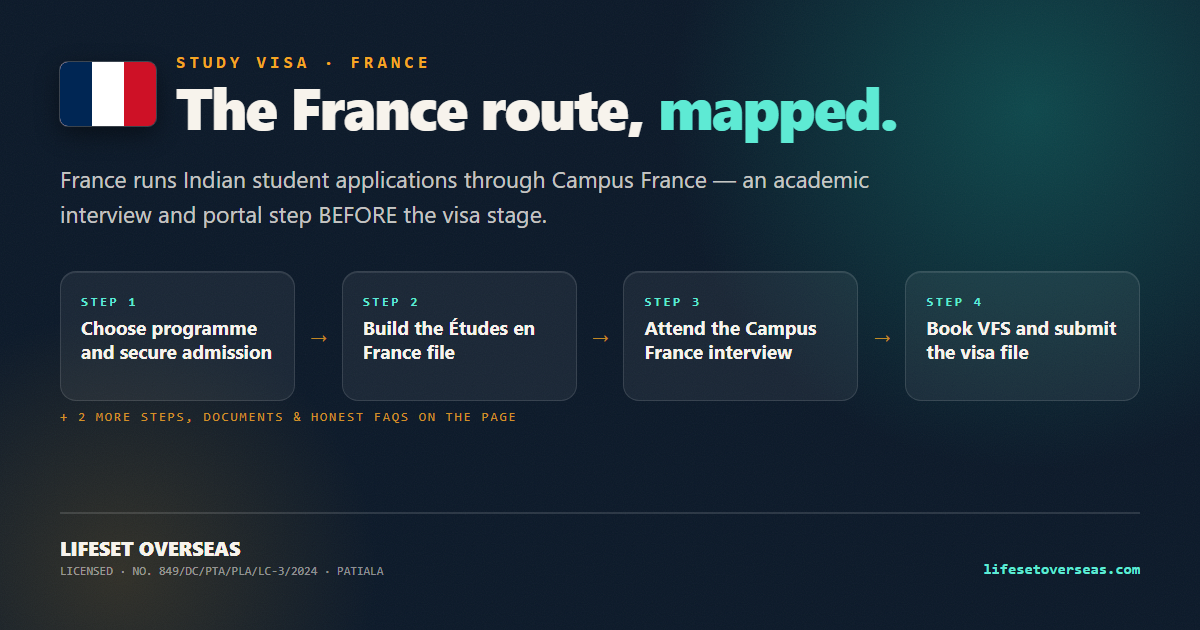
France runs Indian student applications through Campus France: an academic interview and portal step BEFORE the visa stage. Clear that gate with a coherent study plan and the visa itself is largely documentation.

France study visa filing (you hold the offer)

₹24,999–34,999all-in · GST included

Visa refused? Our consultancy fee is refunded under the Refund Policy. Embassy and VFS fees are never ours to refund. How the refund works

  • Study Application Review: ₹11,999
  • Full Student Journey: from ₹49,999

Government and VFS fees are paid to them at cost.

The price on this page is the price. No counsellor call, no package upsell.

Licence No. 849/DC/PTA/PLA/LC‑3/20245.0 · 111 Google reviewsPatiala office, Nabha Road

Processing
The Campus France (Études en France) stage typically takes several weeks including the interview; the visa decision after VFS submission is usually measured in weeks
Support
Your own consultant

8

Documents mapped

6

Steps explained

5

Questions answered

The Campus France (Études en France) stage typically takes several weeks including the interview; the visa decision after VFS submission is usually measured in weeks

Typical processing

France study visa route — the main steps at a glance

France Study Visa — overview

Start here

The gate almost everyone underestimates

France does not decide your student file at the consulate. It decides it at Campus France: the interview and portal stage that every Indian applicant must clear before a visa appointment can even be booked. The officer at VFS mostly checks documents; the Campus France interviewer checks you: why this course, why France, why now, and whether your academic story holds together.

That is good news if you prepare, because it is the one part of the process you fully control. We build files in that order, story first, papers second.

What the interview actually probes

Three questions decide most interviews: does the course follow logically from your education, do you understand what the programme actually teaches, and is your funding real. Memorised answers are recognised instantly; interviewers hear the same script every day. What works is specific knowledge of your own plan: modules, city, costs, and what the degree leads to.

Public university or grande école: two different countries

France's public universities charge set national fees for non-EU students that undercut almost every English-speaking destination, and partial exemptions are common. The grandes écoles, engineering and business schools, are a parallel system: selective, prestigious, and priced like UK universities. Both are legitimate routes; budgeting them identically is the classic planning error. Verify every figure on the institution's own page. Never on an agent's brochure, including ours: we check the current number when we build your budget.

After the visa: the step people forget

The VLS-TS long-stay visa must be validated online within the deadline after arrival. It is your first residence permit, not just an entry sticker. Miss the validation and your stay quietly becomes irregular, which surfaces at the worst possible time: renewal.

The honest budget picture

Tuition is only the second-largest cost in most French student budgets: living costs lead, and they vary more by city than any fee does. Paris is its own economy; Lyon, Toulouse, Lille and Grenoble are dramatically cheaper. The funds figure the consulate expects is revised periodically; we confirm the current requirement and the smartest way to evidence it before anything is filed.

Official sequence: the long-stay student visa from India

From our Knowledge Base (checked against France-Visas and Campus France, 19 September 2026):

  • Unconditional admission or registration in an eligible institution with correct course dates.
  • The mandatory Études en France (EEF) procedure through Campus France India for long-stay cases, with academic and identity evidence uploaded and the academic interview attended as directed.
  • The France-Visas application and its personalised student checklist, generated after the EEF stage.
  • Passport, photograph, accommodation and proof of resources: the current long-stay student minimum is EUR 877.50 per month for applications from 1 August 2026 (the older EUR 615 figure is no longer current).
  • Sponsor relationship, undertaking and accessible funds or regular income where relying on support; minor consent documents and translations as required.
  • The VFS appointment, biometrics, the government fee and the service fee, or a documented exemption.

Short courses under 90 days do not use the EEF long-stay process.

Sources: France-Visas student route (https://france-visas.gouv.fr/en/etudiant); Campus France India visa preparation (https://www.inde.campusfrance.org/node/46); Campus France India application procedure (https://www.inde.campusfrance.org/application-and-admission-procedure).

Official sources

Fees and rules change; the official page always prevails. The guide above was written from our filing experience for Indian applicants; check the current requirements on the authority’s site before you book.

Verified figures for France

What a year in France costs — and what you must prove

Public-university tuition, non-EU student, per year
€2,902 – €3,950
Private universities: €6,000 – €18,000
Funds the visa authority asks you to show
€878 a month

English-taught courses: widely available. varies by institution

Read on the official pages below on 27 Aug 2026. Figures change every academic year — check them before you pay anything.

Where France stands among the 29 Schengen study countries

Computed from verified figures

On the lowest published public-university fee for non-EU students, France sits 16th of 26 Schengen countries (€2,902 a year at the floor, up to €3,950). The living-cost proof the residence permit asks for works out to about €878 a month, which ranks 13th-lowest of the 23 countries that publish a monthly or yearly figure. English-taught programmes are widely available — France is one of 18 Schengen countries where that is true, so the language of instruction is not the filter it is elsewhere.

Closest on tuition: Bulgaria and Greece. Compare all 29 side by side on Study in Europe.

Documents you need

8 items
  • Admission from a French institution

    An acceptance letter (attestation) from a recognised university, grande école or school: secured through Parcoursup/portal or direct application depending on level.

  • Études en France profile

    The online file Campus France evaluates: academic history, statement of purpose and course choice all live here before any visa appointment exists.

  • Campus France interview cleared

    A short academic interview in India assessing course fit and seriousness. Its No Objection is what unlocks the VFS visa appointment.

  • Proof of funds for living costs

    A set monthly amount for the stay, shown via bank funds, sponsorship or a blocked arrangement. The figure is revised periodically. We check the current one before your file goes in.

  • Accommodation proof for the first months

    University housing confirmation, a rental agreement, or a verified host attestation.

  • Language proof matching your course

    DELF/TCF for French-taught programmes; IELTS/TOEFL or a Medium of Instruction alternative where the programme accepts it for English-taught courses.

  • Travel insurance for the initial period

    Cover until French student social security takes over after enrolment.

  • Consistent academic story

    Gaps, backlogs and course changes are not fatal, unexplained ones are. The SOP must make the officer's decision easy.

How the process works

6 steps

Typical processing: The Campus France (Études en France) stage typically takes several weeks including the interview; the visa decision after VFS submission is usually measured in weeks. Start 4–6 months before intake.

  1. Step 1

    Choose programme and secure admission

    Public university, grande école or private school: the fee model and prestige signals differ sharply between them.

  2. Step 2

    Build the Études en France file

    Academic records, SOP and course selection go into the portal; pay the Campus France fee.

  3. Step 3

    Attend the Campus France interview

    Held at a Campus France office in India. Prepare it like an exam about your own plan. That is exactly what it is.

  4. Step 4

    Book VFS and submit the visa file

    With the Campus France attestation, funds, accommodation and insurance. Biometrics at the same appointment.

  5. Step 5

    Receive the VLS-TS long-stay visa

    It doubles as your first residence permit.

  6. Step 6

    Validate the VLS-TS online after arrival

    Within the deadline: skipping this quietly makes your stay irregular even with a valid sticker in the passport.

Frequently asked questions

5 answers
  • No. For Indian applicants the Études en France procedure and Campus France interview are mandatory before the visa appointment. Any agent claiming a shortcut around Campus France is describing a process that does not exist.

  • At public universities, generally yes: non-EU fees are set nationally and sit far below typical UK/North American tuition, and many students receive partial waivers. Grandes écoles and private schools price independently and can cost as much as the UK. Check the fee on the institution's own page, then we verify it in your budget plan.

  • Yes: student status allows part-time work up to a legal annual cap (roughly sixty percent of full-time hours). Cap details are revised; we confirm the current rule when planning your finances. Do not budget tuition out of part-time earnings. No embassy accepts that plan.

  • France offers a post-study residence option for graduates to seek work, and Indian master's graduates benefit from a bilateral arrangement that has been more generous than the standard route. Terms are set by agreement and revised. We confirm the current position before you count on it. No one can promise what the rules will be when you graduate.

  • For English-taught programmes, yes: hundreds exist, especially at master's level. For daily life and part-time work, basic French helps enormously, and the Campus France interviewer will ask how you plan to cope. "I'll manage" is not an answer; a beginner's course already underway is.

Going it alone vs filing with us

Why it matters

On your own

  • Guessing the document list — one missing or wrongly formatted paper triggers a refusal.
  • Generic cover letters copied from the internet that officers recognise and flag.
  • No read on peak rejection windows or what this visa post is strict about.
  • Government and VFS fees are non-refundable — money lost if you are refused.
  • A refusal stamp follows you and weakens every future visa application.

With Lifeset Overseas

  • An honest case assessment before you spend a rupee on government fees.
  • A file built to the embassy's exact checklist and in the exact order.
  • Weak finances, ties or purpose identified and fixed before submission.
  • Previously refused? We can rescue and rebuild the file.
  • Every case handled by one consultant, end to end.

A refusal isn't the end

Refused before?

A refusal is not a permanent bar — but it only improves if the actual reason is found and answered, and nobody can tell you a second application will succeed. If a France visa has been refused, we:

  • Read the actual refusal letter and pinpoint the real gaps.
  • Advise whether to pull the officer's notes (CAIPS / GCMS) for the true reason.
  • Identify which part was weak — funds, employment, purpose or ties.
  • Tell you honestly whether to reapply now or strengthen the file first.

Visa refused? Our consultancy fee is refunded under the Refund Policy. Embassy and VFS fees are never ours to refund. Read the refund policy

Your Lifeset team

Licensed in Punjab · Based in Patiala

Tell us what you have in mind. We’ll help you understand your options and the fee before you decide.

France guides & insights

Prefer us to call you?

Leave your number and travel plans

Studying in France? Get your file checked on one call.

Tell us your course, intake and who is sponsoring you. We tell you what an officer will doubt, and how to fix it now.

Call or WhatsApp me about this enquiry. We never sell your details.

Other France visas