
 Greece visa guide
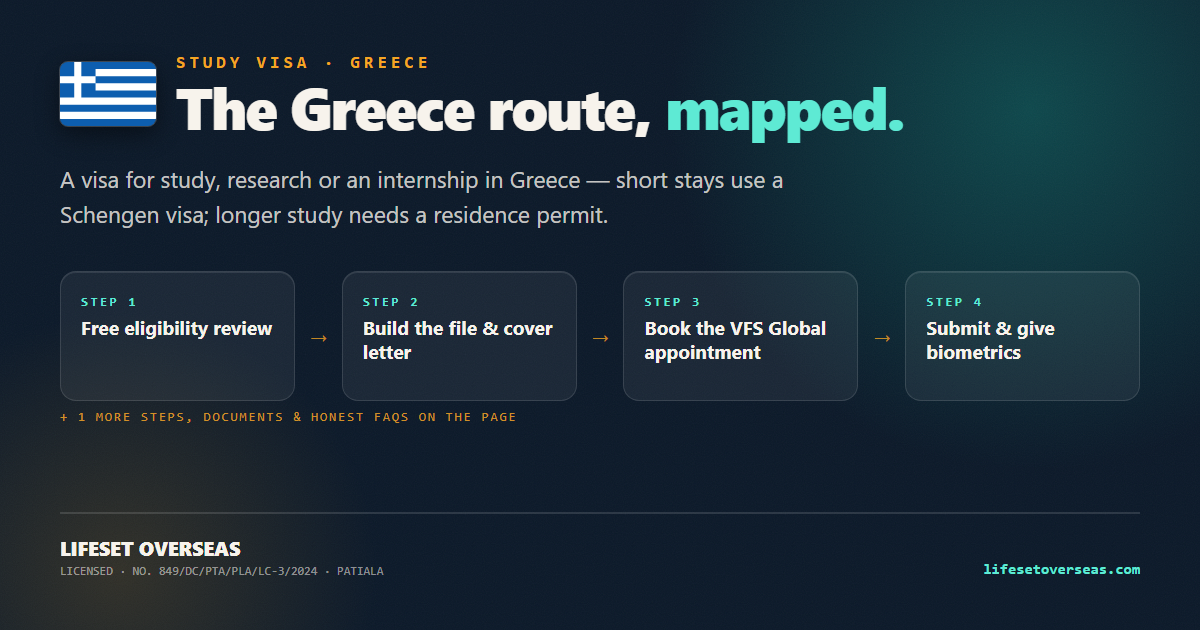
The Greece Study & Research Visa is for study, research or an internship in Greece. Short stays of up to 90 days use a Schengen Type C visa; longer study requires a national long-stay visa or residence permit.
Beyond the standard Schengen documents, the embassy expects a certificate of admission or registration at an educational establishment in Greece, or a cover letter from the inviting institution.
Lifeset Overseas confirms whether your stay needs a short-stay visa or a residence permit and builds the file so your study or research purpose is clearly evidenced.
Studying in Greece costs less than you expect, if you can find the English course
Greece is not the first country Indian students think of for Europe. It should be on the list for two reasons: the living-cost bar for the visa is one of the lowest in the Schengen area, and the English-taught medical programmes at Aristotle University of Thessaloniki, Patras and Crete have opened a route that did not exist a few years ago. The catch is that outside medicine and a handful of master's programmes, most Greek degrees are taught in Greek.
This page sets out the student visa for Greece, with the verified figures and the mistakes we see.
The visa you need
A degree needs a national long-stay visa, known as a type D visa. It is Greece's own visa, applied for through the GVCW visa centre (not VFS) and decided by the Embassy of Greece in New Delhi. On arrival, you apply for a residence permit for studies.
Greece's visa centres in India are run by GVCW (Global Visa Center World), not VFS. Every long-stay (type D) application from India is submitted only at the GVCW centre in New Delhi, whichever state you live in. You attend to give biometrics and submit the file and passport; after the medical report reaches the Embassy, it calls you for an in-person interview.
Money, with the figures we verified
For living costs, Greece asks you to show €400 a month. That is the figure on the consular visa information page, checked on 27 August 2026. Our confidence in it is medium, meaning the second research pass confirmed the source but the figure is one that consulates can adjust, so we re-check it before every filing.
Tuition at Greek public universities for a non-EU student runs from about €3,000 to €15,000 a year. Greek-taught degrees are free at public universities, but English-taught programmes carry a fee set by each department. To give a sense of the spread: the English-taught medical degrees at Aristotle University of Thessaloniki and Patras are listed at €12,000 a year; the International Program in Medicine at the University of Crete at €15,000 a year; master's programmes at International Hellenic University, the Athens University of Economics and Business and the University of the Aegean are priced for the whole programme in the low thousands of euros. National Technical University of Athens sets fees per master's programme. Each figure is on the university's page and changes by intake, so we confirm it with you.
Language
English-taught programmes are available but not everywhere. Medicine at Thessaloniki, Patras and Crete, and selected master's programmes at Athens, Thessaloniki and the islands, are the main options. Each university sets its own English requirement; Patras, for example, asks for B2 level or a TOEFL score. There is no single national test standard.
What goes in the file
- Admission letter from the Greek university, naming the programme and its language.
- Proof that you have paid at least one third of the tuition fees.
- Proof of €400 a month for the period of the visa, from your or your sponsor's account.
- Accommodation in Greece.
- Travel insurance valid for the first year.
- A passport valid for at least 1.5 years from the date you apply, photos on a white background, and the type D form.
- Academic certificates, with translations as required.
- A police clearance certificate apostilled by the MEA and not more than three months old on the day you apply, and the medical examination, which the Greek embassy requires for long stays.
We prepare the file end to end and book the appointment. You attend for biometrics.
Where files from India go wrong for Greece
Applying to a Greek-taught programme without Greek. Some agents push admissions into programmes the student cannot follow. The consulate can ask how you will study in Greek. If you have no Greek, the answer is not good.
Medical certificate and police clearance left to the last week. These take time in India. Start them the day you accept the offer.
Showing exactly €400 a month and nothing more. The figure is a floor. A balance that scrapes the floor, with no history, does not convince.
Confusing the short-stay Greece visa with the study visa. Families who have had a tourist visa for Santorini think the study visa will be similar. It is a different visa with different rules.
Medical seat via a third party with no university admission letter. Only the university's own letter counts.
If Greece refused the visa
A national visa refusal comes with a written reason. You may appeal to the Greek authorities within the stated period, or apply again. For a student facing a semester date, a repaired reapplication is usually the practical path. We read the decision, find the exact gap, and rebuild the file. If the reason was funds, we fix the money story; if it was purpose, we strengthen the academic case.
After graduation: information only
Greece has rules on staying after study for work. We describe them on the call, but we do not file work-related visas. That needs a separate licence, and we do not hold it.
Talk to us
One call settles: whether your programme is truly English-taught, your real yearly cost, what documents need to be started now, and whether your funds story will satisfy the consulate. Try the visa readiness score, and read our Study in Europe hub for the comparison across countries.
Lifeset Overseas, Patiala. Punjab Licence No. 849/DC/PTA/PLA/LC-3/2024. Call or WhatsApp +91 91155 80911, Monday to Saturday, 9 AM to 7 PM.
Official sources
- Hellenic Ministry of Foreign Affairs: https://www.mfa.gr/en/
- GVCW, Greece visa centres in India: https://in-gr.gvcworld.eu/en
- Embassy of Greece in New Delhi, Consular Section: grcon.del@mfa.gr
Fees and rules change; the official page always prevails. The guide above was written from our filing experience for Indian applicants; check the current requirements on the authority’s site before you book.
Verified figures for Greece
What a year in Greece costs — and what you must prove
- Public-university tuition, non-EU student, per year
- €3,000 – €15,000
- Funds the visa authority asks you to show
- €400 a month
English-taught courses: widely available. varies by university
Read on the official pages below on 27 Aug 2026. Figures change every academic year — check them before you pay anything.
