
 Australia visa guide
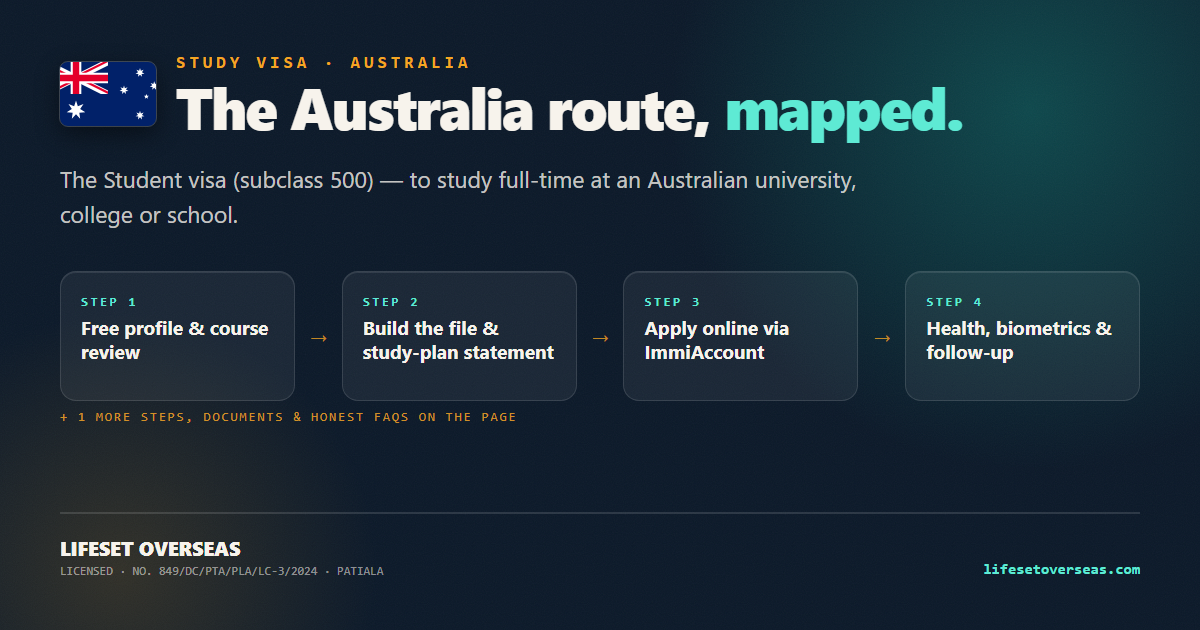
The Australia Student visa (subclass 500) lets Indian students live in Australia to complete a registered course of study. It is granted in line with your enrolment, for up to 5 years, and allows part-time work of up to 48 hours a fortnight while your course is in session.
To be granted the visa you must hold a valid Confirmation of Enrolment (CoE) from your education provider, hold Overseas Student Health Cover (OSHC), and satisfy the genuine-student test: the officer must be satisfied your study plan is genuine and makes sense for your background. Applications are lodged online through ImmiAccount.
Lifeset Overseas guides your course and provider choice, the financial and English evidence, and a strong study-plan statement so your genuineness and your funding are both beyond question.
What the Subclass 500 visa is
Australia uses a numbered subclass system: each visa category has its own subclass number with its own rules. The Subclass 500 (Student) visa is the only visa for foreign nationals undertaking full-time study at a registered Australian education provider. It replaced multiple older student visa subclasses in 2016 and is now the universal student channel.
A Subclass 500 visa is granted for the length of the course plus a buffer, normally a few weeks to a few months depending on programme length. While in Australia on this visa you can work limited hours during teaching periods and full-time during scheduled course breaks (the per-fortnight cap is reviewed by Home Affairs periodically: confirm the current limit before relying on that income).
CoE and CRICOS: the foundation of the file
Two acronyms run through every Subclass 500 application: CoE and CRICOS.
CRICOS, the Commonwealth Register of Institutions and Courses for Overseas Students, is the official register of Australian education providers and courses approved to enrol international students. If your course is not on CRICOS, it cannot support a Subclass 500 visa.
CoE (Confirmation of Enrolment) is issued by your provider once you accept the offer and meet any pre-CoE conditions (deposit payment, document verification). It records the course, course code, dates, tuition, and any tuition already paid. The CoE drives the visa file. Your visa start and end dates, financial requirements, and OSHC duration are all calculated from it.
If your provider issues a "Letter of Offer" but no CoE, you do not yet have what the visa application needs. Pre-CoE letters are common; we wait for the CoE before lodging.
Genuine Student (GS): the 2024 change
In March 2024 the Department of Home Affairs replaced the long-standing Genuine Temporary Entrant (GTE) requirement with the Genuine Student (GS) test. The shift is more than a rename: GS is a structured set of questions on the application form, focused on whether the applicant is genuinely a student first.
The GS questions ask about your current circumstances in your home country, why you have chosen Australia (over alternative destinations), why you have chosen this course and provider, what value the qualification adds to your career or future plans, and any past visa refusals. There is no word limit on most answers, but rambling, generic, or copy-pasted responses are easy for an officer to spot. The strongest answers are specific, personal, and consistent with the rest of the file.
The most common GS-related refusal reasons we see are: course choice that does not progress the applicant's prior education or career (for example, an Indian engineer applying for a Diploma of Hospitality without explanation); inconsistencies between the GS answers and the academic transcripts; vague reasons for choosing Australia; and unaddressed past visa refusals. We rebuild GS responses for clients carefully. This is editorial work, not form-filling.
Financial capacity: what you have to show
Subclass 500 applicants must demonstrate enough money to cover:
- 12 months of living costs at the published threshold (currently AUD 29,710 for the primary applicant: verify the current figure on immi.gov.au before applying).
- First-year tuition as recorded on the CoE, less any deposit you have already paid.
- Return travel for yourself and any accompanying family.
- Additional amounts for each dependant: partner, school-age children with school fees included.
Financial capacity is shown through bank statements, fixed deposits, education loans from approved lenders, scholarships, and sponsor-affidavit-supported parental funds. The funds may be in your name, your spouse's, or a close-family member's name with appropriate declarations and evidence of relationship.
The threshold has been raised more than once in recent years. It was raised significantly in October 2023 and again in 2024: what worked for an applicant in 2022 will not pass the current check. We always work to current published figures.
English, health checks, and OSHC
Most Indian applicants demonstrate English through IELTS Academic (at the score set by Home Affairs' document checklist tool and by your provider; the visa minimum was raised in 2024, so check the current figure before booking a test). PTE Academic, TOEFL iBT, and Cambridge English are also accepted. Some applicants are exempt (for example, if their previous studies were entirely in English at a recognised institution), but the exemption rules are specific. Check before assuming.
Health examinations are conducted by panel physicians approved by the Department of Home Affairs. The medical and chest X-ray are standard for Indian applicants.
Overseas Student Health Cover (OSHC) is mandatory for the full duration of your visa. You buy it from an Australian Government-approved provider for the entire period upfront, and the certificate is uploaded as part of the application.
The application in practice
A typical Subclass 500 file unfolds in this order. You apply to one or more CRICOS-listed providers, accept the offer that fits, and pay the deposit. The provider issues your CoE. You take the English test if you are not exempt. We draft and refine the GS responses with you across multiple iterations. This is where the file lives or dies. You assemble the financial evidence and check it against the current published threshold. You buy OSHC from an approved provider for the full visa length. You complete the medical examination at a panel physician once a HAP ID is generated.
You lodge the application via ImmiAccount with all documents and pay the visa application charge. If biometrics are requested, you visit a Visa Application Centre. The Department processes the file and either grants the visa, requests further information, or refuses with reasons.
Bringing family: dependants and partner work rights
Subclass 500 holders may include their partner and dependent children on the application or have them join later. The partner of a Subclass 500 student typically gets work rights: the per-fortnight cap depends on the principal applicant's course level and is reviewed periodically. Dependent children of school age must be enrolled in school in Australia, and school fees must be evidenced as part of the financial capacity.
This is in marked contrast to the UK, which restricted student visa dependants in 2024 to postgraduate research programmes only. Australia continues to permit dependants more broadly.
Refusals and what to do next
The most common refusal grounds we see for Subclass 500 are: weak or inconsistent GS responses; insufficient financial capacity at the current threshold; doubts about the applicant's English-medium claim; missing OSHC for the full duration; course progression concerns (a step down from prior qualifications without a credible explanation); and unaddressed past visa refusals from any country.
If your application is refused, you receive a refusal decision with the grounds. Depending on the case, your options range from a fresh application that addresses the specific grounds to a Merits Review at the Administrative Review Tribunal where eligible. We assess refused cases individually.
What this is not
This page is about the Subclass 500 student visa. We do not handle the Subclass 482 (Skills in Demand), Subclass 494 (sponsored regional), Subclass 186 (Employer Nomination), or any employer-sponsored work pathway. Those require an MEA Recruiting Agent licence which we do not hold and are outside our licence scope. We do work on the SkillSelect-based skilled migration subclasses (189, 190, 491). Those are points-based permanent residence, not work permits, and they are covered on our Australia PR page.
We also do not file Subclass 485 (Temporary Graduate) post-study work visas as a routine service, since they are typically lodged by applicants from inside Australia after course completion.
How we can help
We are a licensed visa consultancy based in Patiala, Punjab. We handle the Subclass 500 student visa end-to-end on the visa side: provider and course shortlisting (CRICOS-listed only), CoE coordination, GS response drafting and refinement, financial capacity planning to the current threshold, English-test guidance, OSHC and panel-physician scheduling, file assembly, ImmiAccount lodgement, and reapplication strategy where needed. One consultant sees your case from first call to decision, there is no handoff. Book a free 30-minute assessment and we will tell you, honestly, whether your GS story holds together or whether the file needs another drafting round before lodgement.
Official checklist: Student visa (subclass 500)
From our Knowledge Base (checked against Home Affairs, 19 September 2026):
- Confirmation of Enrolment and a valid passport; Genuine Student answers and evidence.
- The English and financial evidence required by Home Affairs' document checklist tool for your nationality and provider; keep its output.
- Academic records, work history and an explanation of course choice and history where relevant to the Genuine Student assessment.
- Overseas Student Health Cover for the required stay; dependants' cover and relationship evidence if included.
- Under-18 welfare and consent arrangements; birth and custody documents where applicable.
- Health examination and character evidence when required; complete translations.
- Declare family members as required even if they are not travelling.
"Some applicants must upload English/funds evidence at lodgement; omission can lead to refusal without a further request." The stay follows the course and the grant, not a standard entitlement.
Sources: Home Affairs Student visa subclass 500 (https://immi.homeaffairs.gov.au/visas/getting-a-visa/visa-listing/student-500); document checklist tool (https://immi.homeaffairs.gov.au/visas/web-evidentiary-tool).
Official sources
- Department of Home Affairs, Immigration and citizenship: https://immi.homeaffairs.gov.au/
Fees and rules change; the official page always prevails. The guide above was written from our filing experience for Indian applicants; check the current requirements on the authority’s site before you book.
